The Question That Arrives with Nothing in Hand
Most astrological questions come with their conveniences. Birth details are supplied, there is somewhere to sit, paper and panchanga are at hand, and there is time to think. Some questions, though, arrive in the middle of the road. The enquirer is impatient, he does not remember the birth details of the person he is asking about, and he wants the answer now.
The question of a missing person is usually of this kind. Someone left the house and did not come back. The man asking is a brother or a father, and he is not even certain when the missing person was born. Working it out from the enquirer’s own chart is one route, but it is a long one. For situations like this the horary tradition carries a few compressed methods that run on a number. The enquirer states a number, and that number becomes the question of the moment.
The reasoning is the same reasoning that holds up the whole of Prasna. The moment a question forms in the mind, the condition of that moment carries the fate of the question. The number that comes out of the mind at that moment is a product of the same condition. This is why the astrologer does not choose the number, the enquirer does. It sounds like a small point, but the entire method stands on it.
One such method is set out below in full, the one B. V. Raman applied to a missing person’s case during a train journey. Its great merit is that it is recorded from end to end. Every step is written down, the arithmetic included, and the outcome was checked within five days. You can read it and use it the same day.
The Method
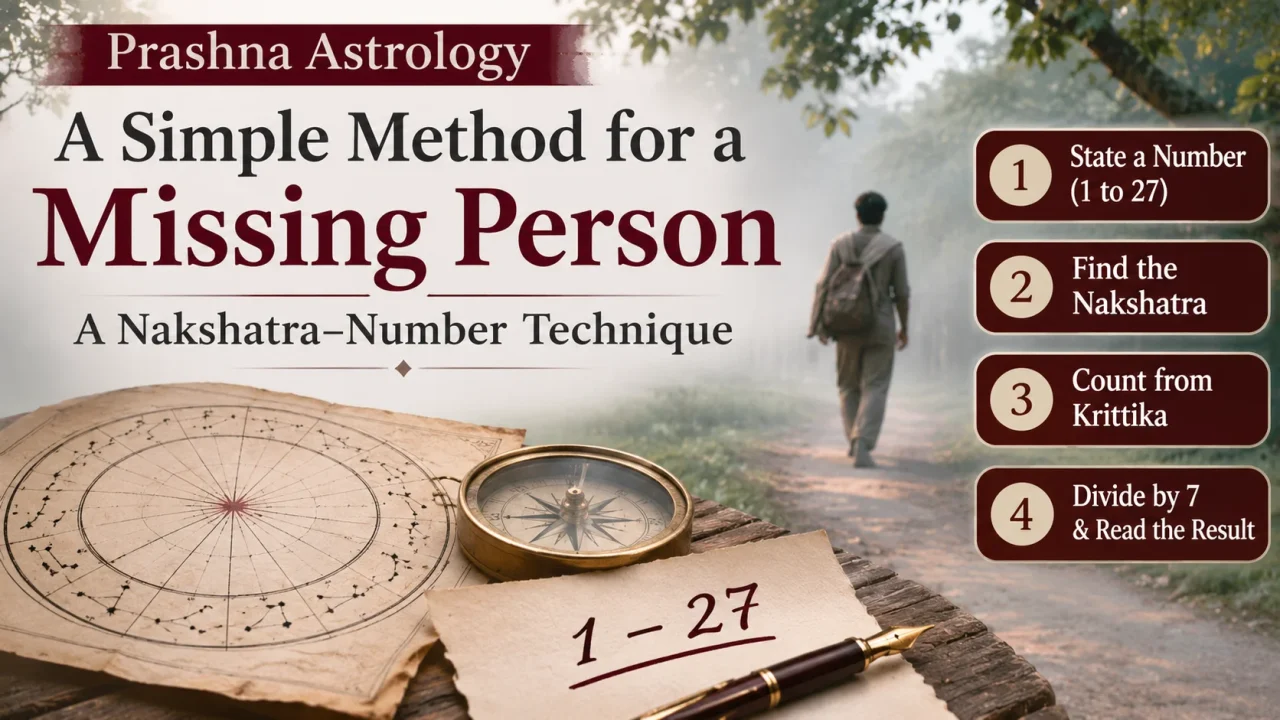
The whole calculation runs in four steps and no chart has to be cast. No panchanga is needed, the exact time need not be known, and the work can be done in your head. The four steps follow in order.
First, ask the enquirer for any number within twenty seven. He has to state it himself, and you give no suggestion.
Second, treat that number as a nakshatra, counted from Ashwini. This is the nakshatra of the question. If the number given is ten, the question nakshatra is Magha.
Third, count that nakshatra again, this time from Krittika. Take Krittika as one and carry the count forward to the nakshatra in question. Subtracting two from the number counted from Ashwini gives you the same figure, since Krittika is the third nakshatra from Ashwini. For the first two nakshatras add twenty seven before subtracting, which makes Ashwini the twenty sixth and Bharani the twenty seventh.
Fourth, divide this figure by seven and take the remainder. The answer follows from the remainder.
| Remainder | Answer |
|---|---|
| 1 | The person is staying somewhere close by |
| 2 | He will return soon |
| 3 | He has gone somewhere other than where he was expected to go |
| 4 | He will return the same day |
| 5 | His return will be delayed |
| 6 | He is unwell |
| 7 | He is trying to get back |
Read the table carefully, because it is not arranged in order of time. The answer at four is quicker than the answer at two, and three, six and seven say nothing about time at all, they describe the man’s condition or whereabouts. The method therefore does more than say when he will return. It also says what state he is in at present.
Two Points the Text Leaves Open
The first concerns a remainder of zero. The table gives answers numbered one to seven, but dividing by seven can leave a remainder of zero. This is not a rare occurrence. Wherever the count from Krittika comes to seven, fourteen or twenty one, which is three of the twenty seven nakshatras, the remainder will be zero. It will arise in roughly one question out of seven, so it cannot be left unaddressed.
The original text does not discuss the situation separately, but the arithmetic settles it. Dividing by seven can only leave a remainder between zero and six, never seven. If zero were not read as the seventh, the seventh answer in the table could never be reached at all, and no text lists an answer that can never occur. Reading zero as seven is therefore not an added solution, it is part of the method.
It is worth understanding why the table runs from one to seven rather than from zero to six. Older texts were written to be committed to memory and their counting began at one, not at zero. That the completion of a cycle means its last position was expected of the reader. Today’s student is accustomed to treating zero as a number in its own right, which is exactly why he hesitates here.
The second point is why the counting is done from Krittika when all of us count from Ashwini today. The reason lies in tradition. The older enumeration of the nakshatras began at Krittika, and nakshatra lists in the Vedic literature usually start there. A number of horary methods have carried that older order forward. In practice all it means is that the number is taken from Ashwini while the counting is done from Krittika. The two starting points are different, and that is where most mistakes happen.
The simple way to avoid the mistake is to remember the subtract two rule. Take two away from the number you were given, and if the number is one or two then add twenty seven first. For every other number subtracting two is enough.
A Ready Table
The calculation is not difficult, but with the enquirer sitting in front of you and someone from his household missing, taking time over arithmetic does not look well. The table below works out all twenty seven numbers in advance. Whatever number the enquirer states, the remainder is on that row, and the answer for that remainder is in the earlier table.
| Number | Nakshatra | From Krittika | Remainder |
|---|---|---|---|
| 1 | Ashwini | 26 | 5 |
| 2 | Bharani | 27 | 6 |
| 3 | Krittika | 1 | 1 |
| 4 | Rohini | 2 | 2 |
| 5 | Mrigashira | 3 | 3 |
| 6 | Ardra | 4 | 4 |
| 7 | Punarvasu | 5 | 5 |
| 8 | Pushya | 6 | 6 |
| 9 | Ashlesha | 7 | 0 |
| 10 | Magha | 8 | 1 |
| 11 | Purva Phalguni | 9 | 2 |
| 12 | Uttara Phalguni | 10 | 3 |
| 13 | Hasta | 11 | 4 |
| 14 | Chitra | 12 | 5 |
| 15 | Swati | 13 | 6 |
| 16 | Vishakha | 14 | 0 |
| 17 | Anuradha | 15 | 1 |
| 18 | Jyeshtha | 16 | 2 |
| 19 | Mula | 17 | 3 |
| 20 | Purva Ashadha | 18 | 4 |
| 21 | Uttara Ashadha | 19 | 5 |
| 22 | Shravana | 20 | 6 |
| 23 | Dhanishta | 21 | 0 |
| 24 | Shatabhisha | 22 | 1 |
| 25 | Purva Bhadrapada | 23 | 2 |
| 26 | Uttara Bhadrapada | 24 | 3 |
| 27 | Revati | 25 | 4 |
One look at the table and the construction of the method becomes visible. The twenty seven nakshatras are divided among seven answers, six of the answers taking four nakshatras each and the seventh taking three. There is nothing to conceal in that. It is what the method is, and the student who works with his eyes open on this point weighs his own results more sensibly.
One small matter remains. The enquirer sometimes states a number larger than twenty seven, say sixty or a hundred. Do not try to bring it within range by subtracting or dividing. The method asks for a number within twenty seven, so it is better to ask again. Asking a second time does not break anything, because the first number never became the question.
Why the Seven Answers Stand in This Order
What follows is not a statement from the text. It is my own reasoning, which came to me after looking at the table for a long while. The reader can test it himself and is free to disagree. The method neither changes nor depends on it, but if the reasoning holds then the table becomes much easier to carry in the head.
The question is why the division is by seven rather than by nine or twelve. There is only one celebrated seven in this subject, the seven traditional planets. Leave out Rahu and Ketu and seven remain, from the Sun to Saturn, and the weekdays run in that same order. Set the seven answers against the weekday order and a picture begins to appear.
| Remainder | Planet | Answer | How it fits |
|---|---|---|---|
| 1 | Sun | Staying close by | The Sun is the fixed centre and does not wander |
| 2 | Moon | Returns soon | The Moon is the swiftest of them |
| 3 | Mars | Gone elsewhere | Mars is wilful and goes its own way |
| 4 | Mercury | Returns the same day | Mercury is quick and governs coming and going |
| 5 | Jupiter | Return delayed | Jupiter is slow moving |
| 6 | Venus | Is unwell | This is the link that sits loose |
| 7 | Saturn | Trying to get back | Saturn is obstruction and effort |
Six of the seven fit so well that calling it coincidence is difficult. Look at the order of speed. The Moon and Mercury, the two quick planets, sit on the answers about returning quickly. Jupiter and Saturn, the two slow ones, sit on delay and on struggle. The Sun, which holds its place, sits on staying close by. The arrangement does not look arbitrary.
The starting point offers a further support. The counting begins at Krittika, and in Vimshottari the lord of Krittika is the Sun. The first remainder falling on the Sun is therefore not arbitrary, it follows from where the count begins. At two and three come the Moon and Mars, and up to this point the Vimshottari order and the weekday order run together. After that they part, because Vimshottari is a cycle of nine while this method is a cycle of seven, so only the weekday order can carry on.
On the sixth row I do not want to stretch the argument. A connection between Venus and ill health can be constructed, but it would be a stretch. It is possible that the whole inference is wrong and that six of the seven fitting is a coincidence. It is also possible that the original table shifted in a place or two while being passed down from some older work. Readers who have access to the older sources would do well to compare them.
For practical purposes the value of all this is that the seven answers no longer have to be memorised. Everyone remembers the order of the weekdays, and everyone knows the nature of each planet. Work out the remainder, think of the planet that stands at that position, and the answer will usually present itself. In consultation, though, give the answer as the original table has it and do not enlarge it with your own inference.
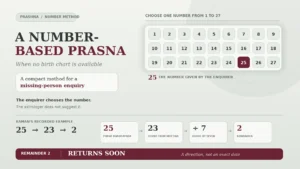
A Recorded Example
B. V. Raman set this episode down in his memoirs. In February 1938 he was travelling from Bombay to Delhi and broke his journey at Jhansi for a day. On the stretch between Jhansi and Gwalior a palmist was seated in the carriage with about a dozen people showing him their hands. Some words passed between him and Raman, and the palmist got down at the next station. The people who had gathered around the palmist then came over to Raman.
Some of them gave their birth details to be answered later, but others wanted an answer there and then. In situations of that kind Raman took recourse to Prasna. One man’s question concerned his missing brother, of whom nothing was known. In a moving train no chart could be cast, and the brother’s birth details were not available either, so he applied this number method.
The enquirer gave the number twenty five. Counted from Ashwini the twenty fifth nakshatra is Purva Bhadrapada, so that became the nakshatra of the question. It was then counted from Krittika. Krittika is the third from Ashwini, so subtracting two from twenty five gave twenty three, and that is the figure Raman works with. Dividing twenty three by seven gives three with a remainder of two.
A remainder of two in the table means the person will return soon. That is what Raman said. The enquirer was not satisfied and remained doubtful about the forecast. Raman gave him his Delhi address. Five days later the same man called on him in Delhi and reported that the missing person had come back.
You can repeat the calculation yourself, and that is the greatest value of this episode. Twenty five gives Purva Bhadrapada, twenty five less two gives twenty three, twenty three divided by seven leaves two, and two means a quick return. Every step can be checked, and the outcome came to light within five days.
What This Example Yields
First the point on which the whole method rests. The number came from the enquirer and not from the astrologer. If the astrologer picks a number himself, or suggests one, the moment is no longer the moment of the enquirer’s mind and the foundation has slipped away. For this reason no limit and no hint should accompany the request. Say only that he should state whatever number within twenty seven comes to mind.
The second point concerns the shape of the answer. Raman did not name a date, he said the man would return soon. This method does not give dates at all, it gives a direction. Those who start extracting dates out of compressed methods like this one are asking of them work they were never built for. If a date is wanted, a full horary chart has to be cast and the Dasa and transit worked out.
The third point is that three of the seven answers speak of time and four speak of condition. Staying close by, having gone elsewhere, being unwell and trying to get back all tell you what state the man is in at present. In a missing person’s case that is the enquirer’s largest question, whether the man is all right. So when giving the answer do not confine yourself to the matter of returning, state the condition the table reports as well.
The fourth point concerns verification. This episode carries weight because five days later the enquirer came back of his own accord and reported the outcome. Most predictions stay unfinished for exactly this reason, that the man who gives them forgets and the man who received them does not return. A method small enough to be applied several times in a day is easier to keep records for, and after a hundred or two hundred applications you will know how far it runs in your hands.
Where the Method Applies and Where It Does Not
Read the seven answers and the limit shows itself. All seven belong to one kind of question only, where a person who has gone is and when he will come back. There is no answer here for marriage, employment, children or litigation. Do not attempt to apply it to those. A mould that yields seven answers will not yield an eighth.
It can also be applied to a lost object, though with some care. Several answers in the table were framed for a person, being unwell for instance, or trying to get back. For an object the sense has to be stretched, and wherever the sense has to be stretched the answer goes slack. Whether the object is close by, whether it will be found soon, whether it has reached somewhere else, saying that much will serve.
Keep the limit of time in view as well. The book states plainly that the fruit of a Prasna belongs to the immediate future, from one day to one year, and that the answer should come about within that span. For a missing person the span is shorter still, because the answers in the table speak in days and weeks. Applying this method to someone missing for years is not right, and a full horary chart is needed there.
Finally, this method is not a substitute for a full horary chart. Where there is time and there are means, casting the chart is the better course, because it is not confined to seven answers. This method is for the situation where casting a chart is not possible, and within that narrow task it does its work.
A Sequence for Practice
The method is small enough to memorise in five minutes. Memorising it and applying it properly are two different things, however, so work through it in order.
- Ask the enquirer to state whatever number between one and twenty seven comes to mind. Give no hint and no suggestion, and allow no opportunity to change the number.
- Work out the nakshatra of that number by counting from Ashwini, and write it down. This is the nakshatra of the question.
- Subtract two from the number. If the number is one or two, add twenty seven first. This is the count from Krittika.
- Divide that figure by seven and take the remainder. If the remainder is zero, read it as seven.
- Take the answer from the table. State both what it says of time and what it says of condition, and add nothing beyond it.
- Write down the question, the number, the date, the time and your answer. When the outcome becomes known, enter it on the same line.
The sixth step is the most important and the most often skipped. Rule six columns on a page and enter every application in it. There is a great deal of argument about number methods and that argument is not settled by reasoning. The man who keeps an account of his own hundred applications stands further forward in any such argument than the man who only invokes the authority of the texts.
One Caution
The largest caution is not about the arithmetic but about the situation. A man who has come to ask about a missing member of his household is a frightened man. In that condition a single sentence from you can make or ruin his night. The sixth answer in the table speaks of ill health, and how that is said matters no less than that it is said.
The second caution is that this method is not a means of finding anyone. It does not say what place the person is in, what direction he lies in, or how he should be searched for. A household whose member is genuinely missing should neither be discouraged from informing the police nor allowed to delay doing so. Astrology can walk alongside that search, it cannot take its place.
The third caution concerns the general limit of number methods. Raman gives a number of such methods in his book and writes alongside them that they have a value of their own and cannot be dismissed as worthless, but that with a chart or with a number the interpreter must possess the faculty of intuition, failing which the interpretation will not come out right. That warning is his own and it applies to this method too.
This does not mean bending the method to suit yourself. What the calculation says is the answer, and picking whichever answer is more agreeable is not practice but weakness. Intuition earns its place where the answer has to be set in the situation of the person before you, not in altering the calculation.
 Gemini AscendantThe usual account of a Gemini ascendant is the shortest of all twelve. Talkative, clever, restless, quick, good with words, two faced. Every one of th…
 Punarvasu Nakshatra Compatibility (Part 3) – Mula to RevatiPunarvasu is the nakshatra that leaves. It is named after the return of the light, it goes and it comes back, and when a relationship becomes intolera…
 Taurus AscendantThe usual description of a Taurus ascendant runs to about six words. Calm, patient, stubborn, fond of comfort, materialistic. Anybody who has met a fe…