Attraction and compatibility are not the same thing, and nowhere in Rohini’s chapter is that gap wider than in this final group of nine. One of these matches is described as compulsive. The two people cannot leave each other alone and cannot stop damaging each other either, and the score sits at thirty-seven per cent. Meanwhile the highest result in this group, seventy-six per cent, begins with Rohini actively disliking the person. A student who reads only the first three months of a relationship will get both of these completely wrong.
These last nine nakshatras, Mula through Revati, are also where Rohini meets the most detached partners in the zodiac. Ketu appears again, the Sun appears in its most ascetic form, Saturn appears twice, and Rahu appears in the one place where Rohini genuinely thrives with it. For a nakshatra whose whole instinct is to hold on, a run of partners who have all, in different ways, learned to let go is a severe test.
What follows is each pairing with its rating, the planetary and mythological reason behind it, and the guidance I would give at the table. The astrology here is unusually clean, and by the end a rule emerges that explains not just these nine but most of Rohini’s chapter.
This is the last part of a three-part series.
The Rohini temperament in one paragraph
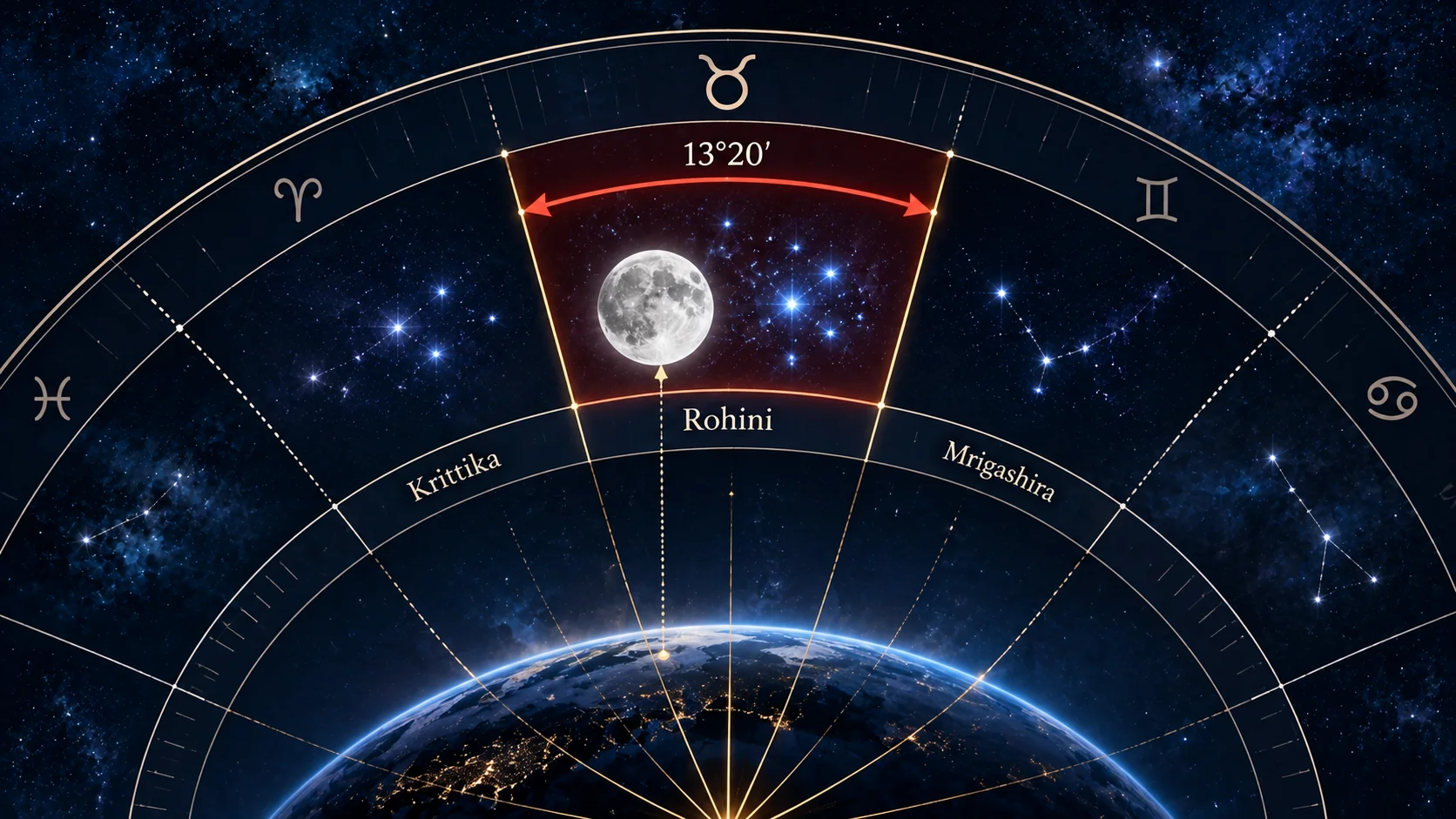
Rohini occupies the middle of Taurus. The sign is Venus’s, the nakshatra is the Moon’s, so appetite and emotion are fused. Its deity is Brahma the creator, its symbol is the ox cart that carries the harvest home, and its yoni is the serpent, which waits, coils and strikes only over what it considers its own. The result is a person who attracts easily, loves through the senses, builds a beautiful life, and cannot let go of any part of it. Every reading below is really a test of one thing, which is how the partner responds to being held.
Rohini and Mula Compatibility
36 per cent. Love offered with conditions to someone who accepts none.
The pattern here is specific. Rohini places the responsibility for its own love and security on Mula’s shoulders, and Mula is entirely unequipped to carry that weight. Mula wants freedom and a clean break from the burden of ordinary responsibility. Worse, Rohini’s love arrives with conditions attached, and that is the one thing Mula will not take. When Mula rejects, it does not soften the blow. It can be hurtful and genuinely cruel about it.
Mula is ruled by Ketu and presided over by Nirriti, the deity of dissolution and endings. Its very name means the root, and its work in the zodiac is to pull things up by the root and see what was underneath. Set that against Rohini’s ox cart, whose entire purpose is to gather the harvest and carry it safely home. One nakshatra accumulates and preserves. The other uproots and discards. There is no version of this pairing in which both instincts are satisfied.
Ketu is also the wrong planet for a Moon nakshatra to lean on. The Moon shines by reflection and needs something to reflect off. Ketu is the headless one, the planet of renunciation, and it gives nothing back in the currency Rohini recognises. My practical advice in this match is blunt. A Mula partner can be loyal in their own way, but they cannot be made responsible for somebody else’s emotional security. Ask them for that and you will lose both the security and the partner.
Rohini and Purva Ashadha Compatibility
53 per cent. Workable, provided Rohini can stand on its own feet.
This relationship survives on one condition, which is that Rohini is willing to give Purva Ashadha real freedom. Do that and there is genuine enjoyment on both sides. Fail to do it and the outcome is predictable. Purva Ashadha does not handle emotions well, and if Rohini unloads all of its emotional and romantic expectations onto them, that becomes the perfect excuse for them to leave, and they will use it.
There is a reason the attraction exists at all. Purva Ashadha is ruled by Venus, and Rohini sits in Venus’s own sign, so the taste for beauty, comfort and enjoyment is shared and immediate. The trouble comes from everything else. Purva Ashadha is presided over by Apah, the waters, and carries the reputation of the invincible one, the nakshatra that will not accept defeat and will not be cornered. Its yoni is the monkey, restless and quick. Water cannot be gripped, and neither can this nakshatra.
Fifty-three per cent is an honest figure for a relationship that depends entirely on one person’s self-management. If the Rohini partner has a full life of their own, friends, work and interests that do not depend on the marriage, this can be a pleasant and long partnership. If the marriage is expected to supply everything, it will not hold.
Rohini and Uttara Ashadha Compatibility
37 per cent. The most dangerous match in the entire chapter.
Note carefully that this is not the lowest score in Rohini’s chapter, and yet it is the one I would warn hardest about. The reason is the nature of the damage. Here two people can fall into such extreme jealousy and sexual rivalry that neither rests until they have destroyed the other. The attraction is compulsive rather than happy. Rohini is deeply sensuous, Uttara Ashadha is cold and ascetic, and that coldness slowly makes Rohini lose faith in itself. The hurt is real and takes a very long time to heal.
The classical scheme explains this with unusual precision. Rohini’s yoni is the serpent. Uttara Ashadha’s yoni is the mongoose. Serpent and mongoose are the one unambiguous enmity in the whole yoni classification, natural predator and natural prey, and the classics reserve their strongest cautions for it. When you see a compatibility description that speaks of two people not resting until they destroy each other, and the yonis turn out to be serpent and mongoose, the system is being consistent with itself rather than dramatic.
The rest fits too. Uttara Ashadha is ruled by the Sun and presided over by the Vishvadevas, the collective gods, which loads it with duty and a certain ascetic austerity. The Sun here does not warm, it disciplines. A Moon nakshatra that measures love in warmth and touch is left permanently short and begins to conclude that the fault is its own. This is the match where I would say plainly what people do not want to hear. Compulsive attraction is not compatibility. The pull you feel is not evidence in favour of the marriage.
Rohini and Shravana Compatibility
50 per cent. The same ruler, and a completely different result.
Rohini already knows Shravana is moody and restless, and that alone would not be a problem. What creates the distance is that Shravana has learned to manage its own restlessness by detaching. It grows a hard surface that Rohini cannot break through. They are not there when they are needed, usually lost somewhere in their own world, and Rohini is left feeling neglected and ignored.
Here is a point worth holding on to. Shravana is ruled by the Moon, exactly as Rohini is, and elsewhere in this chapter another Moon-ruled nakshatra produces one of Rohini’s warmest results. Shared rulership is not automatically an advantage. What matters is what the nakshatra has done with its own lunar nature. One of them lives its moods openly, which makes them legible. Shravana has sealed them, and a sealed Moon gives another Moon nothing to read.
Shravana’s symbol is the ear and its deity is Vishnu, the preserver whose reach extends everywhere. This is the listener of the zodiac, and its attention is genuinely elsewhere much of the time, often on something larger than the marriage. Rohini will interpret that absence as rejection, and it is not. That does not make it easier to live with, but it changes the conversation. In consultation I would work on the Rohini partner’s reading of the absence rather than on the Shravana partner’s behaviour, because the behaviour is structural.
Rohini and Dhanishta Compatibility
53 per cent. Romance freely given, commitment withheld.
Dhanishta is perfectly happy to romance Rohini and has no intention of committing. They appear to enjoy luxury and the good life, which draws Rohini in, and then something strange happens. The moment Rohini displays its own preference for comfort and luxury, Dhanishta turns austere and high minded. Rohini does not know what to make of this, and the mixed signals are genuinely confusing rather than manipulative.
The astrology explains the switch. Dhanishta is ruled by Mars and presided over by the eight Vasus, the deities of elemental abundance, so wealth and capability are natural to it. But the nakshatra spans Capricorn and Aquarius, both of them Saturn’s signs, and Saturn’s relationship with pleasure is to enjoy it while remaining unattached to it. Dhanishta can sit in luxury and walk away from it in the same afternoon. Rohini cannot, and does not believe anyone else can either.
That is the real gap. For Rohini, shared pleasure is the proof of love. For Dhanishta, pleasure is just pleasure, and being seen to need it is a weakness. The symbol of Dhanishta is the drum, which is played outward, for an audience. Rohini’s life is lived inward, in the home. The practical advice is short. Do not test a Dhanishta’s commitment by testing their appetite for comfort. You will get the austere answer every time, and it tells you nothing about how they actually feel.
Rohini and Shatabhisha Compatibility
76 per cent. The highest score here, and it begins with dislike.
Rohini neither likes nor trusts Shatabhisha at first. They come across as cold and unfeeling, and the instinct is to keep away. Then Rohini throws its caution aside and falls in love anyway, and the surprise is that Shatabhisha responds. What develops is a way of loving that belongs only to these two. Shatabhisha opens emotionally to Rohini in a way it seldom does for anyone, and it will work hard to become what Rohini wants in a partner.
This match deserves close study for a technical reason. Shatabhisha is ruled by Rahu, and the Moon, which rules Rohini, is classically afraid of Rahu. That fear appears three separate times in Rohini’s chapter. With Swati it produces mistrust and a low result. With Ardra it converts into excitement and a respectable one. Here, with Shatabhisha, it produces the best score in this entire group. One planetary antagonism, three different outcomes in one chapter. If a student takes nothing else from this chapter, let it be that a planetary relationship is a tendency and never a verdict.
Why does it resolve so well here? Shatabhisha is presided over by Varuna, who binds with his noose and also forgives, and its symbol is an empty circle. This is the nakshatra of the hundred healers, the physician who never admits to being wounded. Rohini’s deepest need is to pour love into something and be the one person allowed in. Shatabhisha has a void at its centre and almost never opens it. When it opens that space for Rohini, Rohini receives exactly what it has been looking for in every other match in the chapter, which is the status of being the chosen one. The practical caution is only at the start. Do not let the initial coldness end it before it begins.
Rohini and Purva Bhadrapada Compatibility
60 per cent. Everything Rohini wanted, with one door kept shut.
Purva Bhadra can be the lover Rohini has been looking for all along. They are generous, flamboyant, and they will keep Rohini in genuine luxury and comfort, which matters more to this nakshatra than it usually admits. The catch is a detached streak in their nature. There are things Purva Bhadra needs to do alone, and no amount of love changes that. The guidance is to not let insecurity, jealousy and possessiveness spoil what is otherwise a good marriage.
Jupiter rules Purva Bhadra, which accounts for the generosity and the largeness of gesture, and its yoni is the lion, which explains the flamboyance and the need for territory of its own. Its deity is Aja Ekapada, the one-footed goat, a fierce and ascetic form, and its span crosses Aquarius into Pisces. Worldly display on one side, otherworldly withdrawal on the other. Both are equally real and neither is a performance.
This is a match where Rohini gets most of what it wants and has to accept a closed door. Sixty per cent is fair, and where I have seen it work, it worked because the Rohini partner understood early that the solitude was not about them. Where I have seen it fail, it failed because every private hour was read as evidence of something being hidden. The difference was entirely in the interpretation, not in the partner’s behaviour.
Rohini and Uttara Bhadrapada Compatibility
75 per cent. The private warmth that nobody else is shown.
Rohini loves Uttara Bhadra’s dependability. They love, nurture and support without drama, and, more importantly, Rohini is let in on their secret sensuality. To the world Uttara Bhadra presents a cool, ascetic face. Rohini knows otherwise, and that private knowledge is precisely what this nakshatra values most. There are times when Rohini wants more excitement, but it will rarely risk alienating a partner this steady.
Uttara Bhadra is ruled by Saturn and presided over by Ahir Budhnya, the serpent of the deep. That detail is worth pausing on. Rohini’s own yoni is the serpent, and elsewhere in this chapter a serpent meeting another serpent produces one of the worst results in the whole set, because two venomous natures know exactly where to strike. Here the serpent is of a different kind, still and deep rather than quick and venomous, and the same resonance produces security instead of injury. The classification tells you which animal. It does not tell you what that animal does, and the deity usually does.
Uttara Bhadra’s yoni is the cow, giving and nourishing, and Rohini sits in Taurus, the sign of the bull. There is a shared domestic, earthy ground under this marriage that makes ordinary life together easy. The one risk is the boredom Rohini quietly admits to. My advice is to build the excitement inside the marriage rather than looking for it outside, because Saturn is slow to anger and slower still to forgive.
Rohini and Revati Compatibility
53 per cent. Two good people with no shared language of love.
Rohini falls for Revati’s idealism and then finds it impossible to live up to the image Revati has formed of it. Revati does not want to be sensuous and generally prefers a simple life. Rohini wants luxury and sensuality and cannot cope with Revati’s guilt about those things, or with the criticism that follows. What looks like a perfect relationship at the start slowly descends into mediocrity.
Revati is ruled by Mercury and presided over by Pushan, the divine shepherd who guides travellers and protects the herd. Its symbol is the fish and its yoni is the female elephant, and the whole nakshatra is gentle, nourishing and idealistic. Nothing here is unkind. The problem is that Revati sits at the end of the zodiac in Pisces, where appetite is being given up rather than enjoyed, while Rohini’s entire vocabulary of love is sensory. Two people can care for each other sincerely and still have no shared way of expressing it.
The word to watch in this match is guilt. Revati’s simplicity gradually makes Rohini feel that its own desires are somehow wrong, and for a Taurus Moon that is the most corrosive thing that can happen. Neither partner is at fault and neither is behaving badly, which is exactly why these marriages are hard to repair. They do not break. They simply become polite.
The rule that emerges from these nine
Line up the two best and the two worst and the logic is unmistakable. Shatabhisha at seventy-six and Uttara Bhadra at seventy-five are both nakshatras with a hidden interior that they show to almost nobody, and both of them let Rohini in. Mula at thirty-six and Uttara Ashadha at thirty-seven are both partners who, in different ways, require Rohini to stop needing. Rohini does not need a partner who is warm to everyone. It needs a partner who is warm to it alone.
Group the scores by planet and the chapter becomes even clearer. Take the three Ketu nakshatras. Ashwini reaches sixty-two, Mula thirty-six, and Magha, elsewhere in the chapter, twenty-eight. Ketu is renunciation and the Moon is attachment, and the results confirm it. Take the three Rahu nakshatras and you get forty-two, sixty-four and seventy-six, a spread so wide that it proves the planetary fear by itself decides nothing. Take the two Moon nakshatras and you get a warm result from the one that lives its moods openly and a cool one from the one that has sealed them.
That is what a compatibility chapter is actually for. Read line by line it is a list of verdicts. Read as a whole it teaches you the method, which is that a planetary relationship sets a tendency, the deity and the yoni describe how that tendency behaves in a real person, and the surrounding conditions decide which way it finally resolves.
When these problems actually surface
One question rarely gets asked and it is the most practical one of all. A compatibility weakness does not sit at a constant level through a marriage. It activates, and it activates on schedule. In my own work the timing follows the planets involved in the mismatch, and this is where Vimshottari dasha earns its keep.
A Rohini married into a Ketu nakshatra will usually find the relationship tolerable for years and then very difficult during a Ketu period, because that is when the partner’s urge to detach is strongest and Rohini’s need to hold is least able to meet it. The Shatabhisha marriage tends to do the opposite, deepening noticeably through Rahu periods. Where Saturn is the partner’s nakshatra lord, as with Uttara Bhadra and, through its signs, with Dhanishta, the testing years arrive during Saturn periods and during Saturn’s transit over the seventh house or over the natal Moon. A couple warned in advance that a specific stretch of years will be heavy tends to survive it. A couple that experiences it as a sudden and unexplained collapse often does not.
Alongside that, check the Moon in the Rohini chart before you say anything final. Rohini is a Moon nakshatra, so a bright, well placed Moon gives the confident and magnetic version of this temperament, while a weak or afflicted Moon gives the same appetites with far less capacity to absorb rejection. Every low score in this group becomes considerably harder to live through when the Moon is under pressure, and the Uttara Ashadha match in particular should not be encouraged at all in such a chart.
The percentage marks where the pressure will fall. The dasha tells you when. The condition of the Moon tells you how much weight the person can carry when it arrives. Put those three together and you are advising a marriage rather than grading one.
 Vimshottari Dasha – Why It Starts From the Moon’s NakshatraMost students learn the dasha table before they learn what it is counting. The order gets memorised, the years get memorised, and the chart is never a…
 Shakti Chakra Gazing – Myth vs Truth | Trataka, Sri Yantra & JyotishaSearch for Shakti Chakra gazing and the results settle quickly into a pattern. A circular black and white diagram appears, concentric rings and radiat…
 Pushya Nakshatra – Reading the Logic Behind the Nourishing StarAlmost every book introduces Pushya with a single word: nourishment. The definition is correct, but it is also where most discussions stop. And the mo…