There is an old story that every student of nakshatras hears early. Chandra, the Moon, married the twenty-seven daughters of Daksha, and among all of them he loved only Rohini. He stayed with her and neglected the rest. The other wives complained to their father, Daksha cursed the Moon with wasting away, and the whole rhythm of waxing and waning that governs our emotional life comes out of that quarrel.
Keep that story in mind while reading this chapter, because it contains the entire psychology of the nakshatra. Rohini is the one who is chosen. She attracts without effort, she is the most desired of the twenty-seven, and precisely because of that she lives surrounded by jealousy. What the story does not say out loud, but every Rohini chart shows, is that the jealousy runs in both directions. The person everyone wants to hold is usually the person who holds on hardest.
This part covers Rohini with the first nine nakshatras, Ashwini through Ashlesha. Rohini’s ideal life partner is Anuradha and its most challenging is Magha, and neither of those falls in this group. What this group does contain is Rohini’s strongest match among the first nine, two relationships that fail badly, and one of the clearest demonstrations anywhere in this chapter of how two planets can create either excitement or suspicion depending entirely on what surrounds them.
This is part 1 of a three-part article.
What you are actually dealing with in a Rohini chart
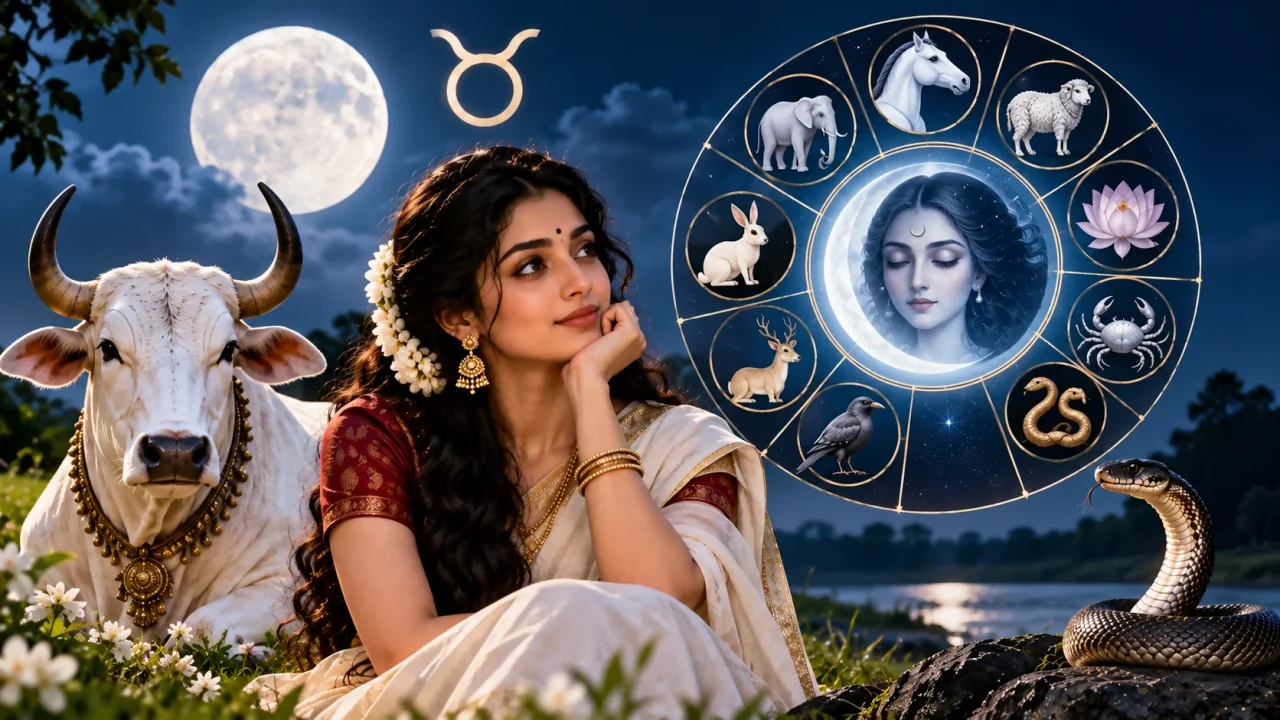
Rohini occupies the middle stretch of Taurus, from ten degrees to twenty-three degrees and twenty minutes. That placement alone tells you a great deal. The sign belongs to Venus and the nakshatra belongs to the Moon, so you have beauty, comfort and pleasure sitting on top of emotion, memory and attachment. Nothing here is cold. Everything Rohini feels, it feels through the senses.
The presiding deity is Brahma, the creator, and the symbol is the ox cart, the vehicle that carries the harvest home. Both point to the same instinct, which is to build, to accumulate and to make something permanent out of what has been given. In relationships this shows up as a genuine gift for creating a beautiful shared life, and as an unwillingness to let any part of that life go once it has been created.
The yoni of Rohini is the serpent, and this is the detail most students skip over. The serpent is patient, it coils rather than chases, and it strikes only when something it considers its own is threatened. Watch how often in the matches below Rohini waits for the other person to move, and how sharply it reacts once possession is in question. That is the serpent, not the cow.
Put the three together and you get the working picture. Rohini is sensuous, romantic, magnetic and slow to commit in appearance while being deeply attached in fact. Its two standing weaknesses are an unrealistic view of love and a possessiveness that it does not always recognise in itself. Almost every score below rises or falls on how the partner handles those two things.
Rohini and Ashwini Compatibility
62 per cent. A thrilling match built on a contradiction.
Ashwini can be the dream partner, exciting, fiery and passionate, with a wild and untameable quality that Rohini finds irresistible. The attraction is genuinely mutual. Ashwini finds Rohini sensuous and desirable, and since both are restless by nature, that shared restlessness keeps the relationship from going stale. On paper this should be higher than sixty-two per cent.
The reason it is not lies in the rulers. Ashwini belongs to Ketu, presided over by the Ashwini Kumaras, the divine physicians who arrive at dawn and are gone before anyone can hold them. Its yoni is the horse. Ketu has no instinct for ownership and no patience for being claimed. Rohini belongs to the Moon, whose entire nature is to hold on to what it loves.
So the difficulty is not a lack of love. The difficulty is that Rohini falls for the untameable quality and then, almost without noticing, sets about taming it. The standard advice here is not to be too possessive, and that is exactly right, but I would put it more sharply in a consultation. Whatever made you fall for an Ashwini partner is the same thing you will try to remove, and the day you succeed the attraction goes with it. A horse that agrees to be tied is no longer the horse you wanted.
Rohini and Bharani Compatibility
64 per cent. Deeply sensual, with a warning attached.
With Bharani the relationship becomes an exploration of sensuality, and it is sexually fulfilling in a way Rohini rarely finds elsewhere. Bharani can take a partner on a journey of ecstasy and love, but there is a condition. Rohini has to be willing to be possessed rather than to possess, and for this nakshatra that is a genuine reversal of role.
The astrology behind it is neat. Bharani is ruled by Venus, and Rohini sits in Taurus, which is also Venus’s sign. There is a shared thread of Venus running through both charts, and that is why the taste for beauty, pleasure and the good things of life is identical on both sides. The deity of Bharani is Yama, the lord of restraint and of limits, and Bharani’s symbol is the yoni itself, the organ of creation. Desire and discipline sit in the same nakshatra.
When the pairing works, Yama’s discipline is what keeps the pleasure from turning into indulgence. When it does not work, both people enjoy the good life without anyone applying the brake, and the warning that always attaches to this pairing, excess both sexual and financial, becomes literal. In practice I would look carefully at the second house and the condition of Venus in both charts before reassuring such a couple about money.
Rohini and Krittika Compatibility
30 per cent. The chase is the whole relationship.
Krittika is warm underneath and diffident on the surface, and Rohini finds that combination hard to resist. What follows is typical of this nakshatra. Rohini does not simply fall in love, it plans a campaign, sets out to seduce and slowly draws the other person into its orbit. For a while Krittika’s strength and potency are thrilling.
Then the problem starts. That same strength begins to feel like domination, and Rohini, who needs room to be adored, starts looking elsewhere. Once that happens Krittika, ruled by the Sun and never quick to trust, will not trust again. Thirty per cent is not a high figure, and the difficulty reads the same from the other side as well, since Rohini is counted among Krittika’s most challenging partners too.
There is a lesson here worth pointing out to students. Krittika and Rohini are neighbours in the zodiac. Krittika ends where Rohini begins and both occupy Taurus. Proximity in the sign chart means nothing at all for compatibility. What matters is that solar fire and lunar water want opposite things from intimacy. Agni consumes and purifies, the Moon nourishes and retains. One burns the offering, the other wants to keep it.
Rohini and Rohini Compatibility
55 per cent. Two dreamers and no one holding the ledger.
Two Rohinis are simply too alike. Both look at life through rose-tinted glasses, and practicality is nobody’s strength. The romance is beautiful while it is being imagined and difficult when the actual conditions of living together arrive. Worse, both of them are still privately looking for the perfect partner, and neither is certain that search has ended in the other.
Vedic astrology has always been cautious about two people sharing the same birth nakshatra, and this pairing shows why. Shared strengths are pleasant. Shared blind spots are dangerous, because there is nobody in the household who sees the thing that neither of them sees. Add the Moon’s natural jealousy on both sides and you get mistrust and possessiveness with no counterweight.
Fifty-five per cent is not a failing score, and these marriages often look lovely from outside. The work is entirely practical. Somebody has to take charge of money, timing and the unglamorous half of life, and since neither will volunteer, it usually has to be decided deliberately rather than left to settle on its own.
Rohini and Mrigasira Compatibility
77 per cent. The strongest match in this group.
Here everything lines up. There is real friendship, the physical relationship is exciting, both want the same things from life, and both are willing to actually talk about love, which is rarer than it sounds. Rohini introduces Mrigasira to sensuality and passion. Mrigasira appears dynamic and in charge to the outside world, but where intimacy is concerned it is Rohini who sets the pace. The result is emotionally complete in a way that is genuinely rare, and the astrology explains exactly why.
Three separate factors are working in favour of this match. First, the presiding deity of Mrigasira is Soma, the Moon itself, and Rohini is ruled by the Moon. There is a shared lunar current running underneath, which is why the emotional understanding is immediate. Second, both nakshatras carry the serpent yoni, one of the few genuinely matched pairs in the whole classical scheme. Third, the first two padas of Mrigasira fall in Taurus, the same sign Rohini occupies, so there is a Venusian taste in common as well.
Mrigasira is ruled by Mars and its symbol is the deer’s head, always searching, always scenting the next thing. That searching quality is the only real risk. Rohini is happy to be the destination, not the journey. As long as Mrigasira’s curiosity is fed inside the relationship, this pairing holds. Starve it and the deer goes looking.
Rohini and Ardra Compatibility
64 per cent. Fear that turns into attraction.
This match is worth studying carefully, because it exposes the method that sits underneath the whole system. The Moon, which rules Rohini, fears and distrusts Rahu, which rules Ardra. That is a real and classical antagonism. But because the rest of the compatibility is high, the fear does not turn into suspicion. It turns into excitement, the pleasurable kind of nervousness that keeps a person interested.
This is an important principle and I want students to take it seriously. The same two planets, in a match where everything else is weak, produce mistrust, avoidance of commitment and behaviour the person cannot explain in themselves. In a match where everything else is strong, they produce charge. A planetary relationship is a tendency, not a sentence, and the surrounding conditions decide which way it resolves.
The practical friction here is different. Ardra is presided over by Rudra, the storm, and its symbol is the teardrop. For all that intensity, Ardra responds to emotional need with practical solutions. Rohini wants romance and receives problem-solving, which is frustrating in a way that is hard to put into words. The guidance is direct. Rohini should stop testing and start stating, because Ardra will meet a clearly expressed need and will completely miss a hinted one.
Rohini and Punarvasu Compatibility
66 per cent. Comfortable, wise, and slow to settle.
Rohini enjoys Punarvasu’s wisdom and, unusually, finds their habit of advising comforting rather than irritating. The sensual games between them are played with confidence. Rohini is secure enough here to wait for Punarvasu to show interest rather than mounting the usual campaign, which tells you how safe this nakshatra feels in that company.
Punarvasu is ruled by Jupiter and presided over by Aditi, the boundless mother. The name itself means the return of the light, and everything about the nakshatra involves going away and coming back. That explains both halves of this match. Punarvasu can advise and reassure like a teacher, which Rohini finds soothing, and Punarvasu will also keep leaving, which a less patient nakshatra would not tolerate.
Two cautions are worth keeping here. Rohini has to teach Punarvasu intimacy, because Jupiter’s nakshatras give warmth freely but physical closeness reluctantly. And both are jealous, possessive, and not particularly keen on formal commitment, so these relationships can run for years in a pleasant, undefined state. If marriage is the goal, somebody has to raise the subject deliberately, and it will not be Punarvasu.
Rohini and Pushya Compatibility
75 per cent. Unglamorous on the surface, excellent underneath.
This is the match Rohini is most likely to reject too early, and that needs saying plainly. Do not judge Pushya by the first impression. The initial attraction is modest, and Rohini, which is used to being swept up, may conclude there is nothing here. What Pushya actually offers is a quality of love that very few nakshatras can match.
Pushya is ruled by Saturn and presided over by Brihaspati, the guru of the gods. Its symbol is the cow’s udder, the purest image of nourishment in the whole scheme, and it is generally regarded as the most protective and sustaining nakshatra of the twenty-seven. Set that against Rohini in Taurus, the sign of the bull and of the earth that produces, and the fit is obvious. These are two nakshatras that both understand feeding and being fed.
What Rohini gives up here is display. Saturn does not do grand romantic gestures, so the theatrical side of love goes unindulged. What Rohini receives in exchange is security, steadiness and genuine peace for a restless mind, and Pushya’s practicality is exactly the counterweight Rohini’s emotionalism needs. Seventy-five per cent is earned over years rather than felt in the first month, and a Rohini client considering such a proposal should be told that in advance.
Rohini and Ashlesha Compatibility
33 per cent. Two serpents in the same room.
Ashlesha is mystical, secretive and at times manipulative, and what develops between these two is less a romance than a contest. There is power play, there are sensual games, and Rohini becomes intensely possessive. Both of them can be venomous, and neither pays much attention to the damage their sharp words do.
The astrological picture here is almost too neat. Ashlesha is presided over by the Nagas, the serpent deities, and its symbol is the coiled serpent. Rohini’s yoni is also the serpent. Put two serpents together and each knows exactly where the other is soft, which is why the wounding in this pairing is so precise. Neither is striking blindly.
The difference is in what happens afterwards. Ashlesha is ruled by Mercury, and Mercury can detach. When the fight is over Ashlesha simply withdraws, cool and unreachable, and gets on with its life. The Moon cannot do that. Rohini absorbs the whole episode and carries it, which is why Rohini is left emotionally wrecked while Ashlesha is merely detached. That asymmetry is the real reason this score is so low. The damage is not shared equally.
Reading the pattern across these nine
Sort these nine and a clear rule appears. Rohini does best with partners who can hold steady while it is being emotional. Pushya does this through Saturn’s patience, Mrigasira through a shared lunar understanding, Punarvasu through Jupiter’s reassurance. In each case the partner absorbs the intensity without either fleeing from it or matching it.
Rohini does worst with partners who can detach faster than it can. Ashlesha detaches through Mercury, Krittika through solar pride. Both leave Rohini holding the entire emotional weight of the relationship alone, and the Moon has no mechanism for putting that weight down. Notice that these are the two lowest scores in the group, and notice that neither of them is a dramatic, obviously incompatible pairing. They start well. That is what makes them dangerous.
The middle band, Ashwini, Bharani and Ardra, all share one feature. Each of them offers Rohini something it genuinely wants and asks Rohini to loosen its grip in exchange. Freedom for Ashwini, surrender for Bharani, plain speech instead of hinting for Ardra. Whether these relationships succeed has almost nothing to do with the partner and almost everything to do with whether that particular Rohini can do the thing being asked.
Before you apply any of this to a chart
Use the Moon’s nakshatra for both people, not the ascendant and not the Sun. Beyond that, there are three things I would check in a Rohini chart before offering any conclusion from the table above.
The first is the pada. All four padas of Rohini lie in Taurus, so the sign flavour does not change, but the navamsa rulers do. The first pada falls in Aries navamsa under Mars and produces a far more assertive, less patient Rohini. The second falls in Taurus navamsa under Venus and gives the classical picture in its purest form. The third falls in Gemini navamsa under Mercury and adds a mental, talkative quality that softens the possessiveness considerably. The fourth falls in Cancer navamsa under the Moon and is the most emotional and the most attached of all. A thirty-three per cent match with a third-pada Rohini does not behave like the same match with a fourth-pada Rohini.
The second is the condition of the Moon itself. Rohini is a Moon nakshatra, so the Moon’s strength, its waxing or waning state, and any affliction to it will change the whole picture. A bright, well placed Moon gives the confident and magnetic Rohini described above. A weak or afflicted Moon gives the same desires with far less ability to handle rejection, and every low-scoring match in this list becomes considerably harder.
The third is Venus, because Rohini borrows its sign from Venus. The condition of Venus decides whether the sensuality and love of comfort express as a warm, generous household or as the excess this nakshatra constantly has to watch for. Along with these, the seventh house and its lord, the fourth house for domestic peace, and the dasha running at the time of marriage will all move the outcome.
Used this way the percentage stops being a verdict and becomes a starting point for the conversation. It tells you which pressure to look for. A Rohini who understands that possessiveness is the single recurring theme in its own compatibility chapter is already in a better position than one who simply reads a number and decides.
 What a Remedy is Supposed to ChangeThe earlier article in this line asked whether a remedy was aimed at the right planet. That question is a real one and it settles a large number of ca…
 When the Remedy Do Not WorkMost people who ask this question have already spent money. A stone was bought and worn on the right finger on the right day. A pooja was done exactly…
 Why the Same Mahadasha Gives Two People Different LivesThe first article in this series ended on one sentence, and that sentence needs an article of its own. A dasha decides whose turn it is. It does not d…