If you want to understand a nakshatra quickly, do not start with its best match. Start with its worst one, because that is where the nakshatra’s weakness is fully exposed and nothing is there to cover it. For Rohini, both extremes happen to sit in this middle group of nine. Magha, at twenty-eight per cent, is Rohini’s most challenging life partner. Anuradha, at eighty per cent, is its ideal. Everything else in the chapter falls somewhere between those two poles.
That is a useful accident, because it lets us do something better than simply listing scores. Read these nine together and a single mechanism becomes visible. Almost every result in Rohini’s compatibility chapter is decided by one thing, which is what the partner does with Rohini’s need to possess. Where that need is welcomed, the score is high. Where it is resisted, the score collapses. Where the partner makes Rohini so secure that the need never activates, the score is high again by a different route.
This part covers Rohini with Magha, Purva Phalguni, Uttara Phalguni, Hasta, Chitra, Swati, Vishakha, Anuradha and Jyeshta. Along with each one I have given the planetary and mythological background that explains the rating, and the guidance I would actually offer in a consultation.
This is part 2 of a three-part series.
The one thing to hold in mind about Rohini
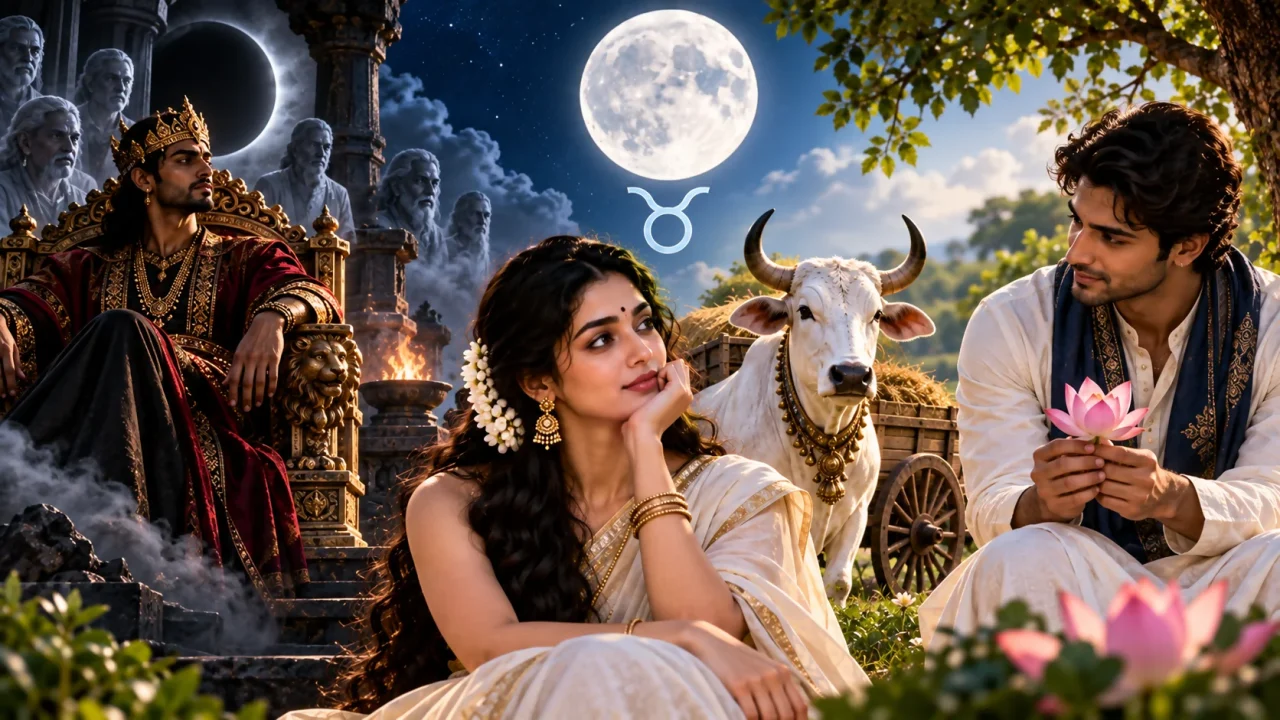
Rohini lies in the middle of Taurus, so the sign belongs to Venus while the nakshatra belongs to the Moon. Pleasure and comfort sit on top of emotion and memory. Its deity is Brahma the creator and its symbol is the ox cart, the vehicle that brings the harvest home, so the instinct is always to build something and then keep it. Its yoni is the serpent, which waits, coils and strikes only when what it considers its own is threatened.
Put plainly, Rohini attracts easily, loves deeply, and holds on hard. The holding is not a character flaw invented by astrologers. It comes straight from the Moon, which has no capacity for detachment, and from a sign that measures love in what it can keep. Once you have that fixed in mind, the nine ratings below stop looking arbitrary and start looking inevitable.
Rohini and Magha Compatibility
28 per cent. The lowest score in the chapter.
This is where Rohini loses its footing completely. Rohini wants romance and Magha wants sex, and that difference alone would only make the relationship unsatisfying. What makes it damaging is the rejection that follows. Magha can trample on feelings without noticing, and it lands directly on Rohini’s least defended place, its self-esteem. Add Magha’s tendency to stray and Rohini’s jealousy becomes extreme. Rohini loses its sense of proportion with Magha, and that phrase is precise. This is not a bad match, it is a match that removes the person’s judgement.
The astrology makes the reason plain. Magha is ruled by Ketu and presided over by the Pitris, the ancestors. Its symbol is the royal throne. A throne does not court anybody, it receives tribute, and Magha’s deepest loyalty runs backwards towards lineage and ancestry rather than forwards towards a partner. Then there is Ketu itself. The Moon shines only by reflection, and Ketu, the headless one, has no face to reflect anything back. Rohini keeps offering and receives nothing in return that it can recognise as love.
There is also a collision of thrones here. Magha expects to be honoured because of what it is. Rohini expects to be adored because of what it is. Neither is willing to be the one who admires. In practice, if this pairing turns up in a consultation, I would not spend time on remedies for the relationship. I would spend it on the Rohini partner’s self-worth, because that is what this match attacks and that is what has to be protected.
Rohini and Purva Phalguni Compatibility
66 per cent. Comfortable, indulgent, and easy to live in.
Purva Phalguni will indulge Rohini and make a real effort to fulfil its romantic dreams, which is exactly what this nakshatra wants and rarely receives. More useful still, they bring a practicality that gives Rohini’s emotional nature something solid to stand on. Life together is genuinely enjoyable. The one gap is in sensual skill, and since teaching is something Rohini enjoys doing, that gap closes quickly.
Purva Phalguni is ruled by Venus, and Rohini occupies Venus’s own sign, so there is a shared taste running through both charts. The deity is Bhaga, who presides over delight, good fortune and marital happiness, and the symbol is the front legs of a bed. Very little in the classical scheme is as directly about enjoyment and rest as this nakshatra. That is why the indulgence comes naturally rather than as an effort.
That practicality is worth explaining, because Venus alone would not produce it. Purva Phalguni sits entirely in Leo, the Sun’s sign, so underneath the pleasure-seeking there is solar steadiness and a certain dignity that keeps the household in shape. The real risk in this match is not conflict, it is comfort. Two people who enjoy life this easily can stop growing, and years pass pleasantly with nothing being built. Brahma is Rohini’s deity for a reason. This nakshatra is happiest when it is creating something, not only enjoying something.
Rohini and Uttara Phalguni Compatibility
72 per cent. The rare partner who wants to be possessed.
Rohini loves the strength of Uttara Phalguni and feels secure with them. They are not the most imaginative lovers, and Rohini will notice that, but they are present, reliable and completely willing to be possessed. For a nakshatra whose possessiveness usually causes the trouble, meeting a partner who accepts it as a form of love changes everything.
This is not an accident of temperament. Uttara Phalguni is ruled by the Sun and presided over by Aryaman, the deity of patronage, friendship and the bonds of marriage itself. Its symbol is the back legs of the bed, the part that bears the weight, the continuation rather than the beginning. If any nakshatra in the zodiac is constructed for the contract of marriage rather than the excitement of romance, it is this one. Belonging is not a threat to Aryaman’s nature, it is the point of it.
There is a warning attached to this match that must not be skipped. Uttara Phalguni carries a jealous temper, and if Rohini ever gives it reason to appear, it is destructive out of all proportion to the provocation. That is the Sun’s pride, and solar pride does not negotiate once it has been publicly injured. My advice to a Rohini in this marriage is simple. You have found a partner who will tolerate your possessiveness. Do not test whether they will tolerate your flirtation.
Rohini and Hasta Compatibility
69 per cent. Two moody people who understand moodiness.
Rohini enjoys Hasta’s sophistication and equally enjoys their earthiness, and finds it easy to connect with both sides of the same person. Both of them are moody, and normally that is a problem. Here it is not, because each understands the behaviour from the inside and neither takes it as an insult. Rohini also likes Hasta’s uncomplicated approach to living, and takes pleasure in helping them get past their self-doubt.
The reason for that mutual understanding is direct. Hasta is ruled by the Moon, exactly as Rohini is. Two lunar nakshatras share a rhythm, so a withdrawn evening is read correctly rather than treated as rejection. The two sides Rohini enjoys come from Hasta’s own composition. The nakshatra sits in Virgo, which is Mercury’s sign and supplies the sophistication and skill, while its lunar rulership supplies the earthiness and the moods. Its symbol is the hand, the organ of craft and of holding, and its deity is Savitar, the generative power of the Sun.
There is one caution I would add that is rarely stated anywhere. When both partners run on the Moon, both can go down at the same time, and then there is nobody steady in the house. In a good year this pairing is warm and intuitive. In a hard year it needs an outside anchor, whether that is work, family or discipline, because neither of them will supply it for the other.
Rohini and Chitra Compatibility
49 per cent. The match that fails by exactly the mechanism it looks like it should survive.
Chitra is dynamic, confident and passionate, and Rohini is drawn straight to that. It willingly lets Chitra dominate the partnership and enjoys the thrill of being near that much power. Then the other half appears. Chitra is implacable and, when it suits, selfish. And here the fatal loop begins. The more possessive Rohini becomes, the more distant Chitra grows, which makes Rohini more possessive still.
Chitra is ruled by Mars and presided over by Tvashtar, the celestial architect, the maker of divine forms. Its symbol is the bright jewel and its yoni is the tiger. Every one of those points the same way. A jewel is meant to be displayed and admired, not gripped, and a tiger does not yield to pressure from anyone. Chitra will give what it chooses to give, generously, and will withdraw completely the moment it feels managed.
This is the one match in the group where I would give the advice to Rohini alone rather than to the couple. Here possessiveness is not a habit that can be worked on over the years. It is the actual mechanism of failure, and it operates early. The only workable guidance is to accept what Chitra is willing to give, and that is correct, but it asks a Moon-ruled nakshatra to do the single hardest thing it can be asked to do.
Rohini and Swati Compatibility
42 per cent. Mistrust that is generated from the inside.
This is a spiritually complex relationship, and the reason behind it deserves careful statement. Rohini can be irrational in its mistrust of Swati, because the Moon, Rohini’s ruler, is frightened of Rahu, who rules Swati. Where a match is otherwise weak, that fear expresses itself as suspicion, fear of commitment and behaviour the person cannot explain in themselves afterwards.
Students should sit with this, because the opposite result appears elsewhere in this very chapter. The Moon and Rahu meet again in another of Rohini’s matches, and there, because the rest of the compatibility is strong, the identical fear converts into excitement and keeps the relationship alive. One planetary antagonism, two completely different outcomes. A planetary relationship is a tendency, not a sentence, and what surrounds it decides how it resolves. That single principle is worth more to a practising astrologer than any table of percentages.
The other half of the difficulty is Swati’s own nature. It is presided over by Vayu, the wind, and its symbol is a young shoot swaying in open air. Independence is not a preference for Swati, it is the substance of the nakshatra. Nothing about it can be held. So Rohini’s instinct to hold meets the one thing in the zodiac that is defined by not being holdable, and the Moon’s inherited fear of Rahu supplies a ready-made explanation for anxiety that Swati has done nothing to earn. In consultation, I would ask the Rohini partner to check the evidence before acting on the feeling, because in this match the feeling arrives without evidence.
Rohini and Vishakha Compatibility
30 per cent. Loved on somebody else’s terms.
Vishakha seems unable to grasp what Rohini needs internally. They are perfectly happy to be in the relationship as long as it runs according to their rules, and Rohini, who needs undivided attention, cannot live inside that arrangement for long. In most such cases both parties have built unrealistic expectations of each other, and Rohini should not place its entire emotional weight on this partner.
Vishakha is ruled by Jupiter and presided over by Indra and Agni together, two deities of force, victory and achievement. Its symbol is the triumphal archway, the gate you pass through after winning something. That is the whole psychology in one image. Vishakha is aimed at a goal, and a partner is part of the campaign rather than the campaign itself. Rohini, on the other hand, needs to be the goal. Jupiter then supplies the conviction that Vishakha’s own rules are the correct ones, which removes the flexibility that might have saved the match.
Note too that Vishakha carries the tiger yoni, as Chitra does, and that these two tiger nakshatras produce Rohini’s two weakest results in this group after Magha. The serpent waits and holds. The tiger goes its own way. It is a useful reminder that the yoni classification is not decoration, it often describes the behaviour more accurately than the planetary lord does.
Rohini and Anuradha Compatibility
80 per cent. The ideal life partner for this chapter.
Anuradha understands love and romance in a way that almost no other nakshatra does, and it keeps that understanding hidden behind a worldly-wise exterior. Once the two of them are past that surface, both can share their romantic dreams openly and become, in the fullest sense of the phrase, the ultimate lovers. Anuradha also tends to do well materially, which comfortably supports Rohini’s taste for luxury. Eighty per cent is the highest figure in the entire chapter and it is thoroughly earned.
The key is the deity. Anuradha is presided over by Mitra, the god of friendship, alliance and bonds entered into freely, and the name Anuradha itself carries the sense of devotion and of following. This is the one nakshatra in the zodiac that genuinely wants deep attachment. So Rohini’s grip, which every other partner in this chapter experiences as control, is received here as devotion. The thing that ruins Rohini’s other relationships is the thing this partner was waiting for.
Saturn rules Anuradha, and that supplies the rest. Saturn’s patience absorbs the Moon’s changing moods without resentment. Saturn’s persistence explains the financial success. And the worldly-wise exterior is Saturn as well, a protective shell built over a very soft interior, which is why the lotus is its symbol, beauty rising out of dark water. The only practical caution is at the beginning. A Rohini meeting an Anuradha for the first time may read that Saturnine reserve as coldness and move on before discovering what is underneath. Tell them to wait.
Rohini and Jyeshta Compatibility
67 per cent. Security removes the need to cling.
Rohini loves Jyeshta’s mystical quality, their charm and their intellect, and finds their capacity to genuinely savour sensuality exciting. Jyeshta loves in style and more than satisfies Rohini’s need for luxury and comfort. Rohini does not fully share their spiritual side, but it knows when to leave them alone, and there is a revealing detail in that: Rohini itself likes a little freedom too.
That line deserves attention, because it contradicts everything else in the chapter. This is the same Rohini that suffocates Ashwini and drives Chitra away. Why does it grant Jyeshta room? The answer is that the possessiveness was never really about ownership. It was about insecurity. Jyeshta gives Rohini so much, materially, sensually and in attention, that the insecurity never switches on, and without the insecurity the clinging simply does not appear.
Jyeshta is ruled by Mercury, which accounts for the charm and the intellect, and is presided over by Indra, the king of the gods. Its name means the eldest and its symbol is the circular amulet, an emblem of protection and of rank. Jyeshta protects what it claims and lives well while doing it. Its placement in Scorpio gives the private, occult depth that Rohini does not enter, and that unentered space is not a problem here. It is what keeps the relationship interesting.
What these nine reveal about Rohini Nakshatra
Line the scores up and the logic is clean. The two highest, Anuradha and Uttara Phalguni, are the two partners who actively want to be bound. The two lowest, Magha and Vishakha, are partners who love on their own terms and will not make Rohini the centre. Chitra fails a step higher up for a related reason, and Swati fails because of an inherited planetary fear rather than anything the partner does.
In the middle sit the comfortable matches. Purva Phalguni works through shared Venusian taste, Hasta through a shared lunar rhythm, and Jyeshta through sheer abundance. None of those three requires Rohini to change its nature, which is precisely why they sit comfortably in the sixties.
There is one more observation worth making. Magha and Chitra both fail, but for opposite reasons, and a practitioner should not treat them as the same problem. Magha never gives the attention in the first place. Chitra gives it generously and then withdraws it under pressure. The first is a wound that never heals because nothing was ever offered. The second is a wound Rohini inflicts on itself by squeezing. Different causes require different counsel.
How to use a chapter’s ideal partner properly
Every chapter in this system names an ideal life partner and a most challenging one, and students misuse both. An ideal partner is not a prescription. It is a description of the conditions under which this nakshatra performs at its best, which for Rohini means a partner who receives attachment as devotion rather than as pressure. Several nakshatras can provide that in a particular chart. Anuradha simply provides it most reliably.
The reverse is also true. Being told that Magha is the most challenging partner does not forbid the marriage. It tells you exactly where the damage will occur, which in this case is self-esteem, and it tells you what to watch for from the first year rather than discovering it in the tenth.
Two technical points before closing. First, always read the match from both sides, because the two entries are not mirror images. What Rohini experiences with a partner and what that partner experiences with Rohini can differ considerably, and a couple’s real difficulty usually sits in the gap between the two readings. Second, check the condition of the nakshatra lord in each chart. Rohini is a Moon nakshatra, so a bright and well placed Moon gives the confident, magnetic version described here, while a weak or afflicted Moon gives the same desires with far less capacity to absorb rejection. Every low score in this list becomes harder to survive when the Moon is under pressure.
Beyond that, the seventh house and its lord, the fourth house for domestic peace, and the dasha running at the time of marriage will move any of these outcomes. The percentage marks the pressure point. The rest of the chart decides whether the couple can stand on it.
 What a Remedy is Supposed to ChangeThe earlier article in this line asked whether a remedy was aimed at the right planet. That question is a real one and it settles a large number of ca…
 When the Remedy Do Not WorkMost people who ask this question have already spent money. A stone was bought and worn on the right finger on the right day. A pooja was done exactly…
 Why the Same Mahadasha Gives Two People Different LivesThe first article in this series ended on one sentence, and that sentence needs an article of its own. A dasha decides whose turn it is. It does not d…