Almost everything written about Aries ascendant can be reduced to four words. Bold, impatient, fiery, direct. A reader takes those four words away, finds that they describe about half the people he knows, and quietly concludes that this part of the subject does not say very much.
He is not wrong to conclude it, because those four words genuinely do not say very much. They describe the first house and then stop, as though an ascendant were a single room rather than the thing that arranges all twelve of them. In the previous article in this series I made the case that an ascendant is not an adjective but an arrangement, and that the arrangement stands complete before any planet is placed in it. Aries is the right place to begin working through that claim, because out of all twelve ascendants it is the only one that carries a particular property, and almost everything else in this article follows from that one property.
Every Sign Sits in Its Own House
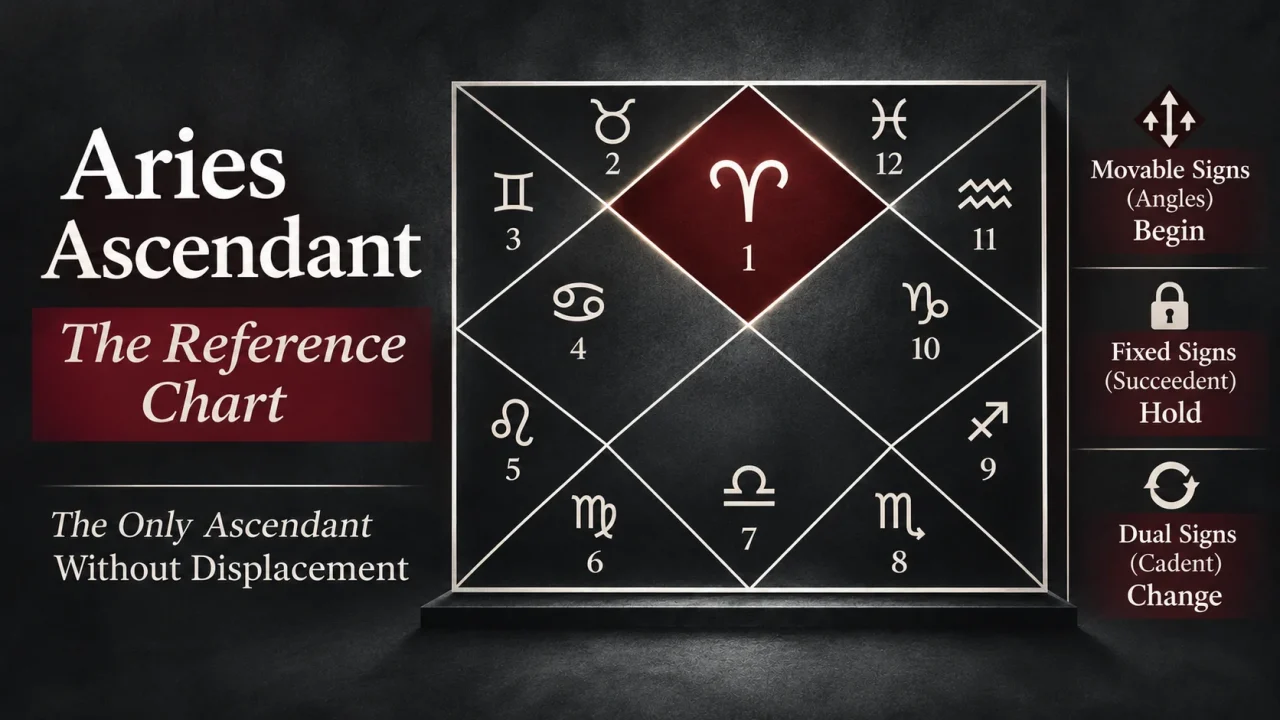
For an Aries ascendant, Aries occupies the first house, Taurus the second, Gemini the third, and the order runs on in that fashion until Pisces comes to rest in the twelfth. Written out plainly it looks unremarkable, and most students pass over it without noticing what has actually happened.
What has happened is that every sign has landed in the house matching its own number in the zodiac. Aries is the first sign of the zodiac and it is in the first house, Cancer is the fourth sign and it is in the fourth house, Libra is the seventh and it is in the seventh, and Pisces, the twelfth, is in the twelfth. There is not one sign anywhere in this chart that has been carried away from the place it naturally belongs to.
This happens for no other ascendant. Move the ascendant forward by a single sign and the whole zodiac slides by one house, so that for a Taurus ascendant the natural second sign is being asked to do the work of the first house, and for a Scorpio ascendant the natural eighth sign has been brought to the front of the chart to stand for the person himself. Every ascendant other than Aries is a displacement of some size, and the amount and direction of that displacement accounts for a great deal of how those charts behave.
Aries ascendant is therefore the reference against which the other eleven are read. Before a student can see what displacement does to a life, he has to know what a chart looks like when there is none at all.
The Three Qualities Fall in Three Clean Rows
Here is the consequence that matters most, and it is the one that gets missed even by students who have noticed everything above. The twelve signs are divided into three groups by quality. Four are movable, four are fixed, and four are dual. The twelve houses are also divided into three groups, the four angles, the four succeedent houses that follow them, and the four cadent houses that follow those. In an Aries ascendant chart these two divisions line up exactly, one on top of the other, with nothing left over.
The four movable signs, Aries and Cancer and Libra and Capricorn, fall in the four angles. The four fixed signs, Taurus and Leo and Scorpio and Aquarius, fall in the four succeedent houses. The four dual signs, Gemini and Virgo and Sagittarius and Pisces, fall in the four cadent houses. No other ascendant produces this, and once it is seen, the behaviour of an Aries ascendant stops being a list of traits and becomes a single structure with three layers.
The angles are the pillars of a chart, the houses on which a life actually stands, and all four of them here hold a sign whose nature is to begin things. The succeedent houses are where life accumulates, and all four of them hold a sign whose nature is to hold on. The cadent houses are where the mind works and where it changes its position, and all four of them hold a sign that is dual by nature and can always argue the other side. Keep those three rows in mind, because the rest of this article is really only a reading of them.
What Aries Itself Carries
Before going further into the arrangement, the sign at the front of it needs to be understood properly, and understood as something other than a temperament. Aries is a movable sign of the fire element ruled by Mars, and its karmic pattern is not courage or anger or leadership, which are only its outward appearances. The pattern underneath is that a person must make his own road by his own initiative, and must establish who he is through struggle rather than receive it from anywhere else.
Wherever Aries falls in any chart, that house becomes a place where certain kinds of action are required. The person has to begin things himself rather than wait for them to begin. He has to find his way through difficulty by pushing through it. He has to decide independently instead of leaning on somebody else to decide for him, and he has to stand up for his own existence and his own right to it. He will be asked to take a risk in order to enter a situation he has not been in before, and he will meet competition there rather than avoid it. The person carrying this sign does not wait for circumstances to turn in his favour. He tries to turn them himself.
In an Aries ascendant chart, this pattern is sitting in the first house, which is to say it is sitting on the person himself. So the struggle is not about money or about relationships or about work, at least not first. It is about identity. Such a person spends a great deal of his life establishing that he exists and that he is the one who decides, and he will keep doing this even in situations where nobody has actually challenged him.
That is the positive face of it. The same energy has a second face, and the second face is what brings most Aries ascendants to an astrologer in the first place. Courage becomes haste and unnecessary risk. Leadership becomes a wish to control the people around him. Independence becomes an inability to cooperate with anybody. A healthy sense of competition becomes enmity where none was needed, confidence hardens into ego and obstinacy, quickness of decision turns into acting without thought, and the capacity to struggle turns into conflict for its own sake. Both faces come out of the same material, which is why neither can be removed without removing the other.
Where the Steadiness Went
Now return to the three rows and look at the middle one, because it answers a question about Aries ascendants that is usually treated as a personal quirk. Such a person very often gathers things he does not need. Not because he is greedy and not because he has planned for anything, but because the gathering itself does not stop when the need is met. Ask him why he is keeping something and the answer is rarely about use.
The structure explains it without any reference to character. The houses where life accumulates are the second, the fifth, the eighth and the eleventh, which hold wealth, stored merit, what comes from others, and gain. In an Aries ascendant chart all four of those houses hold a fixed sign, so every place where accumulation happens has been given a sign whose entire nature is to hold on and not release. The second house is the strongest case of it, since Taurus is the natural gatherer of the zodiac and here it is sitting in its own house, doing the thing it was made for in the place made for it.
But there is a further point, and it is the one worth carrying. Look at the other two rows and ask where else in this chart anything stands still. The angles all hold movable signs, so action does not stand still. The cadent houses all hold dual signs, so the mind does not stand still. Out of twelve houses, the only steadiness anywhere in the frame is in the four houses of accumulation.
So when such a person reaches for something solid, the chart offers him exactly one place to find it. He collects, not because he needs the objects, but because collecting is the only fixed thing available to him. The question of need never arises, because need was never what the gathering was for.
Why Nothing Settles Between Feeling and Reason
The same three rows explain something that Aries ascendants describe about themselves constantly, which is a sense of being caught between what they feel and what they can reason out, with no way to settle the argument. Reason in this chart sits in the third house, which holds Gemini, a dual sign ruled by Mercury. A dual sign does not take a single position, and Mercury is the graha most willing to see both sides of anything. So reasoning here is genuinely two directional. Whatever conclusion it reaches, it can immediately produce the opposite conclusion with equal force.
Feeling sits in the fourth house, which holds Cancer. It is tempting to read the fourth house as solid ground because it is an angle, but the sign sitting in it is movable, and the sign decides the nature while the house only decides the department. Cancer in the fourth means that the emotional base of this life is itself in motion. What such a person feels today about a matter is not reliably what he will feel about it next month.
Put those two together and the deadlock becomes obvious. The argument between feeling and reason cannot be settled, because settling it would require at least one of the two to hold still long enough to be measured against the other, and in this chart neither of them does. One keeps turning over and the other keeps moving, and the person stands between them waiting for a stability that his own frame does not contain.
This is also why advice to such a person to simply follow his heart or simply be logical does not help him. Both instruments are moving.
Many Things Begun at Once
The top row accounts for the pattern that is visible from furthest away. An Aries ascendant tends to have several things started and running at the same time, across quite different parts of his life, and the number of them rarely comes down. A new piece of work, a new arrangement at home, a new undertaking with somebody else, all opened within the same period.
This is not restlessness in the ordinary sense, and it is not a flaw in his planning. The four angles are the houses a life stands on, and they are the self, the home and inner base, partnership, and work in the world. In this chart every one of those four holds a movable sign. The pillars themselves are made of the quality that begins things. A person whose foundations are all built out of initiation will initiate on every front, because there is no part of his structure that was built to sit still and continue.
Whether those beginnings are carried to completion is a separate question, and the answer to it does not come from the arrangement. It comes from the planets, from their strength, and from the dasha running at the time.
The Self and the Eighth House Share One Lord
Mars rules Aries, which is in the first house. Mars also rules Scorpio, which is in the eighth. So the lord of the self is at the same time the lord of crisis, of what is buried, of sudden reversal, of longevity, and of everything that arrives from outside a person’s control.
Notice how exactly this agrees with the karmic pattern described earlier. Aries asks a person to establish his identity through struggle, and in this chart the planet carrying his identity is also the planet carrying his upheavals. The two statements arrive from different directions and say the same thing. The struggle is not incidental to who he becomes. It is the material he is made out of.
This explains a contradiction that puzzles students the first time they meet it. An Aries ascendant is described everywhere as fearless, and then the same person turns out to carry considerable private anxiety about health, about sudden loss, about things ending without warning. There is no contradiction once the structure is visible, because the boldness belongs to the first house and the anxiety belongs to the eighth, and one lord is answerable for both.
None of this predicts misfortune and it should not be read that way. Weight in the eighth house is as often the source of a person’s depth as it is the source of his trouble, and in this chart that weight is tied directly to who he understands himself to be.
The Slow End of the Chart
One more structural fact completes the picture, and it is the one that produces the most complaint. Saturn rules Capricorn, which is in the tenth house, and Aquarius, which is in the eleventh. So work in the world and the income that follows from it are held together under the slowest of the grahas. Standing and money arrive through duty and endurance rather than through opportunity, and they arrive late rather than early.
Set that against the first house. The front of this chart is fast and the back of it is slow, and that mismatch is the central strain of the ascendant. The person acts immediately and is rewarded only after long delay. A great deal of what Aries ascendants complain about comes out of this single disagreement in the frame rather than out of anything in their planets, and a person with Aries rising who expects quick returns from his work is arguing with his own chart.
The Lesson This Ascendant is Set
Every sign sets its carrier a particular lesson, and Aries sets one that can be stated in four movements. Anger has to become courage. Aggression has to become assertion. Impulse has to become initiative. Independence has to become responsible leadership.
Each of those is a refinement rather than a reversal. The energy is not being asked to go away, because without it nothing in this chart works at all. It is being asked to take a better shape. The anger and the courage are the same force, and so are the impulse and the initiative, and the whole work of such a life is the distance between the two words.
Underneath all four there is a single instruction, and it is the one that takes longest. The person has to learn that not every situation requires a fight. An Aries ascendant will enter conflicts that were never offered to him, simply because conflict is the mode he knows, and a good part of his difficulty is made of fights that did not need to happen.
The real turn comes later than most people expect. It comes when he stops struggling only on his own behalf and begins to struggle for something beyond himself. The capacity does not change at that point, but what it is attached to does, and that single change is the difference between an Aries ascendant who exhausts himself and one who builds something.
What This Does Not Tell You
Everything written above is a reading of the arrangement, which means it gives you the ground of a life and not the events in it. These are opening indications and not final judgements.
The sign in a house tells you what kind of karma collects there. It does not tell you what will happen or when. For that you need the lord of that house and his condition, you need the position of Mars in particular since he carries so much of this chart, you need the other planets and what they are doing to each other, and you need the dasha running at the time. Any one of those can turn a reading of the arrangement in a direction the arrangement alone would not have suggested.
There is one exception to this limit, and it is the reason the series exists. The signs do carry a clock of their own, independent of the planets and of the dasha, because each of them becomes active at a particular stage of life. When a sign activates, whatever it holds in that chart and whatever house it occupies comes forward and takes its turn. I will work one sign through completely in a later article so that it can be watched rather than believed, and the full set across all twelve signs is what the Blank Chart Prediction course exists to teach.
What to Do With This
If your own ascendant is Aries, cover the planets and read the three rows before anything else. Find the four angles and confirm that every one of them holds a movable sign, then the four houses of accumulation and confirm the fixed signs, then the four houses of the mind and confirm the dual ones.
Having done that, go through the three patterns described here and ask whether they hold in your own life. Do you have several things open at once across different departments. Does the gathering continue past the point of need. Does the argument between what you feel and what you can reason out ever actually conclude. Where the answer is yes you have confirmed the frame, and where it is no you have found a place where a planet has done something to the ground, which is exactly where to look when you uncover the planets again.
If your ascendant is not Aries, the exercise is still worth doing on another chart, because this is the baseline. Every displacement you meet in the eleven articles that follow will be measured against what you have just read, and a student who has not absorbed the undisplaced case has nothing to measure against.
What this article has given you is one sign in one house, worked through properly. The same sign behaves differently in each of the remaining eleven houses, and the other eleven signs each carry a karmic pattern of their own, which is the material the Blank Chart Prediction course is built out of. Reading one arrangement carefully is worth more than skimming twelve, so take this one as far as it will go before moving on.
The next article takes Taurus, where the whole zodiac has moved forward by one house and the three clean rows break apart for the first time. Reading those two charts side by side teaches more than reading either one alone, because every difference between them is the work of the arrangement and of nothing else.
Questions People Ask
Is Aries ascendant a strong ascendant?
Why is Mars so important for Aries ascendant?
Does Aries ascendant mean an aggressive person?
Which house should I examine first in an Aries ascendant chart?
 Neptune in Vedic AstrologySearch for Neptune in Vedic astrology and you will get the same article twelve times over. Neptune in Aries. Neptune in Taurus. One paragraph for each…
 Why Sade Sati Is Heavy for Some and Light for OthersTwo people are running Sade Sati in the same years. One of them loses his footing. Work goes wrong, sleep goes, and he spends those years feeling that…
 Can a Remedy Change Your Destiny?Suppose a man has pain in his knee. He sits down and does japa. He has a hawan performed. He is told to put something in running water on a Tuesday. W…