Almost every book introduces Pushya with a single word: nourishment. The definition is correct, but it is also where most discussions stop. And the moment you stop there, you lose the interesting part of the question.
Nourishment of what? Given by whom? Under what conditions? Delivered through what structure?
A newborn is nourished by milk. A student is nourished by correction. A business is nourished by capital. A tradition is nourished by discipline carried across generations. These are not the same process, yet Jyotisha packs all of them into one nakshatra occupying thirteen degrees and twenty minutes of Cancer. That compression is not carelessness. It suggests the tradition saw something common running through all these situations, and our work is to find out what that common thing actually is.
This article is an attempt to do that. Not to list attributes of Pushya Nakshatra, but to take its components apart, watch how they interact, and build a framework you can test on real charts.
Why Pushya Deserves a Deeper Look
Pushya carries an unusually strong reputation. In later muhurta literature and in present day popular practice it is treated as one of the most favourable nakshatras for a particular class of activities, and that reputation has quietly replaced analysis. Once a nakshatra is labelled “best”, people stop asking what it actually does.
The more interesting point is the tension most discussions walk straight past. Pushya’s presiding deity is Brihaspati, while its nakshatra lord in the Vimshottari scheme is Saturn. The significations gathered around Brihaspati and around Saturn pull in opposite directions. One expands, the other contracts. One gives, the other withholds until conditions are met.
A nakshatra carrying both is not simple. It is a composite, and composites are where the real learning sits.
The Basic Structure of Pushya Nakshatra
Before interpretation, the raw data.
Pushya spans 3 degrees 20 minutes to 16 degrees 40 minutes of Cancer, lying entirely inside one sign, which matters more than it sounds: a nakshatra that does not straddle a sign boundary keeps a consistent sign environment across its whole span.
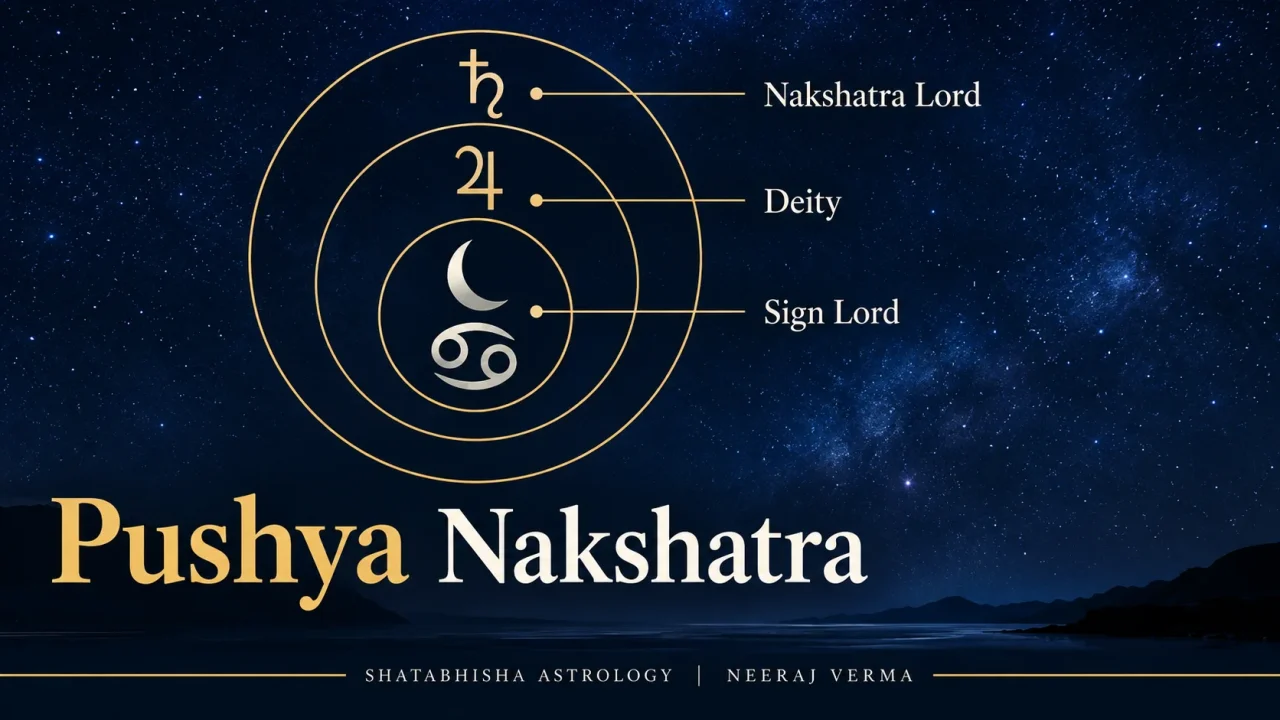
Its presiding deity is Brihaspati. Its nakshatra lord in the Vimshottari scheme is Saturn. Its sign lord is the Moon, since the whole nakshatra falls in Cancer. Its most commonly cited symbol is a cow’s udder, with the lotus and the arrow also appearing in traditional lists. Its gana is Deva. In the activity based classification of nakshatras, Pushya is placed in the Kshipra or Laghu group, the light and swift nakshatras, along with Ashwini and Hasta. This grouping is widely used in muhurta practice and appears in later muhurta handbooks, although the terminology and presentation vary somewhat between sources.
That last detail is often skipped and should not be. A nakshatra associated with sustenance and long term stability is classed among the swift ones. Hold that tension in mind.
So three distinct layers become relevant when interpreting Pushya Nakshatra: its presiding deity Brihaspati, its Vimshottari nakshatra lord Saturn, and the Moon as lord of Cancer. These are three different kinds of connection, not three planets jointly ruling the nakshatra, and keeping them apart is what keeps the interpretation clean.
A point of historical context belongs here too, since it often gets flattened. Nakshatra lists appear in early Vedic material, where this one is generally identified with the name Tishya. Varahamihira’s Brihat Samhita, from the sixth century, contains a chapter dealing with the functions and properties of the nakshatras. The detailed electional rules most practitioners actually use took shape later, in muhurta literature and the regional traditions built on it. These are different layers, and a claim well founded in one of them is not thereby well founded in the others. I will try to say which layer I am drawing on as we go.
Brihaspati as the Deity of Pushya Nakshatra
Students often ask what a nakshatra devata actually does in practical interpretation. The tradition is not uniform here, and a single settled technical rule is more than the material supports. One workable model, offered as a model rather than a classical formula, is that the deity indicates the governing intent of that segment of the zodiac, while the nakshatra lord indicates the agent whose significations colour how that intent works out. Accept that, and Brihaspati tells us what Pushya is for.
Brihaspati in the tradition is the guru, the counsellor, the one who preserves knowledge and advises on right action. The graha Jupiter carries a related set of significations in Jyotisha: wisdom, teaching, guidance, ethics, expansion, faith, children and the ability to see a larger pattern than the one in front of you. The overlap is why the two are so often spoken of together, but the deity assignment and the planetary significations are separate technical facts, and the argument below uses the overlap without collapsing one into the other.
Notice the thread running through all of these. Each is a form of giving that increases the receiver’s own capacity. A teacher’s knowledge is not reduced by being shared. Good counsel makes the person counselled more able to act alone next time. Brihaspati’s gift is not a transfer of goods; it is an increase in someone’s ability to sustain themselves.
From an analytical perspective that is a far more useful working definition of nourishment than “food and motherly care”, and the reframing changes how the whole nakshatra reads.
Saturn as the Nakshatra Lord of Pushya Nakshatra
Here is the question worth raising before teaching anything else about this nakshatra. If Pushya belongs to Brihaspati, why is its lord Saturn?
It is worth sitting with that question rather than smoothing it over. Traditional Jyotisha gives us the assignment; it does not always give us the reasoning. What follows is analytical interpretation, offered as a way of thinking rather than as a rule drawn from a text.
Start with Saturn’s natural significations: discipline, structure, limitation, responsibility, endurance, labour, delay, time itself. Place them next to Jupiter’s: expansion, wisdom, counsel, faith, growth. Then consider what happens when either one operates alone.
Jupiter without Saturn gives without conditions. Knowledge arrives but is not practised. Resources arrive but are not managed. Expansion with no container is simply dispersal. Anyone who has taught for a few years has met the student who absorbs everything and retains nothing, because there is no discipline holding the material in place.
Saturn without Jupiter gives structure with nothing inside it. Rules without understanding. Duty without meaning. Endurance without a direction worth enduring for.
One way to work with the Pushya structure is to treat it as the meeting of the two: Brihaspati as the principle of what is given or developed, and Saturn as the structure and the conditions through which it becomes sustainable. I want to be plain about the status of that. It is an analytical framework, a working model I find useful and that you can test, not a classical rule stated anywhere in this form. Everything built on it in the next few paragraphs carries the same status.
That yields a working proposition: nourishment without structure rarely becomes sustainable growth. Food that is not digested does not nourish. Money that is not managed does not build. Teaching that is not practised does not turn into skill. Read this way, Saturn is not intruding on Brihaspati’s nakshatra; Saturn is what could make Brihaspati’s gift hold.
It also suggests a testable expectation rather than a settled fact: results connected with Pushya may appear as slow consolidation rather than sudden abundance. Whether that holds across a large sample is exactly the kind of claim to test rather than accept.
The earlier puzzle becomes easier to place too, and here again I am interpreting rather than reporting. The Kshipra grouping is traditional. The reading I am about to put on it is mine. Pushya is classed with the swift, light nakshatras even though its themes are slow and sustaining, and the tension eases if you separate initiation from maturation: the act of beginning is what the classification describes, while what the beginning grows into belongs to Saturn’s side of the structure. Useful as a way of holding two facts together, but not a rule anyone has handed down in that form.
The Moon and Cancer Connection
Pushya sits in Cancer, so the Moon is the sign lord of the entire nakshatra. One distinction deserves care here, because it is frequently blurred. Saturn is Pushya’s nakshatra lord, which means a planet placed in Pushya sits in Saturn’s nakshatra. It does not mean that planet runs a Saturn mahadasha. In Vimshottari, the birth nakshatra of the Moon determines the starting mahadasha, and the sequence proceeds from there in its fixed order. A planet sitting in Pushya does not by itself activate anything in that sequence. Saturn’s lordship is an interpretive layer, useful in the way a dispositor is useful, and it is never a substitute for calculating the dasha.
The Moon signifies the mind, emotional security, receptivity, nurturing, habit, care and public response. Cancer adds home, roots, belonging and protection of what is vulnerable. Together they give the nakshatra its receiving end: the deity layer describes what is given, Saturn the terms on which it is given, and the Moon the condition of the one receiving it along with the emotional atmosphere of the exchange.
That third element is easy to underrate. Nourishment is not only about supply; it is also about the capacity to absorb. A person under emotional strain does not learn well or build well, whatever resources are placed in front of them. By locating Pushya in Cancer, the tradition places the theme of sustenance inside the domain of emotional safety.
Put the three layers together and the picture is coherent: intent, method and medium. A good teacher has all three, something worth giving, a method that demands effort, and enough warmth that the student stays in the room.
The Deeper Meaning of Nourishment
If nourishment means raising another’s capacity to sustain themselves, food is only the most literal case. Traditionally, Pushya is connected with sustenance, protection and the flourishing of what is under one’s care. The extension below is analytical interpretation built on that theme, and it should be treated as an interpretive framework rather than a classical rule.
Nourishment in a chart may take the form of knowledge and education, guidance and counsel, protection from harm, material resources, emotional support, financial stability, institutional backing, spiritual training, transferable skills, social belonging, and the long term development of a person, a family or an organisation.
What unites this list is not kindness but the combination of supply and continuity. A single gift is charity. A structure that keeps supplying is nourishment, and the second half of that sentence belongs to Saturn.
This gives a practical test. Ask what, in this specific chart, is being sustained and what is doing the sustaining. Without that, “nourishment” stays a word rather than a reading.
Why Pushya Became Important in Muhurta
Pushya’s standing in electional astrology is long established. Traditional muhurta practice treats it as one of the favourable nakshatras for beginning things, and later popular usage has carried that into buying gold, starting studies, opening accounts and similar acts of acquisition and initiation.
The structure offers a reasonable explanation for why. Muhurta is about choosing a moment whose quality carries into whatever is begun, and the three layers described above add up to close to what one would want in a beginning meant to last. That reading is interpretive, but it is consistent with the tradition’s own preferences.
The older name Tishya, under which this nakshatra appears in early Vedic lists, and the sense of nourishing and flourishing carried by the word Pushya itself, both sit comfortably with the theme. Naming supports an interpretation; it does not establish one.
Traditionally, Pushya is considered suitable for activities connected with learning, initiation, acquisition, stability, care and long term development. That is a meaningful list, and also a specific one, which brings us to the next point.
Pushya Does Not Mean Automatically Auspicious
This section matters more than any other in the article. Pushya Nakshatra has a strong traditional reputation in muhurta, but that reputation does not mean every activity begun in Pushya is suitable, or that the presence of Pushya alone makes a moment good.
Muhurta is not a single factor discipline. A working electional judgement considers the tithi, vara, yoga and karana, the rising lagna and its lord, the condition of the relevant planets, and the muhurta principles applicable to that particular activity. A nakshatra is one input among several. A strong nakshatra with a badly afflicted lagna is not a good muhurta; it is a good nakshatra inside a weak chart.
The clearest illustration comes from muhurta practice itself. The nakshatras conventionally accepted for vivaha muhurta form a short list, usually given as eleven: Rohini, Mrigashira, Magha, Uttara Phalguni, Hasta, Swati, Anuradha, Moola, Uttara Ashadha, Uttara Bhadrapada and Revati. Pushya does not appear on it, and several traditional muhurta systems accordingly exclude or restrict Pushya for marriage despite its general reputation.
Three cautions belong with that observation. First, I am reporting the list as muhurta practice and its handbooks hand it down. I am not attributing it to a particular verse of a particular text, because I have not been able to verify such an attribution, and a citation I cannot verify is worse than none. Second, regional and textual traditions do not all apply the same rule, so this is not one universal exclusion. Third, marriage muhurta is not settled by the nakshatra alone in any case.
Notice also that this is not the same as saying Pushya is bad for marriage. It says Pushya sits outside the conventional vivaha list, which is narrower and more accurate. What the case demonstrates is the working principle: even a highly regarded nakshatra is judged against the activity rather than applied to all activities alike.
So the correct formulation is narrow. Pushya is traditionally favoured for a defined class of activities, within an overall muhurta judgement, when other factors support it. Claims broader than that belong to popular usage rather than to the discipline.
Pushya Nakshatra in the Birth Chart
A long personality list is the least useful thing an article can offer here, because the same nakshatra expresses very differently depending on what sits in it and in what condition. A Pushya placement gives you a theme; the rest of the chart gives you the reading. When you find a planet in Pushya, work through the following before drawing any conclusion about the person.
Which planet occupies Pushya, since that indicates what is being sustained, and the house it occupies, since that points to the field of life where the theme is likely to play out.
Its condition in the sign: dignity, degree, combustion, retrogression, general strength, and the aspects and conjunctions acting on it.
The condition of its sign dispositor, the Moon, which tells you whether the receptive side of the theme is supported or strained. Then Saturn, since Saturn is the nakshatra lord and works here as a second interpretive dispositor, and Jupiter, since a weak Jupiter tends to weaken the “worth giving” side of the equation.
The relevant divisional chart, because a placement that looks promising in the rasi may not hold up in the varga.
Dasha and transit activation, without which even a well formed promise stays dormant.
Consider how different two charts can be. Mars in Pushya in the sixth house with Saturn well placed reads quite differently from Mars in Pushya in the twelfth with Saturn afflicted. No single paragraph can describe every Pushya placement, because the planet, the house, the dignity and the overall chart modify its expression significantly.
Planet-wise Interpretation
The question to ask for each planet is not “what kind of person does this make” but “what does this planet bring into the Pushya framework, and what does the framework do to it”. Each note below is a starting direction for analysis, not a prediction.
Sun in Pushya Nakshatra. Identity and authority enter a structure oriented toward sustaining others, and the Sun’s need for recognition works alongside Saturn’s preference for slow, earned standing.
Moon in Pushya Nakshatra. The Moon is both the occupying planet and the lord of the sign, so the receptive function is doubly emphasised. Which direction that takes depends on the Moon’s strength, its waxing or waning state and any afflictions.
Mars in Pushya Nakshatra. Mars occupies Cancer, its sign of debilitation, so its expression needs careful contextual reading rather than a fixed verdict. Direct assertion is poorly supported by this environment, and effort may be redirected into protection and sustained labour. Before drawing any conclusion, check the house, neechabhanga conditions, dignity, aspects and conjunctions, the divisional charts and the dasha.
Mercury in Pushya Nakshatra. Communication and analysis enter a teaching and caretaking frame, where instruction, explanation and the administration of resources fit naturally. Whether Saturn’s preference for method sharpens Mercury or slows it depends on the chart.
Jupiter in Pushya Nakshatra. Since Pushya lies entirely within Cancer, a Jupiter here is in its sign of exaltation, and its exact exaltation degree, 5 degrees Cancer, falls inside Pushya’s first pada. Note what that does and does not mean. The exaltation comes from the sign, not from the nakshatra, and the precise degree matters for strength, so a Jupiter at 5 degrees is not in the same condition as one at 16 degrees. Neither placement is exceptionally strong simply by being in Pushya. Exact degree, house, aspects, conjunctions, dispositor, divisional charts and dasha all remain relevant to how it works out.
Venus in Pushya Nakshatra. Relationship, value and comfort meet a framework of duty and provision, and care expressed through resources and maintenance fits the theme. How Venus’s preference for ease resolves against Saturn’s conditions depends on its dignity and associations.
Saturn in Pushya Nakshatra. Saturn occupies the nakshatra it rules, in a sign it does not own. Ruling the nakshatra does not by itself produce a favourable or unfavourable result. Saturn’s house, dignity, aspects and dasha can help you judge how the placement may operate, with structure and obligation among the themes likely to come forward.
Rahu in Pushya Nakshatra. Rahu tends to amplify whatever framework it enters, so the theme may be pursued in unconventional or borrowed forms. Treat this as a direction for investigation rather than a verdict, weighing Rahu’s dispositor and house along with Saturn and Jupiter.
Ketu in Pushya Nakshatra. Ketu’s detachment meets a theme of sustenance, and the emphasis may shift toward inner or non material forms of support. Read it alongside the Moon and the wider chart, and avoid fixed psychological claims.
Any of these directions can be modified or reversed by house placement, aspects, dignity, divisional chart and dasha.
Career and Life Themes, Held Loosely
Certain fields sit naturally within the Pushya theme: teaching and education, mentorship, administration, institutional work, caregiving, finance and resource management, traditional knowledge, counselling, religious organisations and government or other structured bodies.
State this carefully. A Pushya placement does not produce a career in these fields. Career is judged from the tenth house and its lord, the dashamsha, the strongest planets, the relevant yogas and the dasha sequence that runs during working life. A nakshatra may colour how a person works; it does not determine what they do.
Use the list in reverse. Where the broader career indicators already point toward teaching or mentoring, a strong Pushya emphasis becomes a supporting detail worth noting. Where they point elsewhere, the list is not evidence.
The Four Padas of Pushya Nakshatra
Pushya, like every nakshatra, spans four padas of three degrees twenty minutes each, and each pada corresponds to a navamsha sign.
Cancer is a movable sign, so its navamsha count begins from Cancer itself. A planet in the first pada, 3 degrees 20 minutes to 6 degrees 40 minutes of Cancer, falls in Leo navamsha. The second pada, up to 10 degrees, falls in Virgo; the third, up to 13 degrees 20 minutes, in Libra; the fourth, up to 16 degrees 40 minutes, in Scorpio.
What should you do with that? Not what most pada descriptions do, which is to convert a navamsha sign into a personality paragraph. Statements of the form “people born in Pushya pada 1 are…” skip the step that matters.
A more defensible method runs like this. Identify the navamsha sign, then open the navamsha chart and examine the planet’s actual condition there: its dignity, its house, and the strength of its navamsha dispositor. Then ask whether the rasi and navamsha positions agree or pull apart. A strong rasi placement combined with a materially weaker navamsha placement calls for a more cautious assessment, while strength repeated in both tends to reinforce the indication. Treat that as a working heuristic rather than a fixed rule. Only then form an interpretation, and keep it about that planet rather than about everyone born in that pada.
Guru Pushya Nakshatra and Traditional Muhurta Practice
Guru Pushya refers to Thursday coinciding with Pushya Nakshatra. Ravi Pushya refers to Sunday coinciding with Pushya.
Three separate facts are in play, and mixing them is the commonest error in explanations of this combination. Thursday is the weekday associated with Brihaspati and the graha Jupiter. Pushya’s presiding deity is Brihaspati. Pushya’s Vimshottari nakshatra lord is, and remains, Saturn. The traditional reading of Guru Pushya rests on the first two, the weekday and the deity pointing to the same significator, not on any claim that Pushya’s nakshatra lord is Jupiter.
With that kept straight, the logic is simple. Vara and nakshatra are two of the five limbs of the panchanga, and when both point to the same significator, that theme is considered strengthened for the day. In popular practice, and especially in commercial promotion around festivals and gold buying, Guru Pushya Yoga has become strongly associated with purchases, investments and starting ventures.
Two points deserve care. First, the weight this combination is given varies between regions, lineages and modern commercial promotion, so its present visibility is not a reliable guide to the emphasis it carries in older muhurta literature. Second, it does not suspend the rest of muhurta: tithi, yoga, karana, lagna and planetary condition still apply, and so does whether the activity itself is one for which Pushya is traditionally considered suitable. A traditional muhurta evaluation is broader than any single combination, and the popular claim that Guru Pushya guarantees success in a purchase or a venture is a modern simplification rather than a traditional position.
How Should We Actually Test Pushya in Real Charts?
Everything above is a framework, and a framework is a hypothesis. None of the interpretive propositions in this article should be treated as established. Treat this section as an assignment rather than as reading.
Begin with fifty to a hundred charts with reliable birth data. Be clear about what a sample that size can do: it is an exploratory starting point, enough to show you whether a pattern is worth pursuing, and nowhere near enough to establish an astrological law. Reliability matters more than volume, because nakshatra level work is sensitive to birth time, and doubtful times produce noise that looks like a pattern.
Separate the charts by which planet occupies Pushya, and do not mix them. Sun in Pushya and Ketu in Pushya are different hypotheses. Record the house placement in each case, because a theme with no field of life attached is not a testable statement.
Note Saturn’s condition in every chart: sign, house, dignity, aspects, and whether its own dasha has run. Note the Moon’s condition the same way, since the Moon is the sign lord, and Jupiter’s, since it carries significations related to the deity.
Record actual life events with dates, particularly those involving education, provision, caregiving, institutional association and financial stability. Events, not impressions.
Build a control group. Take charts with no Pushya emphasis and check whether the same pattern appears there at a similar rate. This single step separates research from collecting confirmations.
Guard against confirmation bias deliberately. Write down in advance what result would count as the principle failing; if you cannot state what would disprove a rule, you are not testing it.
Then run the same test on a fresh set of charts. A pattern that holds in the first sample and dissolves in the second was noise, and discovering that is a successful outcome rather than a wasted month. Some of what you read in books will survive this process and some will not, and the second outcome is what keeps a practice honest.
Common Misinterpretations of Pushya Nakshatra
A few misunderstandings turn up often enough to name: treating Pushya as automatically auspicious in all contexts; reading nourishment as food and motherhood only; confusing Saturn’s nakshatra lordship with dasha ownership; turning pada positions into personality descriptions without opening the navamsha chart; and reading Guru Pushya as a guarantee rather than as one favourable factor inside a complete muhurta judgement.
The most frequent of all is describing the nakshatra without examining the planet sitting in it. The nakshatra supplies a theme. The planet, its house and its condition supply the reading.
Closing Thought on Pushya Nakshatra
Calling Pushya an auspicious nakshatra is not wrong. It is simply uninformative, and it hides the structure that makes the description meaningful in the first place.
What the structure suggests is a relationship between four things: something worth giving, a discipline that makes it last, an emotional environment that allows it to be received, and time enough for it to mature. Brihaspati carries the first, Saturn the second and the fourth, the Moon and Cancer the third. When one of these is significantly weakened in a chart, the theme may express quite differently, which is why a single word like “auspicious” cannot carry the meaning. Read that as a way of organising your thinking, not as a law. Pushya is one of the clearer examples in the nakshatra system of how different principles combine into something that none of them expresses alone.
So take the framework and test it. Pull out the charts you already have, find the Pushya placements, check Saturn, check the Moon, check Jupiter, and see what the lives actually show. Keep what survives, set aside what does not. That is how a rule becomes knowledge instead of repetition.
 Punarvasu Nakshatra Compatibility Part 1 – (Ashwini to Ashlesha)Most nakshatras are given one ideal life partner. Punarvasu is given two, Bharani and Pushya, and both of them rate exactly seventy-six per cent. That…
 What a Remedy is Supposed to ChangeThe earlier article in this line asked whether a remedy was aimed at the right planet. That question is a real one and it settles a large number of ca…
 When the Remedy Do Not WorkMost people who ask this question have already spent money. A stone was bought and worn on the right finger on the right day. A pooja was done exactly…