
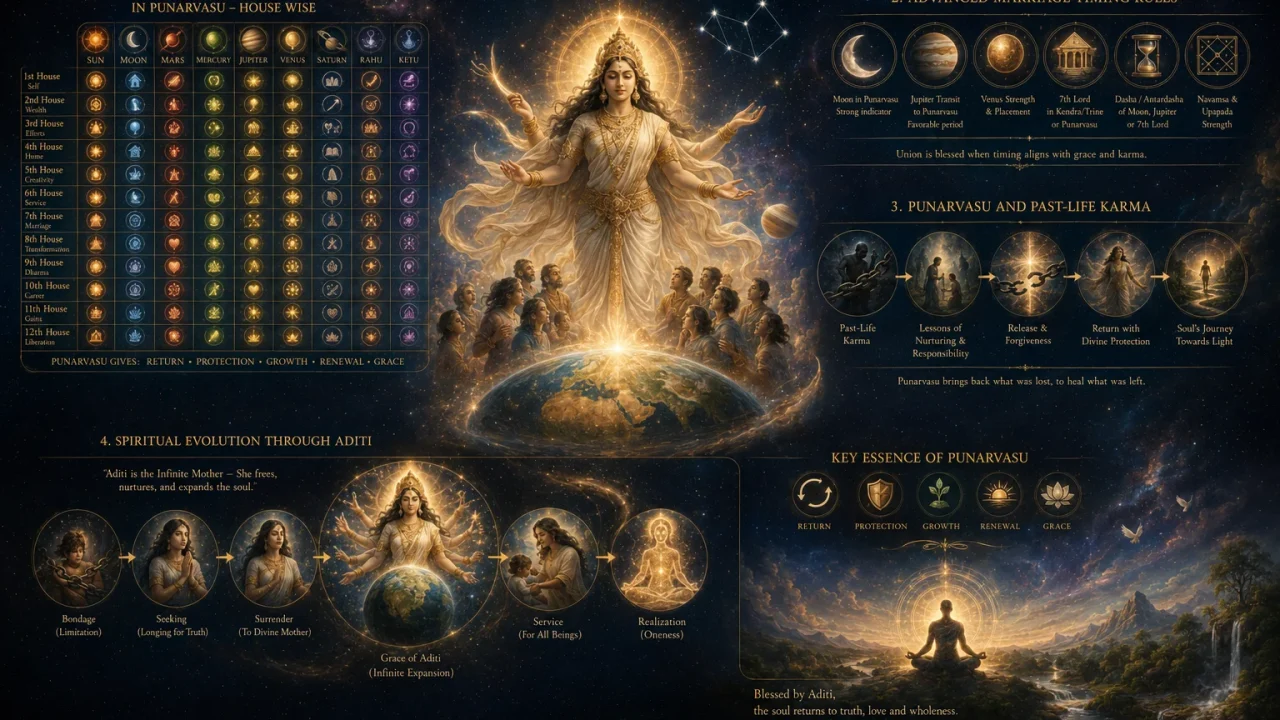
The Karmic Purpose of Punarvasu Nakshatra
The Soul’s Journey of Restoration
Every Nakshatra carries within it a unique karmic lesson. Some teach detachment, others responsibility, transformation, discipline, power, or surrender. The lesson given by Punarvasu Nakshatra appears simple on the surface, yet its implications are extraordinarily deep.
Punarvasu Nakshatra teaches restoration.
At first glance, restoration may seem like a passive process. It can sound as though life simply returns what was lost. But when observed through real human experience, restoration is one of the most transformative journeys the soul can undertake.
Many individuals strongly influenced by Punarvasu move through life with a subtle feeling that something is incomplete. The feeling is often difficult to describe. It may not always be conscious. Yet beneath many decisions, ambitions, relationships, and spiritual pursuits lies a quiet search for something that seems missing.
For one person, it may be emotional security.
For another, a sense of belonging.
For someone else, confidence, purpose, stability, faith, family connection, or inner peace.
The form differs from chart to chart, but the underlying movement remains the same. The individual is attempting to restore something that feels absent from their experience.
This is why the house occupied by Punarvasu planets becomes so important in predictive analysis. That house frequently reveals the area of life through which the restoration process unfolds. The native repeatedly encounters experiences connected to that domain, not because life wishes to create suffering, but because it wishes to create completion.
The mythology of Aditi illustrates this principle beautifully. Again and again, the stories associated with her revolve around the recovery of what was disrupted. Order is disturbed and later restored. Protection weakens and later returns. Harmony is lost and then re-established. The cycle repeats because restoration itself is the lesson.
When this symbolism appears in human life, it creates a distinctive pattern. The native may experience interruption where others experience continuity. Relationships may require rebuilding. Careers may require reinvention. Faith may disappear and later return with greater depth. Stability may be lost temporarily, only to be recovered in a stronger form.
From an ordinary perspective, these events can seem frustrating. The person may wonder why life repeatedly places them in situations that require reconstruction. Yet from a karmic perspective, these experiences are not obstacles to growth. They are the growth.
Punarvasu teaches that true strength is not found in never losing anything. It is found in learning how to rebuild when loss occurs. It teaches that wisdom is not merely acquired through success. It is often developed through recovery.
This is why many Punarvasu natives become remarkably resilient over time. They learn that endings are rarely as final as they first appear. They discover that disruption often carries hidden opportunities for renewal. What once felt like a setback gradually reveals itself as part of a larger cycle of development.
At a deeper spiritual level, the missing piece the soul seeks is often not external at all. The search for restored relationships, restored success, restored security, or restored happiness eventually leads toward something more fundamental: the restoration of connection with one’s own authentic nature.
The soul begins by seeking completion in the world.
Eventually, it discovers that the deepest restoration occurs within.
This is the karmic heartbeat of Punarvasu Nakshatra. Loss and return. Separation and reconnection. Forgetting and remembering. The cycle repeats until understanding emerges.
And through that process, the native gradually learns one of the most profound truths hidden within astrology: what appears broken is not always beyond repair, and what appears lost is not always gone forever. Sometimes life is simply preparing the conditions through which restoration can take place.
Punarvasu Nakshatra in the First House
The Journey of Self-Renewal and Personal Reinvention
When Punarvasu strongly influences the Ascendant or the First House, the principle of restoration becomes woven directly into the native’s identity. Life itself becomes a continuous process of renewal. Rather than following a fixed and predictable path, the individual often passes through several distinct versions of themselves during the course of life.
These are not merely external changes. The transformation frequently reaches the level of personality, worldview, priorities, and self-understanding. The person who exists at one stage of life may look remarkably different from the person who emerges years later.
Career identity often changes more than once. The native may begin life pursuing one direction, only to discover a different calling after significant experiences. Personal philosophies evolve through experience. Beliefs that once seemed unquestionable may be replaced by deeper understanding. Even social identity can undergo repeated reconstruction as the individual moves through different environments and stages of growth.
In many charts, physical appearance itself becomes part of this pattern. Weight changes, lifestyle changes, health improvements, shifts in personal presentation, or significant changes in how the person expresses themselves can occur at important turning points. The outer image frequently reflects the inner process of renewal taking place beneath the surface.
One of the most fascinating observations associated with this placement is the native’s ability to recover from situations that appear devastating to others. Friends, family members, and observers may assume that a particular setback will permanently alter the person’s life. Yet over time, the native rebuilds. Sometimes they emerge stronger, wiser, and more capable than before.
This quality creates a kind of psychological resilience that is difficult to measure through ordinary means. The individual may experience disappointment, failure, rejection, financial pressure, emotional loss, or major life transitions, but something within them refuses to remain broken for long. Recovery becomes part of their nature.
Because the First House represents the self, every major challenge often becomes an opportunity for personal reinvention. Rather than merely returning to who they were before, these individuals frequently emerge as a new version of themselves. The restoration process does not simply repair damage; it creates growth.
This is why many Punarvasu Ascendant natives describe their lives in chapters. Each chapter contains a different identity, different priorities, and different lessons. Looking back, they often realize that every major ending marked the beginning of a new stage of self-discovery.
Psychologically, this placement teaches an important truth. Identity is not something fixed. It is something that evolves. The native gradually learns not to become overly attached to any single version of themselves because life repeatedly demonstrates that growth requires change.
At a deeper spiritual level, the First House expression of Punarvasu reflects the restoration of the self. The individual may temporarily lose direction, confidence, purpose, or certainty, but these qualities tend to return after periods of reflection and growth. Every setback becomes an invitation to rediscover who they truly are.
The influence of Aditi is especially powerful here. Her restorative force does not primarily operate through external circumstances. It operates through the individual themselves. No matter how difficult the experience, some inner capacity for renewal continues functioning beneath the surface.
This is the unique gift of Punarvasu in the First House. Life becomes a series of rebirths rather than a single fixed story. The native learns that identity can be rebuilt, confidence can be restored, and purpose can be rediscovered.
Again and again, they demonstrate one of the deepest truths of this Nakshatra: the ability to begin anew is itself a form of strength. And through that repeated process of self-renewal, Aditi quietly restores the individual from within.
Punarvasu Nakshatra in the Second House
Family, Wealth, and the Power of Restorative Speech
The Second House governs family, lineage, accumulated wealth, values, speech, and the resources that provide stability throughout life. When Punarvasu influences this house, the principle of restoration often becomes visible through family connections, financial patterns, and the individual’s use of words.
One of the most common observations is the presence of family karmas involving distance and reconnection. The native may experience periods of separation from family traditions, ancestral values, or even family members themselves. At certain stages of life, they may feel disconnected from their roots or choose a path very different from the one expected by their family.
Yet the story rarely ends there.
Over time, many of these individuals find themselves reconnecting with aspects of their heritage that once seemed irrelevant or distant. Sometimes this occurs through family reconciliation. Sometimes it happens through a renewed appreciation for cultural traditions, ancestral wisdom, or values that were initially rejected. The theme of return, so central to Punarvasu, becomes clearly visible.
Financially, this placement often follows the familiar rhythm of loss and restoration. Wealth may not always accumulate in a straight line. There can be interruptions, setbacks, or periods of uncertainty that create valuable lessons about security and resource management. However, what is particularly striking is the native’s ability to recover financially after difficult phases.
Money may be lost, but opportunities to rebuild often emerge. Family assets may become unavailable and later return. Business income may fluctuate before stabilizing. The individual gradually learns that financial security is not merely about accumulation but also about the ability to restore stability after disruption.
The most fascinating expression of this placement, however, often appears through speech.
Since the Second House governs the voice and the power of communication, Punarvasu brings a restorative quality to the individual’s words. Their speech frequently encourages, reassures, and rebuilds. They possess a natural ability to help others regain confidence after disappointment or confusion.
Many teachers, counselors, astrologers, mentors, motivational speakers, coaches, and healers display this influence in their charts. What makes them effective is not simply knowledge. It is the healing quality of their communication. People often leave conversations with them feeling lighter, more hopeful, or more capable than before.
This ability usually develops through personal experience. The native often learns the power of encouraging words because they have experienced both discouragement and recovery in their own life. Their communication carries authenticity because it is rooted in lived understanding rather than theory alone.
At a deeper level, Punarvasu in the Second House teaches that wealth is not limited to money. Words, values, wisdom, and emotional support are also forms of wealth. The individual gradually discovers that what they say can become a resource that helps others rebuild their lives.
The influence of Aditi expresses itself here through nourishment and preservation. Just as a mother nurtures growth through care and encouragement, these individuals often nurture others through speech, guidance, and emotional reassurance. Their words become instruments of restoration.
This is the deeper gift of Punarvasu in the Second House. Family bonds may heal, financial stability may return, and lost values may be rediscovered. But perhaps the greatest blessing is the ability to use speech as a force for renewal, helping others remember their strength when they have temporarily forgotten it themselves.
Punarvasu Nakshatra in the Third House
The Path of Repeated Effort and Eventual Mastery
The Third House governs courage, effort, communication, writing, skills, learning through practice, and the willingness to keep moving forward despite obstacles. When Punarvasu influences this house, the principle of restoration expresses itself through repeated attempts, continuous refinement, and the gradual development of mastery.
One of the most noticeable patterns associated with this placement is that success rarely arrives on the first attempt. The native often finds themselves revisiting the same goal multiple times before achieving the desired result. What others accomplish quickly may require several rounds of effort, adjustment, and improvement.
At first, this can feel frustrating. The individual may wonder why life seems to demand repetition. Yet over time, a deeper pattern becomes visible. Every repetition adds skill. Every setback reveals a weakness that can be strengthened. Every restart increases experience.
This placement is frequently seen in the charts of writers, teachers, entrepreneurs, artists, researchers, speakers, and individuals whose success depends upon continuous improvement. An author may rewrite the same manuscript multiple times before producing their best work. A business owner may launch several ventures before finding the right model. A student may repeat an examination or change educational direction before discovering their true strengths.
The same principle appears in creative pursuits. Artists often refine their craft through years of experimentation. Musicians practice the same techniques repeatedly. Speakers gradually develop confidence through repeated public appearances. The path is rarely direct, but the final result is often far more polished because of the process.
Communication itself carries the influence of restoration. The native frequently develops the ability to encourage others through words, ideas, and practical guidance. Having experienced multiple attempts in their own life, they understand that growth is rarely immediate. This makes them effective teachers and motivators because they speak from experience rather than theory.
Relationships with siblings can also reflect the Punarvasu theme. Periods of distance may be followed by reconnection. Misunderstandings may eventually be resolved. Family bonds often pass through cycles of separation and restoration before reaching stability.
Psychologically, this placement teaches one of the most valuable lessons in life: persistence. The individual gradually learns that failure is not always a sign to stop. Sometimes it is simply part of the process of becoming better. What appears to be delay is often preparation.
The influence of Aditi becomes visible through the repeated opportunity to try again. Life rarely closes the door permanently. Instead, it presents another chance, another attempt, another version of the lesson. The native discovers that progress is not measured by how quickly success arrives, but by the willingness to continue despite setbacks.
At its highest expression, Punarvasu in the Third House produces individuals who become masters of their craft through repetition. Their expertise is not based on natural talent alone. It is built through persistence, resilience, and the courage to begin again whenever necessary.
This is the deeper gift of the placement. The native learns that mastery is rarely created by immediate success. It is created through repeated effort, continuous refinement, and the wisdom gained from every attempt along the way. Through that process, Aditi quietly transforms persistence into excellence.
Punarvasu Nakshatra in the Fourth House
Home, Belonging, and the Search for Inner Security
The Fourth House is naturally connected with home, family, emotional foundations, property, ancestry, and the sense of belonging that supports a person’s inner life. Since one of the primary symbols of Punarvasu is the house itself, this placement creates a particularly powerful expression of the Nakshatra’s restorative nature.
When Punarvasu influences the Fourth House, matters related to home and emotional security become major themes throughout life. The native’s relationship with home is rarely simple or static. Instead, it often unfolds through cycles of movement, separation, return, and renewal.
One of the most common observations is repeated relocation. The individual may live in different cities, states, or even countries before eventually finding a place that feels truly aligned with their emotional needs. Some spend years away from their birthplace only to discover that life later guides them back toward familiar roots.
Property matters frequently reflect the same pattern. There may be delays in purchasing a home, interruptions in construction projects, disputes involving land, or uncertainty regarding family property. Yet in many cases, what is delayed is not denied. The native often achieves success after a period of waiting, adjustment, or repeated effort.
Family relationships also tend to follow the rhythm of Punarvasu. Emotional distance may develop at certain stages of life. Misunderstandings, separation, or differing life paths can create temporary disconnection. However, many of these relationships eventually move toward healing and reconciliation. Time often brings greater understanding, allowing family bonds to be restored.
A fascinating pattern seen in many charts is a later-life reconnection with ancestry. The person may become interested in family history, ancestral property, cultural traditions, or values that once seemed unimportant. What was ignored in youth frequently gains significance with maturity. The native begins recognizing the importance of roots and continuity.
Psychologically, this placement often creates a lifelong search for security. During the early stages of life, the individual may attempt to find stability through external conditions such as property, family approval, financial comfort, or a particular living environment. While these things are important, life gradually teaches that no external structure can provide complete security by itself.
This is where the deeper lesson of Punarvasu begins to emerge.
The native discovers that true security does not come solely from owning a home, preserving traditions, or creating ideal circumstances. Those things can support well-being, but lasting peace arises from an inner sense of stability. The individual learns to carry a feeling of home within themselves rather than depending entirely on external conditions.
The influence of Aditi is especially visible here. Her restorative energy works through family healing, property restoration, emotional recovery, and the rebuilding of inner foundations. Whenever life creates instability, circumstances often arise that help the native reconnect with what truly matters.
At its highest expression, Punarvasu in the Fourth House produces individuals who understand the deeper meaning of home. They learn that belonging is not merely a place on a map. It is a state of inner alignment. Through repeated experiences of separation and return, they discover that the most important home is the one that exists within the heart.
This is the unique gift of Punarvasu in the Fourth House. It teaches that homes may change, relationships may evolve, and life may require many relocations. Yet beneath all these movements lies a deeper process: the gradual restoration of emotional wholeness and the discovery of an inner security that cannot be taken away.
Punarvasu Nakshatra in the Fifth House
Creativity, Intelligence, and the Return of Forgotten Gifts
The Fifth House governs intelligence, creativity, education, children, self-expression, speculation, and the storehouse of past-life merit. When Punarvasu influences this house, the principle of restoration often manifests through learning, creative development, and the rediscovery of talents that were temporarily forgotten or neglected.
One of the most common patterns associated with this placement is interruption followed by continuation. Educational journeys may not always proceed in a straight line. The native may pause studies due to circumstances, change academic direction, or lose interest for a period of time. Yet what is left unfinished often returns later. The person eventually resumes learning with greater maturity and purpose than before.
Creative pursuits frequently follow a similar rhythm. Writers may abandon projects and later return to complete them. Artists may step away from their craft for years before rediscovering their passion. Musicians, performers, and creators often experience periods of inactivity followed by renewed inspiration. What appears dormant is rarely lost permanently.
This reflects one of the deeper themes of Punarvasu. The Nakshatra does not merely create new opportunities. It revives possibilities that already existed but were temporarily forgotten. Talents that seemed inactive often re-emerge at the exact stage of life when they are most needed.
Children can also become an important area of karmic development. In some charts, there may be delays connected with childbirth or the expansion of the family. However, delays should not automatically be interpreted negatively. Punarvasu often indicates eventual fulfillment after patience, preparation, or changes in circumstances. The larger chart must always be examined before drawing specific conclusions, but the theme of delayed restoration appears frequently.
Another fascinating observation is the tendency for these individuals to reconnect with abilities from earlier phases of life. A person may rediscover a childhood talent, an abandoned hobby, a forgotten academic interest, or a creative skill that had remained unused for years. What once seemed irrelevant suddenly becomes meaningful again.
Psychologically, this placement often teaches faith in one’s own creative process. The native learns that inspiration moves in cycles. There may be periods of expression and periods of silence. Periods of confidence and periods of self-doubt. Yet beneath these fluctuations, the creative impulse remains alive.
The Fifth House is also associated with intelligence and the ability to understand life through insight rather than mere information. Punarvasu adds a reflective quality to this process. The native frequently gains wisdom by revisiting experiences, reviewing old lessons, and discovering deeper meanings in situations that were previously misunderstood.
The influence of Aditi becomes especially beautiful here. Her restorative energy does not merely return external opportunities. It awakens dormant potential. She reminds the native that gifts can be forgotten but not destroyed. Skills can become inactive but not disappear. Creativity can rest without dying.
At its highest expression, Punarvasu in the Fifth House produces individuals who repeatedly rediscover themselves through learning, creativity, and self-expression. Their greatest talents often emerge after periods of interruption rather than continuous development. What others view as delay often becomes preparation.
This is the deeper blessing of the placement. The native learns that true gifts are never completely lost. They may disappear from awareness for a time, but when the moment is right, they return with renewed strength and purpose.
In this way, Aditi restores not only opportunities and relationships, but also the forgotten treasures hidden within the individual themselves.
Punarvasu Nakshatra in the Sixth House
Healing Through Struggle and the Wisdom of Overcoming Challenges
The Sixth House governs illness, obstacles, competition, debts, daily responsibilities, service, and the challenges that test an individual’s resilience. At first glance, it may appear to be a difficult house. Yet when Punarvasu influences this area of life, its restorative nature transforms many challenges into opportunities for growth, healing, and self-development.
One of the most noticeable themes associated with this placement is the ability to recover from difficulties. The native is rarely spared from life’s challenges, but they often possess an unusual capacity to overcome them. Obstacles that seem overwhelming at one stage eventually become sources of experience, confidence, and wisdom.
Health is frequently an important area of learning. Periodic health concerns may arise, sometimes following the characteristic Punarvasu pattern of improvement, recurrence, and eventual recovery. The individual often becomes highly aware of the relationship between lifestyle, discipline, and well-being. Through personal experience, they learn lessons about healing that can later benefit others.
This is one reason why many individuals involved in healing professions display strong Sixth House Punarvasu influence. Doctors, therapists, counselors, nurses, alternative healers, wellness practitioners, and service-oriented professionals often develop their expertise through direct encounters with struggle, recovery, and human suffering. Their understanding is not merely theoretical. It is rooted in lived experience.
The Sixth House is also connected with service, and Punarvasu adds a nurturing quality to that service. These individuals often find fulfillment in helping others overcome difficulties. Whether through healthcare, counseling, education, social work, coaching, or community support, they are naturally drawn toward roles that contribute to restoration and improvement.
Competition follows a similar pattern. Success rarely comes through effortless victory. Instead, the native often develops strength through repeated challenges. They learn how to improve, adapt, and persevere when circumstances become demanding. Every obstacle becomes a teacher, and every setback contributes to greater competence.
Financial obligations, workplace responsibilities, and daily struggles may also become important areas of growth. The person gradually learns that consistency often produces better results than dramatic action. Small improvements repeated over time create lasting change. This practical wisdom becomes one of the placement’s greatest strengths.
Psychologically, Punarvasu in the Sixth House teaches an important truth: difficulties are not always enemies. Some challenges appear in life to develop qualities that could not emerge under comfortable circumstances. Patience, discipline, compassion, resilience, and humility are often strengthened through adversity.
The influence of Aditi becomes visible in the recovery process. Whenever life creates imbalance, opportunities for healing tend to emerge. The native may face illness, conflict, pressure, or responsibility, but the story frequently moves toward restoration rather than defeat. Challenges become pathways rather than barriers.
At its highest expression, this placement produces individuals who transform personal struggles into service for others. Because they have faced obstacles themselves, they understand how to guide people through difficult periods. Their strength comes not from avoiding hardship, but from learning how to work through it.
This is the deeper gift of Punarvasu in the Sixth House. The native discovers that healing is not merely the absence of difficulty. It is the ability to grow through difficulty and emerge wiser on the other side. Through repeated experiences of challenge and recovery, they learn one of Punarvasu’s most enduring lessons: what is tested can become stronger, and what is wounded can become a source of healing for others.
Punarvasu Nakshatra in the Seventh House
Relationships as a Path of Healing and Renewal
The Seventh House governs marriage, partnerships, long-term relationships, agreements, and the way we connect with significant people in our lives. When Punarvasu influences this house, relationships often become one of the primary vehicles through which the soul learns the lessons of restoration, forgiveness, and emotional growth.
One of the most noticeable patterns associated with this placement is that relationships rarely remain superficial. Important partnerships tend to carry deeper karmic significance and often become catalysts for personal transformation. Through these relationships, the native learns about trust, commitment, patience, and the possibility of rebuilding what has been damaged.
Temporary separations are not uncommon. Relationships may pass through phases of distance, misunderstanding, emotional withdrawal, or even physical separation. At certain points, it may appear that the connection has reached its conclusion. Yet when Punarvasu is strongly involved, the story is often more complex than it initially appears.
A recurring observation in many charts is the theme of reconnection. Broken relationships sometimes find their way back into the native’s life. Couples who experience significant challenges may eventually discover a deeper level of understanding. In some cases, a relationship that survives a difficult period becomes stronger than it was before the crisis occurred.
This reflects the essential nature of Aditi. Her energy is not concerned with maintaining perfection. Instead, it focuses on restoration. The relationship may be tested, but the possibility of healing remains alive. What appears broken may not be permanently broken. What seems lost may still contain the potential for renewal.
Marriage often follows a similar pattern. The native may encounter periods where the relationship requires conscious effort, communication, and emotional maturity. Difficulties are not necessarily signs of failure. Frequently, they become opportunities for both partners to grow. Through these experiences, the relationship evolves beyond its original form and develops greater depth and resilience.
The spouse frequently plays an important role in emotional healing. In many cases, the partner becomes a stabilizing influence during periods of uncertainty. They help the native recover from disappointments, regain confidence after setbacks, or navigate difficult phases of life. The relationship itself becomes a space where restoration takes place.
Psychologically, this placement teaches that love is not merely about attraction or compatibility. It is also about the ability to repair, forgive, and continue growing together. The native gradually learns that meaningful relationships are not defined by the absence of problems, but by the willingness to work through them consciously.
However, an important caution must always be remembered. Punarvasu increases the possibility of reconciliation, but it does not guarantee it. Astrologers should be careful not to make simplistic predictions based solely on the Nakshatra. Afflictions to the Seventh House, Venus, the Seventh Lord, Darakaraka, Navamsha influences, and dasha activations must all be evaluated before drawing conclusions.
A relationship may be restored, transformed, or completed depending upon the larger karmic structure of the chart. Punarvasu simply increases the likelihood that life will offer opportunities for healing where other placements might indicate permanent closure.
At its highest expression, Punarvasu in the Seventh House teaches that relationships can become instruments of evolution. Through love, separation, forgiveness, and reunion, the individual learns one of the deepest truths of this Nakshatra: genuine connection is not about never being broken. It is about discovering the wisdom, compassion, and maturity required to rebuild when life demands it.
In this way, Aditi restores not only relationships, but also the hearts of the people within them.
Punarvasu Nakshatra in the Eighth House
Transformation, Rebirth, and the Wisdom Hidden Within Crisis
The Eighth House is one of the most mysterious and transformative areas of the horoscope. It governs hidden karma, psychological transformation, inheritance, secrets, research, crisis, loss, rebirth, and the profound changes that reshape the course of life. When Punarvasu influences this house, the principle of restoration expresses itself through some of life’s deepest and most powerful experiences.
This is one of the most profound placements for understanding the mythology of Aditi. Here, restoration does not occur through simple recovery. It occurs through transformation. The native often experiences situations that completely alter their understanding of themselves, other people, and life itself.
A recurring pattern associated with this placement is the ability to emerge stronger after major crises. Difficult experiences may arrive unexpectedly and create periods of uncertainty, emotional intensity, or deep introspection. At the time, these events can feel overwhelming. Yet when viewed from a broader perspective, each crisis becomes a turning point that leads to greater maturity and self-understanding.
The individual frequently discovers that some of the most important growth in life occurs after periods of disruption. What initially appears to be an ending often becomes the beginning of a new phase. Old identities dissolve. Outdated beliefs collapse. Attachments lose their grip. In their place, a more authentic understanding gradually emerges.
This is why life under this placement often contains several significant transformations rather than a single continuous path. The native may experience dramatic changes in relationships, finances, career direction, spiritual beliefs, or personal identity. Each chapter leaves them fundamentally different from who they were before.
The Eighth House is also connected with hidden knowledge, and Punarvasu gives a natural curiosity about subjects that explore the deeper layers of existence. Many astrologers, occult researchers, spiritual practitioners, psychologists, investigators, healers, and students of esoteric traditions display strong Eighth House Punarvasu influence. They are drawn toward understanding what lies beneath the surface because life itself has repeatedly shown them that appearances rarely tell the whole story.
Inheritance and shared resources may also follow the Nakshatra’s characteristic pattern of interruption and restoration. Delays, complications, or unexpected developments can occur, yet opportunities often emerge later when circumstances change. The principle of return frequently operates in subtle ways through Eighth House matters.
Psychologically, this placement creates a profound relationship with change. The native gradually learns that resisting transformation only prolongs suffering. Over time, they begin recognizing that certain endings are necessary for growth. What once felt like loss is eventually understood as preparation for renewal.
The influence of Aditi is especially meaningful here. Her restorative energy does not prevent transformation. Instead, it guides the individual through it. The old must sometimes break apart before something healthier can emerge. The process may be uncomfortable, but it is rarely meaningless.
At its highest expression, Punarvasu in the Eighth House produces individuals who become wiser through every major challenge they face. They understand that life’s most important lessons are often hidden within periods of uncertainty. Because they have repeatedly experienced breakdown followed by renewal, they develop a deep trust in the transformative process itself.
This is the deeper gift of the placement. The soul learns that destruction and renewal are not opposites. They are stages of the same journey. What appears to be an ending may simply be the beginning of a more authentic life.
Through repeated cycles of crisis, transformation, and recovery, the native discovers one of Punarvasu’s greatest truths: renewal often begins where certainty ends, and every rebirth carries within it the possibility of greater wisdom.
Punarvasu Nakshatra in the Ninth House
The Return to Wisdom, Faith, and Spiritual Guidance
The Ninth House governs higher wisdom, dharma, spiritual knowledge, philosophy, teachers, mentors, blessings, long-distance journeys, and the search for deeper meaning in life. When Punarvasu influences this house, the principle of restoration operates through the realm of wisdom and spiritual understanding. The native’s journey often becomes one of returning to truths that feel strangely familiar, as though the soul is remembering something it once knew.
One of the most remarkable patterns associated with this placement is a natural attraction toward ancient teachings, timeless philosophies, and spiritual traditions. The individual may explore many paths during life, yet they often feel drawn toward knowledge that carries a sense of permanence and depth. Rather than constantly seeking something entirely new, they frequently rediscover wisdom that resonates at a profound inner level.
Many astrologers have observed that individuals with strong Punarvasu influence in the Ninth House often reconnect with spiritual practices that seem to arise effortlessly. Meditation, prayer, scriptural study, contemplative practices, or other forms of spiritual discipline may feel surprisingly natural. The person may encounter a teaching and experience an immediate sense of recognition, as though they are remembering rather than learning.
The role of teachers becomes especially significant. Throughout life, important mentors often appear at critical moments. Just when confusion reaches its peak, guidance arrives. A teacher, spiritual guide, book, philosophy, or meaningful encounter provides exactly the perspective needed to move forward. These experiences frequently become turning points in the native’s development.
This pattern reflects the nurturing quality of Aditi. Her influence often manifests through protection in the form of wisdom. Instead of removing every challenge, life provides guidance that helps the individual understand the challenge more deeply. The teacher arrives when the student is ready, and the lesson appears when it is needed most.
Faith itself tends to evolve through experience rather than blind belief. The native may pass through periods of doubt, questioning, or spiritual uncertainty. Yet personal challenges often strengthen rather than weaken their connection with deeper truths. Difficult experiences become catalysts for reflection, leading to a more mature and authentic form of faith.
A recurring observation is that many of these individuals discover their strongest spiritual convictions after periods of adversity. When external certainty disappears, they begin searching for something more enduring. Through this process, wisdom becomes lived experience rather than intellectual theory.
The Ninth House is also connected with destiny and the larger purpose behind life’s events. Punarvasu brings a unique perspective to this area. The native gradually learns that not every delay is a mistake and not every setback is a failure. Certain experiences occur because they are preparing the individual for a deeper level of understanding.
Over time, this creates trust in divine timing. The person begins recognizing that life unfolds according to rhythms that cannot always be understood immediately. Opportunities arrive when they are meant to arrive. Teachers appear when the lesson is ready to be received. Spiritual growth often accelerates after periods that initially seemed difficult or confusing.
At its highest expression, Punarvasu in the Ninth House produces individuals who become seekers of wisdom rather than seekers of certainty. They learn that faith is not the absence of questions but the willingness to continue the journey despite unanswered questions. Their spirituality becomes grounded in experience, reflection, and personal transformation.
This is the deeper gift of the placement. The soul remembers its connection with higher wisdom and gradually finds its way back to it. Through teachers, teachings, challenges, and moments of insight, the individual discovers that true knowledge is never completely lost. It may be forgotten for a time, but when the moment is right, it returns.
In this way, Aditi restores not only opportunities and circumstances, but also the soul’s relationship with wisdom itself. And through that restoration, the native learns one of the most beautiful lessons of Punarvasu: what is meant for spiritual growth always finds its way back into one’s life.
Punarvasu Nakshatra in the Tenth House
Career Reinvention and the Search for True Professional Purpose
The Tenth House governs career, profession, reputation, public image, authority, achievements, and the contribution an individual makes to society. When Punarvasu influences this house, the principle of restoration becomes deeply connected with professional life. The native’s career journey is rarely a straight line. Instead, it often unfolds through cycles of experimentation, disruption, learning, and eventual realignment.
One of the most common observations associated with this placement is professional reinvention. The individual may begin their career with one set of ambitions, only to discover later that a different direction is more meaningful. Career changes, shifts in professional identity, and unexpected redirections frequently become important milestones in their development.
At certain stages, setbacks may appear significant. A business may fail, a position may be lost, recognition may be delayed, or a carefully planned path may suddenly become unavailable. Yet what makes this placement unique is that such events rarely represent the end of the story. More often, they become turning points that push the native toward a more suitable and authentic professional role.
This is why many individuals with strong Punarvasu influence in the Tenth House look back and realize that their greatest successes emerged from experiences that initially felt like failures. What seemed like a setback was actually a correction. What appeared to be a loss was often a redirection toward a better path.
The native frequently learns through experience rather than immediate achievement. Each professional challenge adds wisdom. Every career transition provides clarity. Over time, the individual develops a deeper understanding of what truly aligns with their abilities, values, and purpose.
This placement is commonly found among consultants, educators, researchers, advisors, counselors, coaches, and professionals whose work involves helping others solve problems or navigate change. Such careers naturally reflect the restorative nature of Punarvasu. The native often succeeds by helping people rebuild, learn, improve, or find direction.
A fascinating pattern is that professional authority tends to grow with experience. Recognition may not always come early, but it often becomes more meaningful because it is built upon real understanding rather than temporary success. The native’s expertise is usually refined through repeated exposure to challenges and practical situations.
Psychologically, Punarvasu in the Tenth House teaches an important lesson about ambition. Early in life, the individual may pursue success according to external standards such as status, recognition, or financial achievement. As experience accumulates, they begin seeking something deeper. The question gradually changes from “How can I succeed?” to “What work truly reflects who I am?”
This shift often marks a major turning point in the career journey. Once professional purpose becomes aligned with inner values, progress tends to become more stable and fulfilling.
The influence of Aditi is especially visible in this process. Her restorative energy repeatedly redirects the native whenever they move too far from their authentic path. Careers may change, goals may evolve, and professional identities may be rebuilt, but each transition serves a larger purpose. The aim is not merely success. The aim is alignment.
At its highest expression, Punarvasu in the Tenth House produces individuals who discover their true vocation through experience rather than certainty. They become wiser with every professional chapter and more effective with every challenge they overcome.
This is the deeper gift of the placement. The native learns that career is not simply a means of earning a living. It is a journey of growth, correction, and self-discovery. Through repeated cycles of effort, setback, and renewal, Aditi gradually restores professional purpose until the individual finds the work they were truly meant to do.
Punarvasu Nakshatra in the Eleventh House
The Return of Opportunities, Friendships, and Long-Term Success
The Eleventh House governs gains, income from profession, friendships, social networks, ambitions, achievements, and the fulfillment of long-term desires. When Punarvasu influences this house, the principle of restoration becomes especially visible through opportunities, relationships, and goals that seem lost but later return in unexpected ways.
One of the most noticeable patterns associated with this placement is the recovery of gains. Financial opportunities that appear delayed often re-emerge at a later stage. Income may fluctuate at certain periods, but complete and permanent loss is less common than temporary interruption. The native frequently discovers that what seemed unavailable was merely postponed.
This creates a unique relationship with success. Progress may not always arrive according to the expected timeline. Goals may take longer to achieve than initially planned. Yet over time, opportunities tend to return, often in a more favorable form than before. The individual gradually learns that delay and denial are not always the same thing.
Friendships and social connections often follow a similar pattern. Important people may move out of the native’s life for a period of time and later reappear. Former colleagues, friends, mentors, or associates sometimes reconnect after years of separation. These renewed connections frequently become valuable because both individuals have matured through their separate experiences.
The Eleventh House is also the house of networks, and Punarvasu gives a remarkable ability to benefit from long-term relationships. The native often discovers that opportunities arrive through people they have known for years rather than through completely new contacts. Relationships built patiently tend to produce significant rewards over time.
Another fascinating observation is the tendency for ambitions to survive setbacks. Many people abandon their goals after encountering obstacles. Individuals with strong Punarvasu influence in the Eleventh House often do the opposite. They may pause, reconsider, or adjust their approach, but they rarely abandon their aspirations completely. The dream remains alive beneath the surface.
Because of this, objectives that initially appear unrealistic often become achievable later in life. The person may require several attempts, additional experience, or unexpected detours before success arrives. Yet persistence gradually transforms possibility into reality.
Psychologically, this placement teaches patience. The native learns that meaningful achievements often unfold over longer periods than expected. Immediate results become less important than sustained effort. Through repeated experiences, they begin trusting that progress is occurring even when visible rewards are temporarily absent.
Faith also becomes an important lesson. Not blind optimism, but a deeper confidence that worthwhile goals deserve time to develop. The individual learns to continue moving forward even when circumstances seem uncertain. This faith frequently becomes one of their greatest strengths.
The influence of Aditi is clearly visible here. Her restorative energy operates through opportunities that return, friendships that reconnect, and ambitions that refuse to die. What appears lost is often simply waiting for the right conditions to re-emerge. The native repeatedly experiences life bringing back possibilities that once seemed gone forever.
At its highest expression, Punarvasu in the Eleventh House produces individuals who understand the value of perseverance. They learn that success is not always about speed. Sometimes it is about remaining committed long enough for life to complete its cycle.
This is the deeper gift of the placement. Gains may be delayed, friendships may pass through periods of distance, and ambitions may face repeated challenges. Yet through patience, persistence, and faith, the native discovers that many of life’s most important rewards arrive not when they are expected, but when they are ready to be received.
Punarvasu Nakshatra in the Twelfth House
The Restoration of the Soul and the Return to the Divine
The Twelfth House represents spirituality, liberation, solitude, meditation, surrender, inner healing, sacred wisdom, and the dimensions of life that exist beyond ordinary worldly concerns. When Punarvasu influences this house, its restorative nature reaches its highest and most subtle expression. Here, the focus is no longer on restoring wealth, relationships, status, or opportunities. The restoration occurs within consciousness itself.
This placement often creates a natural attraction toward spiritual exploration. The individual may feel drawn toward meditation, contemplative practices, sacred texts, spiritual retreats, pilgrimage, silence, or environments that encourage introspection. Even if worldly responsibilities occupy much of their life, there is usually a deeper longing to understand the nature of existence and the purpose behind human experience.
One of the most fascinating observations associated with this placement is the spontaneous reactivation of spiritual interests. Certain teachings, practices, or philosophies may feel immediately familiar. The native may encounter a spiritual path and experience an unusual sense of recognition, as though they are reconnecting with something already known rather than learning something entirely new.
This is why many astrologers associate Punarvasu in the Twelfth House with the return of unfinished spiritual karma. Practices that may have been cultivated deeply in previous stages of the soul’s journey often reappear naturally. The person may find themselves drawn toward meditation, prayer, service, spiritual study, or inner disciplines without any obvious external reason.
Periods of isolation frequently play an important role in their development. At certain points, life may create circumstances that encourage withdrawal from external distractions. These phases are not always easy. The individual may initially experience loneliness, uncertainty, or a feeling of being disconnected from the outer world. Yet with time, these very periods often become the source of profound insight and transformation.
A recurring pattern is that major spiritual awakenings occur after phases of solitude. When external noise decreases, the individual begins hearing a deeper voice within. Questions that remained unanswered for years suddenly become clearer. Priorities shift. The search for meaning becomes more important than the pursuit of external validation.
The Twelfth House is also associated with healing at the deepest level. Punarvasu adds a remarkable capacity for inner recovery. Emotional wounds, spiritual confusion, and periods of existential uncertainty gradually give way to greater understanding. The native often discovers that healing is not simply about removing pain. It is about transforming pain into wisdom.
Psychologically, this placement teaches surrender. The individual learns that not everything can be controlled, predicted, or managed through effort alone. Some lessons require trust. Some transformations require letting go. Through repeated experiences, they begin understanding that true peace arises not from controlling life, but from aligning with it.
The influence of Aditi is especially powerful here. Her restorative force operates beyond material circumstances. She restores the connection between the individual and their deeper nature. Whenever the soul becomes lost in confusion, distraction, or excessive attachment to the outer world, life gently creates circumstances that encourage return.
This is the highest expression of Punarvasu. The restoration is no longer about recovering something external. It is about remembering what was never truly lost.
At its deepest level, Punarvasu in the Twelfth House teaches that the soul’s journey is ultimately a journey of return. Return to wisdom. Return to peace. Return to truth. Return to the divine presence that exists beneath all changing experiences.
This is why many individuals with this placement experience profound moments of awakening after periods of struggle or isolation. What appeared to be separation becomes reconnection. What seemed like emptiness becomes inner fullness. What felt like wandering becomes homecoming.
In this way, Aditi fulfills her highest role. She does not merely restore circumstances. She restores consciousness itself, guiding the individual back toward the source from which all healing, wisdom, and renewal ultimately arise.
Advanced Predictive Rule
The Planet Returns What It Naturally Signifies
One of the most valuable predictive observations associated with Punarvasu is surprisingly simple, yet its practical application can significantly improve chart interpretation. Over years of chart analysis, a recurring pattern becomes visible: the planet occupying Punarvasu often becomes the vehicle through which restoration occurs.
In other words, the native may temporarily lose, weaken, disconnect from, or struggle with the matters represented by that planet. Yet during the appropriate dasha, transit, or activation period, those same significations frequently return in a renewed form.
This principle does not suggest that life becomes free of challenges. Rather, it indicates that the story connected with the planet often includes interruption followed by recovery, loss followed by restoration, or decline followed by rebuilding.
The astrologer’s task is therefore not only to identify what the planet signifies, but also to understand how those significations may reappear after periods of absence or difficulty.
Sun in Punarvasu Nakshatra
When the Sun occupies Punarvasu, the themes of identity, confidence, authority, recognition, and paternal influences often follow the restoration principle. The native may pass through periods where self-confidence weakens or professional recognition declines. Relationships with father figures may experience distance or misunderstanding. Yet life frequently creates opportunities for these areas to heal and strengthen over time.
The person often emerges from difficult phases with a more mature sense of self. Confidence is not merely regained; it is rebuilt on a stronger foundation. Authority, respect, and personal influence tend to return after periods of challenge.
Moon in Punarvasu Nakshatra
The Moon naturally governs emotions, family life, inner security, and psychological well-being. When placed in Punarvasu, emotional balance often follows cycles of disruption and recovery. Family relationships may pass through difficult periods before healing occurs.
The native develops an extraordinary ability to recover emotionally. Even after disappointment, loss, or emotional turbulence, hope gradually returns. Family harmony that appears damaged often finds pathways toward restoration.
Mars in Punarvasu Nakshatra
Mars represents courage, initiative, determination, and the ability to take action. Its placement in Punarvasu frequently creates situations where motivation is temporarily blocked or ambitions encounter setbacks.
Yet the defining feature of this placement is recovery. The native repeatedly rediscovers the strength to move forward. Lost momentum returns. Courage reawakens. What seemed like defeat often becomes preparation for a stronger and more focused effort.
Mercury in Punarvasu Nakshatra
Mercury governs learning, communication, education, analysis, and intellectual development. Individuals with this placement often experience interruptions in study, changes in educational direction, or periods where communication becomes challenging.
Over time, however, knowledge returns as a central theme. Learning resumes. Communication improves. Intellectual confidence grows. Many such individuals eventually become effective teachers, writers, researchers, or communicators precisely because they have personally experienced the process of intellectual rebuilding.
Jupiter in Punarvasu Nakshatra
Jupiter functions exceptionally well in this Nakshatra because both share themes of growth, wisdom, and expansion. When challenges arise, the restoration often involves faith, prosperity, guidance, and higher understanding.
Periods of confusion are followed by clarity. Financial setbacks may be followed by renewed opportunities. Teachers and mentors often appear at critical moments. The native repeatedly discovers that wisdom and support arrive when they are most needed.
Venus in Punarvasu Nakshatra
Venus governs relationships, affection, harmony, beauty, and emotional fulfillment. Its placement in Punarvasu often creates cycles involving connection, separation, and reconciliation.
Relationships that appear lost sometimes return in a transformed form. Emotional happiness is rebuilt after disappointment. The individual learns that love is not merely about attraction but also about healing, forgiveness, and renewal.
Saturn in Punarvasu Nakshatra
Saturn modifies the restorative process by introducing time, patience, and endurance. Stability may be delayed, but it is rarely denied. The native often experiences prolonged periods of effort before results become visible.
Yet once restoration occurs, it tends to be durable. Financial security, professional standing, and personal stability are rebuilt slowly and carefully. Saturn teaches that what is restored through perseverance often lasts longer than what is gained quickly.
Rahu in Punarvasu Nakshatra
Rahu creates a strong desire to reclaim something that feels lost. This may involve status, success, recognition, relationships, or personal ambitions. The native often experiences repeated cycles of pursuit, setback, and renewed effort.
Remarkably, opportunities frequently return through unexpected or unconventional channels. What appears impossible through traditional means may become possible through innovation, risk-taking, or an entirely new approach.
Ketu in Punarvasu Nakshatra
Ketu directs the restorative principle toward inner life and spiritual growth. The native often possesses a natural connection with wisdom that seems older than their formal education or life experience.
Periods of withdrawal, solitude, or detachment frequently lead to deeper insight. Spiritual awareness returns naturally. Forgotten inner strengths re-emerge. The person often discovers that peace is not something acquired from the outside but remembered from within.
The Deeper Predictive Application
The real power of this rule emerges when the planet’s dasha, antardasha, or major transit activation occurs. During those periods, the astrologer should carefully examine whether the native is being given another opportunity in the areas represented by that planet.
A lost relationship may return under Venus.
A career revival may occur under the Sun.
Educational opportunities may reappear under Mercury.
Faith may be restored under Jupiter.
Emotional healing may unfold under the Moon.
The exact outcome depends upon the overall chart, but the underlying principle remains remarkably consistent.
Punarvasu rarely erases a story completely. More often, it pauses the story, reshapes it, and eventually reintroduces it in a form that allows deeper growth and understanding.
This is why the rule is so valuable in predictive work. The planet in Punarvasu does not merely indicate what the native experiences. It often reveals what life intends to restore. And understanding that restoration can dramatically improve both prediction and guidance.
The Hidden Nadi Secret of Punarvasu Nakshatra
When Karma Returns Seeking Completion
One of the most profound observations that emerges from Bhrigu Nandi Nadi analysis is that life rarely operates through isolated events. What appears to be a new situation is often part of a much older karmic story. Certain experiences repeat because something within them remains unfinished.
When Punarvasu becomes prominent in a Nadi sequence, this principle becomes especially visible. The chart often begins describing the return of circumstances that the soul has encountered before. These returns are not accidental. They are part of a larger process through which karma seeks completion.
A relationship that seemed permanently over may unexpectedly return to the forefront of life. Sometimes the person returns physically. Sometimes the emotional lesson returns through another relationship. The faces may change, but the underlying theme remains remarkably familiar.
The same pattern can appear in family matters. A conflict that was ignored years ago resurfaces. A family responsibility that was postponed demands attention again. Long-standing emotional issues return, not because life wishes to create suffering, but because resolution has not yet occurred.
Professional life frequently reflects the same principle. An old career path may suddenly become relevant. A skill that was abandoned may once again become valuable. The native may find themselves returning to work, knowledge, or responsibilities they believed belonged entirely to the past.
From a purely material perspective, these repetitions can feel frustrating. The individual may ask why life keeps bringing them back to the same issues. They may believe that progress means never revisiting old territory.
Punarvasu teaches something very different.
Progress is not always measured by moving away from the past. Sometimes progress is measured by returning to the past with greater awareness.
This is the hidden wisdom of the Nakshatra. The soul is not always being asked to experience something new. At times, it is being asked to complete something old.
Aditi’s mythology reflects this principle repeatedly. The stories associated with her rarely focus on permanent loss. Instead, they describe restoration, renewal, and the return of what was disrupted. Something is damaged, and then it is repaired. Something is separated, and then it is reunited. Something is forgotten, and then it is remembered.
The same process unfolds in human life.
An unfinished karma does not disappear simply because time passes. It remains active beneath the surface until understanding develops. Life then creates another opportunity. The circumstances may look different, but the lesson remains connected to the original pattern.
This is why Nadi astrology often appears so precise when Punarvasu is involved. The chart is not merely predicting events. It is describing a karmic narrative that continues unfolding across different phases of life.
Many astrologers mistakenly interpret these returns as obstacles or signs of bad karma. Yet from the perspective of Aditi, the meaning is far more compassionate. Life is not punishing the individual by repeating the lesson. Life is offering another chance to understand it.
The repeated relationship is an opportunity for greater maturity.
The recurring family issue is an opportunity for healing.
The returning professional challenge is an opportunity for wiser action.
The unfinished responsibility is an opportunity for completion.
Seen from this perspective, repetition becomes a blessing rather than a burden.
At its deepest level, Punarvasu reminds us that karma is not merely a system of consequences. It is also a system of opportunities. The soul is repeatedly invited to grow, correct, heal, and complete what remains unfinished.
This is the hidden Nadi secret of Punarvasu. What returns is rarely returning to trap you. It is returning to liberate you.
And when the lesson is finally understood, the cycle no longer needs to repeat. The karma reaches completion, the story finds its ending, and the soul moves forward carrying the wisdom that only experience can provide.
Punarvasu Nakshatra and Past-Life Karma
The Soul’s Desire to Complete What Was Left Unfinished
One of the deepest karmic themes associated with Punarvasu is the principle of unfinished completion. Beneath the visible events of life, this Nakshatra often reveals a soul that carries a subtle desire to return to experiences, responsibilities, relationships, or lessons that were not fully understood in the past.
This does not necessarily mean that every recurring event is a direct repetition from a previous lifetime. Rather, it suggests that certain karmic themes remain active within the soul’s journey and continue seeking resolution. Life repeatedly creates circumstances through which those themes can be explored, understood, and eventually completed.
This is one reason why many Punarvasu natives experience a strong sense of familiarity with particular situations. They may find themselves facing similar relationship dynamics, repeating professional challenges, encountering comparable emotional struggles, or revisiting the same fundamental questions at different stages of life.
At first, these repetitions can feel confusing.
The native may wonder why the same lesson keeps appearing in different forms. They may believe they have moved beyond a particular issue, only to discover it returning through a new person, a new environment, or a new set of circumstances.
Yet from a karmic perspective, the repetition serves a purpose.
Each return offers another opportunity to see something that was previously overlooked. Each cycle provides a slightly different perspective. The lesson is not repeated because the soul is being punished. It is repeated because deeper understanding remains possible.
This is where Punarvasu differs from many other Nakshatras. Its energy is not focused on final endings. It is focused on restoration, correction, and completion. Life does not simply close the door and move on. Instead, it gently circles back, presenting another chance to engage with what remains unresolved.
The mythology of Aditi reflects this beautifully. Again and again, the stories associated with her involve restoration after disruption. What is lost returns. What is broken heals. What is separated reconnects. The same principle operates at the karmic level. Lessons return because growth remains unfinished.
In practical chart analysis, strong Punarvasu influence often appears in individuals who seem destined to revisit the same core themes from multiple angles. A lesson about trust may appear through relationships, friendships, and professional partnerships. A lesson about self-worth may emerge through career, family, and personal development. The outer circumstances change, but the underlying teaching remains connected.
Over time, the soul begins responding differently. The repeated experience gradually loses its power to create suffering because understanding starts to emerge. The person sees the pattern. Awareness replaces reaction. Wisdom begins replacing habit.
This moment is crucial.
The purpose of repetition is not endless repetition. The purpose is understanding.
Once genuine insight develops, the cycle often changes. The lesson has served its purpose. What once felt like a recurring struggle becomes a source of wisdom. The individual no longer encounters the same experience in the same way because they are no longer the same person.
At a deeper spiritual level, Punarvasu teaches that life is remarkably compassionate. The universe does not expect perfection on the first attempt. It provides another opportunity. And another. And another. Not to prolong suffering, but to support growth.
This is the hidden beauty of the Nakshatra. It recognizes that human beings learn gradually. Understanding often requires experience. Wisdom often requires repetition. Growth often requires multiple chances.
And so the pattern continues until the lesson is fully integrated.
This is the deeper karmic secret of Punarvasu. The soul returns not because it is trapped, but because it is still learning. The lesson repeats not because life is against the individual, but because life is still teaching.
And when wisdom finally emerges, what once felt like repetition is revealed to have been guidance all along.
A Rare Observation from Charts Research
Why Many Punarvasu Nakshatra Natives Become Guides After Personal Suffering
One of the most fascinating observations that emerges from long-term horoscope research is the recurring life pattern seen in many individuals strongly influenced by Punarvasu. While the outer details vary from chart to chart, the underlying sequence often remains remarkably consistent.
First, a significant challenge appears.
The native enters a period of struggle, confusion, loss, disappointment, or uncertainty. At the time, the experience may feel deeply personal and difficult to understand. Life seems to be taking something away, creating pressure, or forcing the individual into unfamiliar territory.
Then comes the second stage.
The person begins searching for a way through the difficulty. They learn, adapt, experiment, fail, recover, and slowly develop a deeper understanding of themselves and their circumstances. The struggle becomes a teacher.
Eventually, recovery follows.
The problem that once seemed overwhelming gradually loses its power. The individual regains stability, discovers new strengths, and develops a broader perspective. Yet the most important transformation is often invisible. Something changes within. Wisdom emerges from experience.
Then the final stage begins.
The person starts helping others who are facing similar challenges.
This is where the deeper purpose of the cycle becomes visible.
The individual who once struggled with emotional pain becomes a counselor, mentor, or source of support for others. The person who overcame financial hardship begins guiding others through uncertainty. Someone who rebuilt their life after failure becomes an example of resilience. The one who searched for meaning eventually helps others find direction.
Again and again, this pattern appears in charts with strong Punarvasu influence.
The suffering is not wasted.
The recovery is not merely personal.
The wisdom becomes useful to others.
This mirrors the deeper symbolism of Aditi herself. Her role is far greater than simple restoration. She protects, nurtures, guides, and creates the conditions necessary for growth. She transforms difficulty into development and experience into wisdom.
Many Punarvasu natives unconsciously embody this same principle. They do not become guides because life was easy. They become guides because life required them to learn how to heal, rebuild, and begin again. Their authority comes from experience rather than theory.
This is why people often trust them during difficult periods. Their advice carries weight because it is rooted in lived reality. They understand suffering, not as an abstract concept, but as something they have personally encountered and overcome.
Psychologically, this placement creates a unique relationship with adversity. The native gradually stops viewing challenges as meaningless interruptions. Over time, they begin recognizing that many of their most valuable insights emerged from periods they once wished to avoid.
The experience changes their relationship with both success and failure. They understand that setbacks can contain hidden lessons. They recognize that growth often occurs beneath the surface long before visible results appear. Most importantly, they develop compassion for others who are still moving through the struggles they themselves once faced.
At its highest expression, Punarvasu produces individuals who become living examples of restoration. Their lives demonstrate that recovery is possible, that healing can occur, and that difficult chapters do not have to define the future.
This is the deeper blessing hidden within the Nakshatra. The native is not merely restored for their own benefit. They are restored so they can become a source of hope, encouragement, and wisdom for others.
In this way, the story of Aditi continues through human experience. What begins as personal suffering gradually transforms into guidance. What begins as struggle becomes understanding. And what begins as recovery eventually becomes service.
That is why so many Punarvasu natives, often without realizing it, become lights for others during dark periods. They carry within them the lived knowledge that renewal is possible, and sometimes that knowledge becomes the greatest gift they can offer the world.
Why Punarvasu Nakshatra Produces Late Understanding
The Wisdom Hidden Within Repeated Cycles
One of the most unusual and misunderstood features of Punarvasu is that its greatest blessings are often recognized only later in life. During the early years, the native may not see the deeper purpose behind what is happening. The experiences themselves are visible, but the meaning behind them remains hidden.
This is why many individuals with strong Punarvasu influence spend a significant portion of life feeling confused by the repetitive nature of their journey.
Projects begin and then change direction.
Relationships enter life and then move away.
Career plans require adjustment.
Opportunities appear, disappear, and then return again.
At the time, these cycles can feel frustrating. The native may wonder why life does not move forward in a simple and predictable manner. They may compare themselves to others who seem to achieve stability more quickly and question why their own path contains so many revisions and restarts.
Yet Punarvasu rarely reveals its wisdom immediately.
The meaning becomes clear only when enough time has passed to see the larger pattern.
Looking back, the individual begins noticing something remarkable.
The repeated losses were not merely losses.
They were teaching resilience.
Each setback forced the person to discover strengths that would otherwise have remained hidden. Every disappointment expanded their capacity to adapt. Every challenge increased their ability to recover.
The repeated returns were also serving a purpose.
They were teaching faith.
Again and again, life demonstrated that endings were not always final. What seemed permanently lost often reappeared in a different form. Opportunities returned. Relationships healed. Direction was rediscovered. Through these experiences, the native gradually learned to trust that life operates through cycles rather than straight lines.
The repeated opportunities carried their own lesson.
They were teaching wisdom.
The first opportunity may have been approached with enthusiasm but little understanding. The second arrived after experience had created greater maturity. By the third or fourth cycle, the native was no longer reacting impulsively. They had developed insight. What once appeared to be repetition was actually refinement.
This is one reason why many Punarvasu natives seem wiser in the second half of life than they did in the first. Their understanding is not based solely on study or observation. It is based on lived experience accumulated through many cycles of loss, recovery, growth, and renewal.
The mythology of Aditi reflects this gradual unfolding beautifully. Restoration is rarely instantaneous. It is a process. Something must first be lost, interrupted, forgotten, or weakened before it can be restored. Without the interruption, the lesson of renewal cannot be fully understood.
Psychologically, this placement teaches patience with life’s timing. The native gradually learns that not every answer arrives immediately. Some truths require years of experience before they can be appreciated. What feels like confusion in one chapter often reveals itself as preparation in another.
This delayed understanding also creates humility. The individual becomes less attached to immediate judgments about success and failure because experience has repeatedly shown that today’s setback may become tomorrow’s blessing. They begin seeing life through a wider lens.
At its highest expression, Punarvasu teaches that wisdom is often retrospective. The soul understands the lesson only after it has walked the path. What once seemed unfair begins to make sense. What appeared chaotic reveals an underlying order.
This is the deeper blessing of the Nakshatra.
Aditi does not always reveal her gifts immediately. She allows the native to experience the cycle first, understand it later, and embody its wisdom eventually.
And when that understanding finally arrives, the person often realizes that the very experiences they once resisted were the ones that shaped their strength, deepened their faith, and prepared them for a more meaningful life.
The Highest Expression of Punarvasu Nakshatra
The Soul’s Return to Its Original Nature
At the deepest level of interpretation, Punarvasu is not really about recovering money, relationships, career success, health, status, or opportunities. These are the visible expressions of its energy, and they certainly appear in practical chart analysis. Yet they are not the final destination of the Nakshatra.
They are symbols.
They are reflections of a much greater process taking place beneath the surface of human experience.
The highest expression of Punarvasu is the recovery of one’s original nature.
This is the secret hidden within the mythology of Aditi and the reason this Nakshatra possesses such profound spiritual significance. Every cycle of loss and restoration in external life points toward a deeper inner reality.
Ancient spiritual traditions across the world repeatedly describe the human soul as fundamentally whole. Wisdom, peace, love, and inner completeness are not qualities that must be created from nothing. They already exist at the deepest level of consciousness.
Yet human life often creates the experience of separation.
The individual becomes identified with fear, ambition, disappointment, attachment, success, failure, and countless temporary experiences. Gradually, they forget their deeper nature. They begin searching outside themselves for something they already carry within.
This is where the journey of Punarvasu begins.
The soul feels that something is missing.
It seeks fulfillment through relationships.
It seeks fulfillment through achievement.
It seeks fulfillment through recognition, wealth, knowledge, or security.
And while these experiences have value, they rarely satisfy the deeper longing completely.
Life then begins teaching through cycles.
Something is gained.
Something is lost.
Something returns.
Something changes.
Again and again, the individual discovers that external conditions are temporary. Every restoration in the outer world carries a hidden lesson. It quietly points toward a deeper restoration taking place within.
A relationship returns and teaches the value of love.
A career is rebuilt and teaches the meaning of purpose.
Health is restored and teaches gratitude.
Faith returns and teaches trust.
Each experience becomes a reminder of something more fundamental.
The soul is being guided back to itself.
This is why the symbolism of return is so central to Punarvasu. The return is not merely to a person, a place, or a circumstance. It is ultimately a return to truth.
A return to wisdom.
A return to inner peace.
A return to authenticity.
A return to the deeper awareness that exists beneath all temporary experiences.
At this level, Aditi is no longer simply a goddess of protection and restoration. She becomes a symbol of consciousness remembering its own wholeness. Her mythology teaches that no matter how far the individual appears to wander, the possibility of return always remains.
This understanding transforms the way an astrologer views the Nakshatra.
Punarvasu is not merely fortunate because it restores what was lost. It is sacred because it reveals the deeper purpose behind every restoration.
The recovered relationship is not the final lesson.
The recovered wealth is not the final lesson.
The recovered opportunity is not the final lesson.
Each one points toward something greater.
They remind the individual that life itself is constantly inviting a return to what is real, essential, and eternal.
Wherever Punarvasu appears in a horoscope, this principle quietly operates beneath the visible events. Life will repeatedly attempt to restore what has been forgotten, rebuild what has been damaged, and reconnect what has become separated.
Sometimes this happens through success.
Sometimes through failure.
Sometimes through loss.
Sometimes through unexpected blessings.
But the direction remains the same.
The movement is always toward wholeness.
This is the eternal promise contained within the story of Aditi. No matter how fragmented life may appear, renewal remains possible. No matter how distant the soul feels from its own truth, the path back remains open.
And that is the highest expression of Punarvasu: not the restoration of circumstances, but the restoration of consciousness itself.
– by Neeraj Verma
Read: Part 1 | Read: Part 2 | Are You Finding a Loyal Partner?
Unfold The Secrets of Past life And Curses From Previous Birth
 Ardra Nakshatra Compatibility Part 2 – (Magha to Jyeshta)Fourteen per cent. In all the years I have worked with these results I have not seen a lower figure anywhere, and it belongs to Ardra and Jyeshta, whi…
 Shakti Chakra Gazing – Myth vs Truth | Trataka, Sri Yantra & JyotishaSearch for Shakti Chakra gazing and the results settle quickly into a pattern. A circular black and white diagram appears, concentric rings and radiat…
 Ardra Nakshatra Compatibility Part 1 – (Ashwini to Ashlesha)Ardra is the most emotional nakshatra in the zodiac and the one least willing to admit it. Everything about its relationships turns on that single fac…




3 thoughts on “The Hidden Predictive Secrets of Punarvasu Nakshatra – Decoding Destiny (Part-3) – Karmic Purpose & Predictive Rules”
please give on revati naksatra, rahu in 8th house.
please give complete details of revati 3,4th pada, rahu in 8th house .
This is the first time I have read such an insightful article on Punarvasu Nakshatra. I have Punarvasu ascendant in my birth chart. Thank you