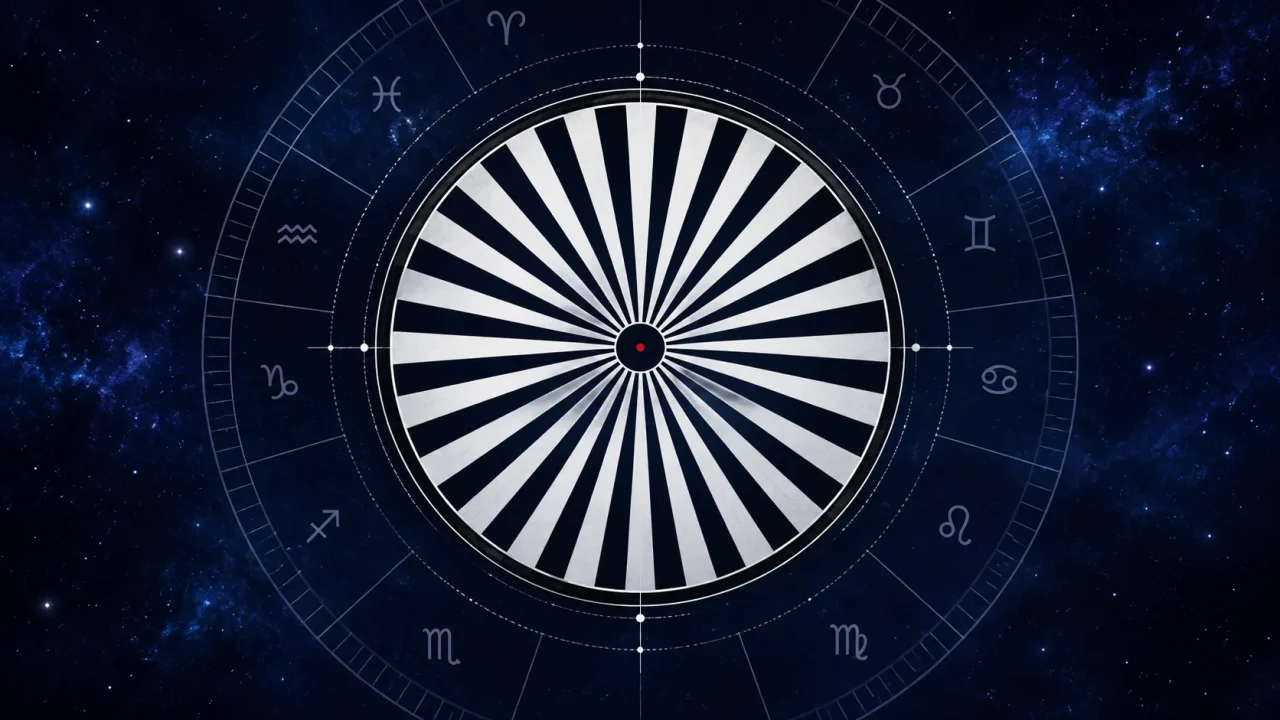
Search for Shakti Chakra gazing and the results settle quickly into a pattern. A circular black and white diagram appears, concentric rings and radiating segments drawn around a dot at the centre, described as an ancient Tantric figure and accompanied by a promise that forty days of practice will awaken kundalini, open the third eye and produce a hypnotic gaze. A good many of these pages go further and tell the reader that the practice belongs to a particular planet, or that it serves as the remedy for a particular house of the horoscope.
Three assumptions run through nearly all of that material, and none of them holds up well when the sources are checked. The first is that the diagram in circulation is an old Tantric figure. The second is that gazing at any geometric form is the classical practice called Trataka. The third is that Jyotisha carries a ready-made planetary rulership for such a practice, waiting to be looked up.
This article works through the subject source by source: what the hatha texts prescribe under the name Trataka, where the word Shakti Chakra occurs in Sanskrit literature and what it means there, how the Sri Yantra is structured and how the Srividya tradition uses it, which circulating claims have textual or scientific support, and what classical Jyotisha does and does not establish about vision, attention and mantra. Where a claim appears to belong to modern practitioners rather than to any text I was able to trace, that is said plainly, because the distinction matters more than the enthusiasm.
Why One Term Produces So Much Confusion
The phrase “Shakti Chakra Gazing” is a compound of English and Sanskrit with no single textual home, and its parts do not point in the same direction. “Gazing” translates Trataka, a well-defined hatha yoga practice with a short but precise textual basis. “Chakra” means wheel or circle, and in Tantric usage it covers a great many things: a plexus in the subtle body, a diagram used in worship, a circle of deities, a ritual gathering, a cosmological cycle. Joined to Shakti it produces a term, Shakti Chakra, that appears in several distinct traditions with several distinct referents, almost none of which is a printed picture meant to be stared at.
Adding the adjective “ancient” to that compound creates the impression of a unified practice handed down intact, when what appears to have happened is that a modern concentration exercise has borrowed a classical term. The borrowing is not illegitimate in itself. Traditions develop, and a newer practice built on older principles can be genuinely useful. The honest position is to say so rather than to claim a pedigree the available sources do not support.
Trataka: What the Hatha Texts Actually Say
The Hathayogapradipika of Svatmarama, a fifteenth century compilation and the most widely used hatha manual, places Trataka in its list of six purificatory acts at chapter two, verse twenty-two: dhauti, basti, neti, trataka, nauli and kapalabhati. The placement itself is significant. Trataka is classified as a shatkarma, a cleansing act, not as a meditation technique in its own right and not as an initiatory rite.
The instruction comes at verses thirty-one and thirty-two. One should look steadily, with an unmoving gaze and a collected mind, at a small object, continuing until tears fall; this, the text says, is what the teachers call Trataka. It destroys diseases of the eyes and removes sloth, and it should be guarded carefully, like a box of jewels.
Three things there deserve attention, because modern accounts routinely pass over them. The object is sukshma lakshya, a small or subtle target; the text specifies neither a candle flame nor a yantra, and the candle is a later convention rather than scripture. The endpoint is physiological, since tears fall once the eyes have been held open past the point where the blink reflex would fire, so the text sets a bodily limit rather than a fixed duration. And the claimed benefits are modest: eye disease and tandra, a word covering drowsiness and mental heaviness. There is no kundalini in these verses, no psychic sight, no influence over other people.
The Gherandasamhita, a seventeenth century text, also includes Trataka among its cleansing acts and treats it as preparation for the deeper work of dharana. In both texts the practice clears and steadies the practitioner so that the later stages become possible. It is preparatory, not the goal.
Trataka should also be separated from a practice with which it is often confused. Shambhavi mudra, in the fourth chapter of the Hathayogapradipika, has the eyes fixed outward while attention is turned entirely inward, so that the practitioner looks without seeing. Trataka fixes attention on an external object; Shambhavi mudra uses the open eye as a posture while the object of attention is internal. Modern writing that treats them as one technique loses a distinction the tradition took trouble to draw.
Behind both lies a broader principle. Yogasutra 1.35 observes that a refined sensory experience, once it arises, binds the mind to steadiness. Patanjali is not describing Trataka and it would be careless to claim he was; he is stating the principle on which all object-based concentration rests, of which Trataka is one application and the modern Shakti Chakra practice another.
Where the Word Shakti Chakra Actually Occurs
Sanskrit sources use Shakti Chakra in several senses, and the variety is itself the answer to one of the central questions. In the non-dual Shaivism of Kashmir the term carries its most developed meaning. Abhinavagupta’s Tantraloka discusses the Shakti Chakra as the wheel of energies, the totality of the powers through which consciousness manifests, contracts and reabsorbs the world, and the sixth aphorism of the Shivasutra’s first section speaks of the dissolution of the universe through union with that wheel. This is metaphysics, not iconography. The Shakti Chakra here is not on paper. It is the operating structure of consciousness itself, and the practice associated with it is recognition, not staring.
Elsewhere the sense is more concrete without becoming a training diagram. Vatsaraja’s Pujastuti uses it for a ring of goddesses, a circle of presiding energies, in a context connected with the drawing of the Sri Chakra: a circle of deities invoked and worshipped. The Pancaratra Ahirbudhnyasamhita uses Shakti Chakra for a thirty-spoked wheel within a larger cosmological system belonging to Vishnu’s manifestation. Tantric Buddhism, in the Dakarnavatantra, uses it for a circle of yoginis in Samvara practice. A Marathi lexical sense records the universe considered as the display of maya.
The pattern across these usages is reasonably consistent. In the sources I examined, Shakti Chakra denotes an arrangement of powers, whether cosmological, ritual or metaphysical, rather than a printed figure given to a beginner for eye training. I did not find a classical source using the term in that second sense, though I cannot rule out one existing in material I have not seen. That does not make the modern practice worthless; it means the claim of antiquity under this name is not supported by the literature I could verify.
The Modern Shakti Chakra Diagram and What It Is
What circulates today under this name is usually one of two kinds of image. The first is a radial figure of alternating light and dark segments arranged around a central point, sometimes with concentric rings or a spiral. The second is a simplified yantra-like design, occasionally a reduced Sri Yantra, occasionally an invented geometric figure.
The first type appears to have a modern lineage, and in the material I examined that lineage is not primarily a yogic one. Radial and spiral charts of this kind occur in twentieth century Indian popular literature on sammohan, that is, hypnotism and the cultivation of what such books call netra shakti or drishti shakti. The vocabulary is Sanskrit, the presentation often devotional, and the claimed results run to influence over others, magnetic personality and command. Hindi material circulating under titles such as “Shakti Chakra par Tratak” belongs to this genre. Whether every circulating diagram originates there I cannot say, since much of the material is undated and uncredited. What can be said is that these diagrams resemble that genre far more closely than anything in the classical Tantric record, and that the genre is roughly a century old.
The radial pattern also has a specific perceptual property. Alternating high-contrast segments converging on a centre produce strong afterimages and apparent motion when fixated, so anyone gazing at such a figure for a few minutes will see it seem to rotate, pulse, or dissolve into a grey field. This is ordinary visual physiology: local adaptation of retinal receptors, lateral inhibition at contrast boundaries, and the Troxler effect, in which a steadily fixated peripheral stimulus fades from awareness. Whether or not its designers knew the terminology, the diagram is engineered to produce dramatic visual events quickly, and that is the honest explanation of why it feels more powerful than a candle flame to many beginners. A practitioner told in advance that such effects indicate awakening will interpret them that way.
Is Shakti Chakra the Same as the Sri Yantra?
No, and the conflation does real damage to a student’s understanding. The Sri Yantra, also called Sri Chakra, is a rigorously defined figure. Nine interlocking triangles, four pointing upward and five pointing downward, intersect to produce forty-three smaller triangles in concentric levels, surrounded by an eight-petalled lotus, a sixteen-petalled lotus, three circles and a square enclosure with four gateways. At the centre is the bindu. The upward triangles are read as Shiva, the downward as Shakti, and Saundaryalahari’s eleventh verse is the passage most often cited for this reading. Commentarial traditions count the resulting angles slightly differently, so a reader will meet both forty-three and forty-four depending on whether the central region is counted separately.
The nine levels are the navavarana, the nine enclosures, running from Trailokyamohana at the outer square through Sarvashaparipuraka, Sarvasamkshobhana, Sarvasaubhagyadayaka, Sarvarthasadhaka, Sarvarakshakara, Sarvarogahara and Sarvasiddhiprada to Sarvanandamaya, the bindu. Each has its presiding goddesses and mantras, and the navavarana puja moves through them in sequence.
Here is the part most modern articles omit. In the classical Srividya ritual literature I was able to trace, the emphasis falls on worship, mantra, nyasa, visualisation and navavarana practice rather than on hatha-style unblinking Trataka. The practice is built on initiation from a guru, on the panchadashakshari or shodashakshari mantra, on ritual movement through the nine enclosures, and on dhyana of the goddess in her described form. The Parashuramakalpasutra, the principal manual of the tradition, prescribes japa, puja, mudra and pranayama. I did not find in it, or in the standard ritual literature I examined, an instruction to gaze at the Sri Chakra in the hatha sense of unblinking fixation until tears fall.
Three statements follow, and the difference between them matters. Sri Yantra worship has a strong and well-documented traditional basis. Hatha-style unblinking Trataka on the Sri Yantra does not have an equally strong classical basis, at least in the sources I could verify. Modern Sri Yantra gazing therefore appears to combine an old object with a later or modern gazing method, which is reasonable enough but should not be described as a single inherited practice.
The two terms can now be separated. The Sri Yantra is a precisely defined traditional figure with a documented ritual use, while the modern Shakti Chakra is a concentration diagram of recent origin which, in the material I could trace, sits closer to popular literature on gaze training than to Srividya. It also follows that image quality says nothing about authenticity: a carefully rendered figure may have been designed recently by someone with no contact with the tradition, while a rough photocopy from an old Hindi book may represent an actual line of practice.
The Bindu and Why the Centre Matters
Whatever diagram is used, the centre does real work, and here the classical and modern accounts genuinely converge. In Tantric cosmology the bindu is the undifferentiated point from which manifestation proceeds and into which it resolves. In the Sri Yantra it is the innermost enclosure, Sarvanandamaya, the seat of the union of Shiva and Shakti. The whole geometry is organised around it and the ritual sequence moves inward toward it. The bindu is not decoration; it is the structural and theological centre of the figure.
There is also a plainly perceptual reason why a central point matters. The fovea, the small central region of the retina where acuity is highest, subtends roughly two degrees of visual angle. A target smaller than that can be held entirely in sharp central vision without eye movement, which is exactly what steady fixation requires. The Hathayogapradipika’s insistence on a sukshma lakshya is sound instruction whether one arrives at it through yogic transmission or through optics. The symbolic account and the physiological one point in the same direction here. A figure without a definite centre gives attention nowhere to settle.
What Happens During Gazing, Described Without Embellishment
When the eyes are held still on a small target a predictable sequence unfolds. Within a minute or two, blinking becomes uncomfortable to suppress and the eyes begin to water, which is reflex rather than purification. Within two to five minutes the surrounding field fades from awareness as unchanging peripheral stimuli drop out of perception. If the target is a flame, an afterimage persists when the eyes close, and that retained image is what most traditions ask the practitioner to hold in antar trataka, inner gazing.
Meanwhile the mind does what minds do. It generates thoughts, notices discomfort, plans, remembers and drifts. The practitioner notices the drift and brings attention back, and then it drifts again. The visual side is the conspicuous half, but the return of attention is the half that does the training, and it is where this practice meets every other attentional discipline, including, as I will suggest later, the work an astrologer does over a chart. Experienced practitioners generally report that the visual events become less interesting over time, which is a reasonable sign that the attention has stopped chasing them.
Drishti: The First Real Point of Contact with Jyotisha
Some care is needed here, because the temptation to manufacture connections is strong and the results are rarely convincing. Jyotisha contains no chapter on Trataka and none on gazing diagrams. What it does contain is a developed vocabulary for what gazing involves: sight, attention, mind, mantra, discipline and transmission. That vocabulary can reasonably be used as an interpretive framework, provided it is stated that interpretation is what it is.
Start with the word itself. Drishti in Jyotisha means aspect, the influence a graha casts across the chart. Every graha aspects the seventh house from itself; Mangala adds the fourth and eighth, Guru the fifth and ninth, Shani the third and tenth. Jaimini’s system adds rashi drishti, the sight of signs upon signs. The entire predictive apparatus rests on the idea that influence travels along lines of sight, and that where a graha looks, it acts. That is not a metaphor borrowed to decorate a yoga article; it is the structural assumption of the science. A graha does not affect what it does not see, and a practitioner does not become absorbed in what he does not look at.
There is a second and more practical resonance. Reading a chart is an exercise in controlled attention under visual overload: twelve houses, nine grahas, their dignities and aspects, the divisional charts, the dashas, the transits. A beginner looks at all of it and sees noise. An experienced astrologer finds the two or three factors that organise the whole. That capacity is not knowledge of rules but the trained ability to let the irrelevant fall away while the central pattern stays steady, which is functionally what happens when the periphery fades and the bindu remains. I offer that as an observation from teaching rather than a doctrine from any text, but it is why I think gazing and chart reading sit closer together than they appear to.
Chandra and the Movement of the Manas
If any single principle in Jyotisha bears on this subject it is the identification of the Moon with the mind, and this one stands on firm textual ground. The Purushasukta states it at Rigveda 10.90.13: candrama manaso jatash chakshoh suryo ajayata, the moon was born from the mind, the sun from the eye. The Brihatparasharahorashastra repeats it in its account of the grahas, describing the Sun as the atman of all and the Moon as the manas. This is among the least disputed correspondences in the system.
Practically, it gives a framework for describing how a particular person’s attention behaves, which bears directly on how they will experience any concentration practice. The Moon’s sign, nakshatra, paksha condition, aspects and house position together describe the characteristic movement of that person’s mind. A Moon in a movable sign closely associated with Mangala describes attention that moves quickly and returns quickly; a Moon in a fixed sign under Shani’s aspect describes attention slow to settle and slow to leave; a waning Moon without benefic aspect classically indicates less inherent stability. Someone with the second configuration will find the first ten minutes of gazing harder and the next twenty easier, and someone with the first the opposite.
The status of those statements should be exact. That the Moon signifies manas is classical, and that its condition describes mental steadiness is classical. That these principles predict how a person will find a gazing practice is interpretation, reasoning from established significations to a case the texts do not address. One further claim should be treated with suspicion wherever it appears: that gazing strengthens the Moon. I found no classical source establishing it, and the logic of grahashanti does not work that way, since remedies are prescribed through deities, mantras, gemstones, charities and observances attached to particular grahas. No traditional list I examined includes a gazing diagram as a lunar remedy.
Surya, the Eyes, and the Houses of Sight
The Sun’s association with vision is as old as the Moon’s with mind and comes from the same verse: from the eye, the sun was born. In Jyotisha the Sun is karaka for the right eye and the Moon for the left. The houses carry this further. Mantreshwara’s Phaladeepika, in its opening chapter on bhava significations, assigns the right eye to the second house along with the face and speech, and the left eye to the twelfth along with loss, expenditure and the bed. Classical medical astrology uses these two houses, with their lords and the two luminaries, to assess conditions of the eyes.
It is worth being precise about what this does and does not allow. These significations are astrological symbolism, part of a traditional interpretive language for the body. They do not establish whether a particular person will physically tolerate a practice that strains the eyes. Trataka involves suppressing the blink reflex until the eyes water, which for most healthy people is harmless, but whether it is safe for a given individual is a medical question. Anyone with glaucoma, retinal disease, recent eye surgery, migraine with visual aura or any other eye condition should take advice from a doctor before beginning, and that advice stands regardless of what the chart shows. A horoscope is not an eye examination and should never be used in place of one. Where the chart can reasonably contribute is in the conversation around the practice: an astrologer who sees an afflicted second or twelfth house in someone already reporting eye trouble has a traditional reason to raise the subject and suggest a medical check, not a basis for clearing or refusing the practice.
A symbolic extension is available too, and should be labelled as such. The second house concerns what is taken in and held; the twelfth concerns what is released and what lies beyond the visible. A practice that begins with the outward eye and ends with an inward image moves, symbolically, from one territory to the other. That is a way of thinking, not a finding.
The Fifth House: Mantra, Vidya and Buddhi
The fifth house holds most of the genuine astrological content of this subject, and it repays careful reading of what the classical sources actually assign to it. Phaladeepika’s first chapter gives the fifth house atman, intelligence, knowledge of the future, life, son, belly, and Shruti and Smriti, that is, revealed and remembered scripture. The Uttarakalamrita attributed to Kalidasa adds mantras, spiritual practice and authorship. The Brihatparasharahorashastra centres its treatment on children, intelligence, education and purvapunya, merit carried from previous births.
Two things follow. The positive point is that mantra practice, scriptural learning, discrimination and inherited spiritual merit are all classically fifth house matters. To ask whether a person’s chart supports sustained sadhana involving mantra and inner discipline, the fifth house, its lord, its occupants and the condition of Guru are the traditional place to look. Assessment of mantra siddhi through the fifth house is standard in the tradition and taught in most serious lineages.
The correction concerns yantra. Many modern articles state that the fifth house governs yantra with the same confidence as the mantra signification. I could not find yantra in the classical bhava lists I checked: mantra is there in the Uttarakalamrita, Shruti and Smriti in Phaladeepika, but yantra is not. It may appear in a source I have not seen, and I would welcome a citation, but until one appears the careful statement is that fifth house rulership of yantra looks like a modern extension rather than a classical signification. The extension is not unreasonable in itself, since Tantric theory treats mantra and yantra as the sonic and visual form of the same deity. The difficulty is only that it is an inference, and inferences presented as citations are a large part of why this literature is hard to use.
The Ninth House, Guru, and the Question of Transmission
Phaladeepika gives the ninth house the acharya, the deity, the father, worship, tapas, previous merit and virtue. This is the house of transmitted tradition, and its relevance here is specific rather than decorative. Almost everything that has gone wrong in the popular presentation of Shakti Chakra gazing is a failure of transmission. A diagram is downloaded without a teacher, claims are attached to it without a source, a duration is prescribed without supervision, and the practitioner proceeds with nobody to tell him whether what he is seeing is significant or is an afterimage.
The requirement of initiation in Srividya is not gatekeeping for its own sake. A symbolic system transmitted without its interpretive framework will be read through whatever framework the recipient happens to have, which today usually means a marketing page. An astrologer assessing suitability for serious sadhana has traditional grounds for weighting the ninth house and the condition of Guru heavily; whether that judgment extends to this practice is inference.
The Twelfth House and the Turn Inward
The twelfth house carries loss, expenditure, the bed, seclusion, foreign places and, in the tradition’s later development, moksha. It is the house of what leaves the field of ordinary transaction, and the structural correspondence with gazing practice is the most interesting of the symbolic connections available. Every form of object-based concentration follows the same arc: the practitioner begins with an external object, the external field drops away, and what remains is an internal image and eventually attention without an object at all.
The twelfth house is the astrological vocabulary for that movement, and also for what goes wrong when it is unbalanced, since the same house carries isolation, confusion and loss of contact with ordinary life. A person with a heavily tenanted twelfth house, particularly with an afflicted Moon, may take to inward practice readily and may also be less well anchored when it produces unusual experiences. The twelfth has no classical association with gazing; it has one with withdrawal, and withdrawal is what the practice structurally is.
Budha and Shani: Discrimination and Duration
Two remaining grahas carry principles that apply here, and both applications are interpretive rather than cited. Budha in the Brihatparasharahorashastra is the giver of speech, and across the tradition it governs buddhi in its analytical sense: discrimination, classification, the ability to tell one thing from another. Separating a classical claim from a later one, or an afterimage from an experience, is an act of viveka. A practitioner without it takes every visual event as a milestone; an astrologer without it builds correspondences that no source supports.
Shani governs duration: what is sustained without reward, slow accumulation, discipline that continues after enthusiasm has gone. No concentration practice produces anything in a week. The Hathayogapradipika’s promise to remove tandra is a promise about a changed baseline, and baselines change over months. Whatever one thinks of the colourful claims, the undramatic ones require Shani’s quality to test. A person with a well-placed Shani, in the traditional reading, sustains what he begins; applying that to gazing practice is my inference.
Can the Navagraha Be Mapped Onto the Navavarana?
This question comes up constantly, because nine and nine is an irresistible coincidence, and the answer is that there is no established correspondence. The presiding powers of the nine enclosures are classes of yoginis and their chakreshvaris, named and invoked in the navavarana puja, each enclosure carrying its own goddesses, mantras and mudras. The structure is internally complete. Nothing in it calls for planetary assignment, and the standard ritual manuals supply none.
The number nine recurs across Indian systems for reasons of structure and convention, not because the instances are secretly the same. Nine grahas, nine enclosures, nine durgas, nine nidhis, nine rasas. Nine and nine is a coincidence of counting, not evidence of correspondence, and mapping any two such sets without textual warrant produces a scheme that looks impressive and predicts nothing. If a particular lineage does teach such a correspondence, it should be understood and presented as that lineage’s own teaching rather than as a general rule of the tradition, and anyone offering it has the ordinary obligation to say where it comes from.
The same caution applies to assigning a graha to the practice at all. I have seen it called Saturnine because it requires discipline, lunar because it involves the mind, solar because it involves the eye, and a Ketu practice because it is esoteric. Each argues from one associated quality, and by that standard almost anything can be assigned to almost any graha.
Kundalini, Hypnosis and the Rest of the Claim Stack
The claims attached to this practice are easier to assess once sorted by the kind of support each has: classical textual claim, later traditional claim, modern practitioner claim, or something testable against scientific evidence. Kundalini awakening is the most common. Neither of the two Hathayogapradipika verses on Trataka mentions it, and the text has a great deal to say about kundalini elsewhere, in connection with the bandhas, pranayama and specific mudras, which makes the silence in these verses more telling rather than less. Later yogic literature does place gazing within a progression leading toward such states, and practitioners report experiences they interpret in those terms. The reasonable classification is therefore a later traditional and modern practitioner claim rather than a statement of the primary hatha sources, and it should not be presented as an established effect of the practice.
Hypnotic or influencing power over others is a modern practitioner claim, characteristic of the sammohan literature in which the radial diagram appears, and I found no yogic textual basis for it. Nor is there controlled evidence that gazing at a diagram confers influence over other people. The charitable reading is that someone who practises daily concentration becomes calmer and more attentive in conversation, and that others respond to that, which is an ordinary effect with an ordinary explanation.
Pineal gland activation is a modern claim that can be checked against established physiology, and on that check it does not hold. In humans the pineal is not directly photosensitive. Light reaches it only indirectly: retinal photoreceptors signal the suprachiasmatic nucleus of the hypothalamus, which relays through the sympathetic chain and the superior cervical ganglion to the pineal, where melatonin output is regulated. There is no light path to the gland that bypasses the eyes, and I am aware of no evidence that fixating on one geometric figure affects it differently from fixating on anything else. The claim appears to rest on an analogy with the parietal eye of some reptiles, which does not carry over to mammals.
Third eye opening is hard to evaluate because it is stated in so many different ways. As a description of the ajna chakra within subtle physiology it is a traditional claim and belongs to that framework. As a claim about literal perception of non-physical objects it is a modern practitioner claim for which I found no supporting evidence, and those who report afterimages, phosphenes and closed-eye imagery are describing real perceptual events with well-understood optical explanations. Divya drishti does appear in later yogic literature in connection with advanced practice, which makes it a later traditional claim; it is not in the trataka verses.
What the Evidence Does Support
There is a modest research literature on Trataka, and it is worth knowing accurately, since sceptics and enthusiasts both tend to misrepresent it. The most cited study is Talwadkar, Jagannathan and Nagarathna’s 2014 trial in the International Journal of Yoga, which randomised sixty elderly participants in Goa, forty-eight of whom completed, to one month of daily thirty-minute Trataka or to a waitlist. The Trataka group improved significantly on digit span, on the six letter cancellation test and on Trail Making Test B, both immediately after practice and at one month. The authors themselves note the small sample, recruitment from two old age homes, and the narrow range of domains assessed.
A 2025 systematic review in the Journal of Neurosciences in Rural Practice found three randomised trials in all, covering cognition in the elderly, anxiety in children undergoing dental procedures, and blood pressure and heart rate variability in hypertensive patients. Methodological quality was moderate, with PEDro scores between five and seven, samples between fifty-five and one hundred twenty, and protocol heterogeneity that prevented meta-analysis. The proposed mechanism involves attentional networks, specifically the frontal eye fields and superior colliculus, together with reduced activity in the default mode network associated with mind wandering. That last point is the interesting one. If the mechanism is attentional engagement and default mode suppression, the classical instruction and the modern finding are describing the same thing from opposite ends: removing tandra and reducing mind wandering are not far apart.
Taken together, the available evidence suggests that several weeks of daily Trataka may improve attention, working memory and executive function, and may reduce some physiological markers of anxiety. That is the most the current literature will carry: the evidence base is small, the studies are modest in size, the protocols differ, and nothing here demonstrates that Trataka works in the way popular accounts describe. Claims beyond these outcomes are untested or unsupported. I also found no study comparing one gazing object with another, so there is at present no evidence that a Shakti Chakra diagram performs better than a candle flame, a dot on a wall or a Sri Yantra.
How an Astrologer Could Actually Research This
Rather than asserting correspondences, an astrologer with a teaching practice is unusually well placed to test them. What follows is a framework rather than a set of results. Take a cohort of students beginning the same protocol on the same object for the same duration. Record for each the Moon’s sign, nakshatra, paksha strength, aspects and house; the fifth house and its lord; the ninth house and Guru; the twelfth house and its occupants; Budha’s dignity; Shani’s placement; and the second and twelfth houses with the luminaries for eye tolerance. Then collect outcomes that can actually be recorded: days completed out of days attempted, self-reported time to first settling within a session, whether eye discomfort forced shortening, and a simple attention measure at baseline and at one month, such as the letter cancellation task used in the published trials.
The hypotheses are then specific enough to be wrong, which is the point. Does Shani’s dignity predict completion rate better than any other factor? Does the Moon’s condition predict time to settle? Does second and twelfth house affliction predict eye discomfort? Does fifth house strength predict anything at all, or is its relevance to mantra simply not transferable to visual practice? Most will probably show nothing, and that would itself be worth knowing. Specifying in advance what would count as a negative result is exactly what the popular literature on remedies never does.
Practical Cautions
A few things are worth saying plainly to anyone taking this up. Begin short. Five minutes is a reasonable first session, extended gradually. The Hathayogapradipika’s instruction to continue until tears fall is a limit, not a target, and it was written for people under supervision. Do not practise unblinking fixation at all, without asking a doctor first, if you have glaucoma, recent eye surgery, retinal disease or a history of migraine with visual aura. No tradition is served by ignoring ordinary prudence.
Treat visual phenomena as information about your eyes rather than about your progress. Colour shifts, apparent motion, the figure dissolving, persistent afterimages: these are what human visual systems do under steady fixation, and a practitioner who measures progress by phenomena will chase phenomena.
Be sceptical of any source that promises a fixed result in a fixed number of days or claims power over other people, since that combination is characteristic of the sammohan genre rather than of yogic instruction. And if the interest is genuinely in the Sri Yantra, it is better approached as the tradition approaches it, through a teacher and through worship, than through a downloaded image and a timer.
Where This Leaves the Subject
Most of the confusion around this subject comes from the terminology rather than from the practice. Once the terms are separated, the picture is reasonably clear. Trataka has a genuine classical foundation, narrow but well attested. The modern Shakti Chakra diagram appears to be of recent origin and should not be assumed to be the Sri Yantra, which belongs to a different tradition with a different method of use. The claims attached to the modern practice sit at several different levels of support, and keeping those levels distinct is most of the work.
On the Jyotisha side, I found no established planetary ruler for this practice and no classical source making it the remedy for any particular house. What the tradition does offer is a vocabulary for what the practice actually involves. Drishti gives a developed language for sight and its effects, Chandra for how a person’s mind moves, Panchama Bhava for mantra, vidya and buddhi, the ninth house and Guru for transmission, the twelfth for the turn from outer to inner, Budha for discrimination and Shani for duration. Used carefully, with the classical material kept separate from interpretation, that is enough to discuss the practice intelligently with a student without inventing a rulership for it.
What remains, and what seems to me worth more attention than it usually receives, is the connection between seeing and attending. Jyotisha treats sight as the channel through which influence travels, and Trataka treats a steady gaze as the means of holding attention in one place. Neither tradition developed that parallel formally, and it would be wrong to claim that either did. But it is a reasonable place for an astrologer to begin thinking about why a practice built on the eyes should have anything to do with the mind.
 Punarvasu Nakshatra Compatibility Part 1 – (Ashwini to Ashlesha)Most nakshatras are given one ideal life partner. Punarvasu is given two, Bharani and Pushya, and both of them rate exactly seventy-six per cent. That…
 What a Remedy is Supposed to ChangeThe earlier article in this line asked whether a remedy was aimed at the right planet. That question is a real one and it settles a large number of ca…
 When the Remedy Do Not WorkMost people who ask this question have already spent money. A stone was bought and worn on the right finger on the right day. A pooja was done exactly…