
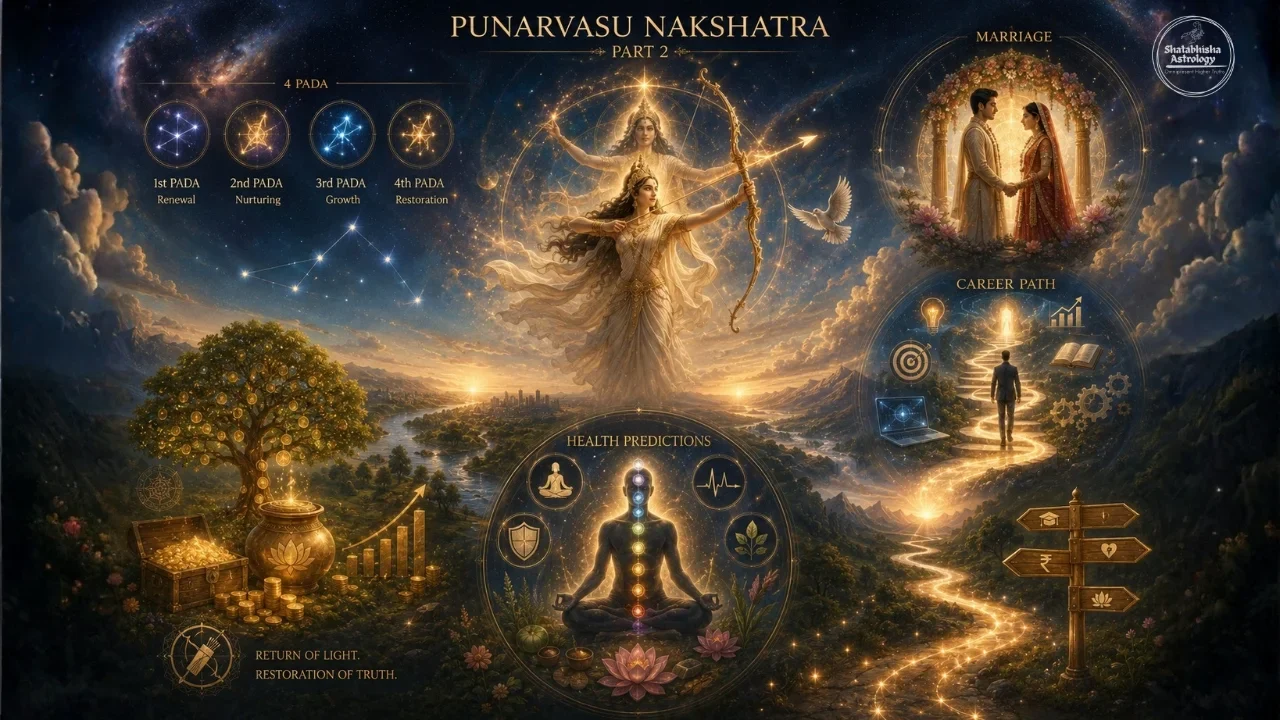
The Four Padas of Punarvasu and Their Predictive Secrets
Although the mythology of Aditi provides the foundation of Punarvasu Nakshatra, the four padas reveal how this restorative energy manifests differently in human life.
Each pada represents a unique pathway through which the soul experiences loss, recovery, growth, and renewal.
Punarvasu First Pada (Aries Navamsha)
Restoration Through Action and Courage
The first pada of Punarvasu falls in Aries Navamsha and carries the energetic influence of Mars. While the core nature of Punarvasu remains centered on restoration, renewal, and return, the way these themes manifest changes significantly through the Aries filter. Here, restoration does not occur through waiting, reflection, or gradual healing. It occurs through movement.
These individuals possess a natural tendency to respond to setbacks with action. When life creates disruption, their instinct is rarely to remain passive for long. They may experience disappointment, loss, or failure, but something within them immediately begins searching for a way forward. The challenge becomes a call to engage rather than a reason to withdraw.
This creates a distinctive psychological pattern. While others may spend long periods processing defeat, first-pada Punarvasu natives often redirect their energy toward rebuilding. They prefer doing something rather than remaining trapped in helplessness. Even when emotionally affected by circumstances, they usually recover through activity, initiative, and purposeful effort.
One of the most frequently observed manifestations of this placement is entrepreneurial resilience. In practical chart analysis, individuals with strong first-pada influence often experience multiple beginnings in business, career, or personal projects. The first attempt may fail. The second may struggle. The third may require significant adjustment. Yet they continue moving forward with remarkable persistence.
What is striking is that failure often becomes fuel rather than discouragement. Every setback provides information. Every obstacle becomes part of the learning process. Their journey rarely follows a straight path, but repeated attempts gradually strengthen both skill and confidence. Over time, this willingness to begin again often becomes one of their greatest assets.
At a deeper level, the life lesson of this pada revolves around courage. The restoration promised by Punarvasu does not arrive passively. It arrives through the willingness to take action despite uncertainty. These natives learn that renewal is not merely something that happens to them. It is something they actively participate in creating.
The symbolism of Aditi takes on a dynamic quality here. Rather than restoring through patience alone, she restores through initiative. Opportunities return because the individual remains willing to act. Doors reopen because they continue knocking. New beginnings emerge because they refuse to let temporary failure define the final outcome.
At their highest expression, these individuals become powerful examples of resilience in action. They demonstrate that setbacks need not become permanent identities. They show that rebuilding often begins with a single decision to try again. And through repeated experiences of falling and rising, they discover one of the deepest truths of this pada: courage is not the absence of failure, it is the willingness to begin again after failure has occurred.
This is the unique gift of Punarvasu in Aries Navamsha. The native learns that restoration is not merely a blessing received from life. It is a process activated through boldness, initiative, and the refusal to remain defeated. Here, Aditi restores through action, and every new beginning becomes an expression of that divine principle.
Punarvasu Second Pada (Taurus Navamsha)
Restoration Through Stability, Security, and Preservation
The second pada of Punarvasu falls in Taurus Navamsha and carries the influence of Venus. While the essential theme of renewal remains unchanged, the focus now shifts toward material stability, emotional security, relationships, family resources, and the preservation of what sustains life. Here, restoration is not expressed through rapid action as in the first pada. It unfolds through patience, practical effort, and the gradual rebuilding of stability.
Individuals with strong second-pada influence often find that their most important life lessons revolve around security. The disruptions they encounter frequently involve finances, possessions, family responsibilities, relationships, or emotional attachments. At certain stages of life, they may experience losses that shake their sense of stability, forcing them to reconsider what truly provides lasting support.
Yet the remarkable feature of this pada is that recovery usually arrives through tangible and practical channels. Family assistance appears when it is most needed. Property-related opportunities emerge. Long-term partnerships become sources of support. Financial setbacks are slowly corrected through persistence and careful management. The process may not be dramatic, but it is often dependable.
One pattern frequently observed in charts with strong second-pada influence is financial fluctuation during the earlier part of life. The native may pass through periods of uncertainty regarding income, resources, or material security. There can be cycles of gain and loss that teach important lessons about value, patience, and responsible stewardship. However, as maturity develops, stability often increases. What was once unstable gradually becomes more secure because experience has refined the individual’s relationship with material resources.
Relationships also play a significant role in this pada. Emotional bonds, family connections, and long-term partnerships often become vehicles through which restoration occurs. During difficult periods, support frequently arrives through people rather than circumstances alone. The native learns that security is not built solely through personal effort, but also through meaningful connections and mutual care.
Psychologically, this pada develops resilience through preservation rather than confrontation. The individual discovers the importance of maintaining what is valuable rather than constantly pursuing what is new. Their strength lies in nurturing resources, protecting relationships, and creating environments where growth can occur steadily over time.
The symbolism of Aditi takes on a softer and more sustaining form here. Restoration happens through nourishment. What has been weakened is strengthened again. What has been threatened is protected. What has been lost is gradually rebuilt through patience and care. The process resembles a garden recovering after a difficult season, not through sudden change, but through consistent attention and support.
At its highest expression, this pada teaches that true abundance is not measured by how much one acquires, but by how much one can preserve, cultivate, and sustain. The native learns that lasting security comes from building strong foundations rather than chasing temporary gains.
This is the unique gift of Punarvasu in Taurus Navamsha. Aditi restores not through urgency or struggle, but through nourishment, stability, and continuity. The lesson is simple yet profound: what is cared for with patience has the power to endure, and what endures can always be rebuilt when life demands a new beginning.
Punarvasu Third Pada (Gemini Navamsha)
Restoration Through Knowledge and Understanding
The third pada of Punarvasu falls in Gemini Navamsha and is influenced by Mercury. Among all four padas, this is perhaps the most intellectually active and mentally adaptive expression of the Nakshatra. The theme of restoration remains central, but here the process unfolds through learning, communication, ideas, and the continuous expansion of understanding.
For these individuals, life’s most significant turning points are often connected with knowledge. Challenges frequently arise in areas related to education, communication, skills, intellectual confidence, or the ability to express thoughts clearly. Yet the remarkable feature of this pada is that the very area that experiences interruption often becomes the source of future strength.
A common pattern observed in many charts is interrupted education followed by eventual completion. The native may face circumstances that delay learning, change academic direction, or temporarily pull them away from study. However, the desire to learn rarely disappears completely. Years later, they often return to unfinished subjects with greater maturity and purpose.
The same principle can be seen in communication. Some individuals struggle early in life with self-expression, confidence in speaking, or articulating their thoughts. Yet through experience and persistence, these challenges gradually transform into strengths. The person who once found it difficult to communicate may later become an effective teacher, writer, speaker, or guide for others.
This explains why many astrologers, educators, researchers, counselors, authors, and intellectual workers possess strong placements in this pada. Their life journey frequently involves converting personal confusion into understanding and then sharing that understanding with others. What they learn through experience becomes knowledge that benefits a wider audience.
Psychologically, this pada possesses a strong capacity for reframing adversity. When setbacks occur, the native instinctively seeks meaning. Rather than asking only, “Why did this happen?” they eventually begin asking, “What can this teach me?” This shift in perspective becomes a powerful tool for recovery. Understanding itself becomes healing.
The influence of Mercury also gives these individuals considerable adaptability. They often recover through information, dialogue, learning new skills, or changing the way they perceive a situation. Where other people may feel trapped by circumstances, third-pada natives frequently discover that a new insight can completely alter their experience.
The symbolism of Aditi takes on a distinctly intellectual form here. Restoration occurs through wisdom. Confusion gives way to clarity. Ignorance transforms into knowledge. Questions eventually lead to understanding. The individual learns that many problems lose their power once they are truly understood.
At its highest expression, this pada produces people who become bridges of knowledge. They help others navigate uncertainty because they have personally walked through periods of confusion and emerged with deeper insight. Their authority comes not merely from study, but from lived experience transformed into wisdom.
This is the unique gift of Punarvasu in Gemini Navamsha. Aditi restores not through force, wealth, or emotional security alone, but through understanding. The native discovers that knowledge has the power to rebuild what confusion once dismantled, and that every interruption in learning may simply be preparing the ground for a deeper form of wisdom to emerge later in life.
Punarvasu Fourth Pada (Cancer Navamsha)
Restoration Through Love, Healing, and Emotional Renewal
The fourth pada of Punarvasu falls in Cancer Navamsha and is ruled by the Moon. Among all four padas, this is often regarded as the most natural and complete expression of Punarvasu’s essential nature. Here, the themes of restoration, protection, nourishment, and renewal reach their deepest emotional expression. The energy of Aditi finds a particularly comfortable channel through the Moon, creating a personality that is often deeply caring, receptive, and emotionally aware.
For these individuals, life’s most important lessons are frequently connected with home, family, belonging, emotional security, and inner healing. Their journey is rarely focused only on external achievement. Instead, life repeatedly guides them toward understanding the emotional foundations upon which all other success ultimately depends.
One of the most noticeable qualities of this pada is its remarkable capacity for compassion. These natives often possess an intuitive ability to understand the emotional experiences of others. People naturally feel comfortable sharing their struggles with them because they sense genuine empathy rather than judgment. Even without formal training, many become counselors, healers, teachers, guides, or simply trusted sources of emotional support within their communities.
A fascinating pattern observed in many charts is that the native’s greatest emotional wounds eventually become their greatest source of wisdom. Experiences of rejection, loss, separation, family challenges, or emotional disappointment often leave deep impressions during certain phases of life. Yet these same experiences gradually develop profound understanding and sensitivity.
What initially appears as suffering later becomes insight. What once caused pain becomes a bridge of connection with others. The native learns not only how to heal themselves, but also how to support others who are facing similar struggles. In this way, emotional hardship is transformed into emotional intelligence.
The symbolism of home becomes especially important in this pada. Some natives experience powerful karmic connections to family, ancestry, childhood environments, or places that evoke a sense of belonging. Even when life takes them far from their roots, there is often a deep inner search for emotional home, a place where they can feel safe, accepted, and connected.
Spiritually, this pada teaches that true strength is not always found in control or achievement. Sometimes strength is found in vulnerability, compassion, forgiveness, and the willingness to remain open-hearted after disappointment. The native gradually discovers that healing is not a sign of weakness but a form of courage.
The influence of the Moon also enhances intuition. Many individuals with strong fourth-pada placements possess an instinctive understanding of emotional undercurrents. They often sense what others are feeling before it is spoken. This sensitivity can become a tremendous gift when balanced properly, allowing them to offer comfort, guidance, and reassurance during difficult times.
The role of Aditi in this pada is especially beautiful. Restoration occurs through love, care, acceptance, and emotional nurturing. The healing process is not forced. It unfolds naturally, much like a wounded heart slowly recovering in a supportive environment. What has been hurt is gently restored. What has been fragmented is gradually made whole again.
At its highest expression, this pada produces individuals who embody the nurturing qualities of Aditi herself. They become living reminders that healing is possible, that emotional pain can be transformed into wisdom, and that compassion has the power to restore what suffering once seemed to destroy.
This is the unique gift of Punarvasu in Cancer Navamsha. Aditi restores through the heart. The native learns that love is not merely an emotion, it is a healing force capable of rebuilding both individuals and lives. And through that process, they discover that some of life’s deepest renewals occur not through achievement, but through emotional understanding and genuine human connection.
Marriage Predictions in Punarvasu Nakshatra
Relationships, Separation, and the Possibility of Restoration
The mythology of Aditi offers some fascinating insights into the nature of relationships when Punarvasu is strongly involved in a horoscope. Since Aditi represents restoration, protection, and renewal, her influence often becomes visible in the way emotional bonds evolve over time. However, this influence is frequently misunderstood. Many assume that Punarvasu automatically guarantees smooth relationships or permanent harmony. Practical chart analysis suggests something far more nuanced.
One recurring observation is that Punarvasu rarely favors superficial partnerships. Relationships connected with this Nakshatra often carry deeper karmic lessons. As a result, they frequently pass through periods of testing before reaching stability. The bond may be meaningful, but that does not mean the path is easy.
Temporary separations are not uncommon. Engagements may break unexpectedly. Marriage may be delayed despite sincere intentions. At times, emotional distance develops even between people who genuinely care for one another. From the outside, these situations can appear like failures or endings. Yet when Punarvasu is strongly involved, the story often continues beyond the apparent conclusion.
This reflects the central principle of Aditi herself. Just as life restores opportunities, homes, and dreams under Punarvasu, relationships may also move through cycles of disruption and renewal. The connection is tested, weakened, interrupted, or temporarily lost, only to reappear later in a stronger or more mature form.
In practical prediction, this pattern becomes especially noticeable when Venus, the 7th lord, Darakaraka, or other important relationship significators occupy Punarvasu. In such charts, reconciliation themes appear more frequently than average. Former partners may reconnect after years of separation. Relationships that seemed permanently damaged may gradually heal. Marital difficulties often become catalysts for growth rather than immediate indicators of permanent dissolution.
One of the most interesting aspects of this Nakshatra is that emotional maturity often develops through these cycles. The first version of a relationship may not survive because both individuals are still learning important lessons. Time, distance, and experience create growth, allowing a healthier form of connection to emerge later. In this sense, restoration does not always mean returning to the past exactly as it was. It often means rebuilding the bond on a stronger foundation.
Psychologically, Punarvasu teaches an important lesson about relationships: meaningful connections are not defined by the absence of challenges. They are defined by the capacity to heal, adapt, and grow through those challenges. This is why many natives eventually discover that periods of separation revealed weaknesses that needed attention rather than proving the relationship was impossible.
However, an important caution is necessary. Astrologers should never assume that every separation under Punarvasu leads to reunion. Such conclusions can create unrealistic expectations and inaccurate predictions. The possibility of restoration is increased, but it is never guaranteed. The condition of Venus, the 7th house, relationship yogas, dasha periods, and the overall structure of the chart must always be examined carefully.
Punarvasu does not promise reconciliation. It simply increases the likelihood that life will provide opportunities for healing, completion, or renewal where other Nakshatras might indicate permanent closure.
This distinction is crucial. The deeper gift of Aditi is not that every relationship survives. It is that relationships are given a greater chance to evolve beyond their initial difficulties. Sometimes that evolution leads to reunion. Sometimes it leads to a healthier partnership. And sometimes it leads to emotional closure that was previously impossible.
In every case, the principle remains the same. Punarvasu reminds us that relationships, like life itself, are often more resilient than they first appear. What seems broken may still contain the possibility of restoration. And understanding that possibility allows the astrologer to see beyond temporary separation and recognize the deeper karmic story unfolding underneath.
The Spouse Indicated by Punarvasu Nakshatra
The Restorative and Supportive Partner
When Punarvasu strongly influences the 7th house, the 7th lord, Venus, Darakaraka, or important placements in the Navamsha chart, the spouse often embodies many of the qualities associated with Aditi herself. Such a partner is rarely defined only by romance or attraction. Instead, they frequently become a source of stability, healing, and emotional restoration within the native’s life.
One of the most noticeable characteristics of these spouses is their supportive nature. They tend to stand beside their partner during difficult periods rather than withdrawing when challenges arise. Relationships influenced by Punarvasu often place great importance on loyalty, patience, and the willingness to work through problems rather than immediately abandoning the connection.
Forgiveness is another quality that appears frequently. These individuals usually possess a natural ability to look beyond temporary mistakes and focus on the larger picture of the relationship. This does not mean they tolerate everything without limits, but they often demonstrate a remarkable capacity to rebuild trust and restore harmony when conflicts occur.
The protective nature of Aditi is also visible in many such spouses. They often become emotional anchors during uncertain times. When the native experiences professional setbacks, financial difficulties, family problems, or personal crises, the spouse frequently plays a stabilizing role. Their presence provides reassurance and continuity when external circumstances become unstable.
Family values are commonly emphasized as well. Many Punarvasu-influenced spouses place significant importance on creating a secure home environment, maintaining family bonds, and nurturing meaningful relationships. They are often concerned with preserving emotional connections rather than pursuing individual interests at the expense of the partnership.
A spiritual dimension is also frequently present. This does not necessarily mean formal religious involvement. More often, it appears as a deep belief in growth, healing, forgiveness, and the possibility of renewal. Such individuals tend to approach life with a sense of faith that difficulties can be overcome and that relationships can evolve beyond temporary challenges.
One particularly interesting observation in chart analysis is that these spouses often possess extraordinary emotional resilience. They may have experienced their own struggles, disappointments, or setbacks earlier in life, yet those experiences have strengthened rather than hardened them. As a result, they understand suffering without becoming consumed by it.
This is why many become the stabilizing force during critical turning points in the native’s life. During periods when others might lose hope, the spouse often continues providing encouragement and perspective. Their role is not merely that of a companion, but sometimes that of a restorer, someone who helps the native reconnect with their own strength after periods of confusion or loss.
In many charts, the spouse becomes instrumental in helping the native recover from setbacks. Financial recovery may occur through mutual support. Emotional healing may emerge through patience and understanding. Personal growth may accelerate because the relationship provides a secure foundation from which the native can rebuild.
However, as always, these indications must be judged within the context of the entire horoscope. Punarvasu increases the likelihood of these qualities, but the condition of Venus, the 7th house, Navamsha placements, and planetary influences ultimately determine how strongly they manifest.
At its highest expression, the spouse indicated by Punarvasu reflects the essence of Aditi herself, not because they prevent all difficulties, but because they help create renewal after difficulty. Their greatest gift is often not perfection, but the ability to help relationships survive, heal, and grow stronger through life’s inevitable challenges.
Career Predictions and Professional Karma
The Professional Path of Restoration and Renewal
The mythology of Aditi offers profound insight into the professional karma of Punarvasu. At its core, Aditi is the force that restores order after disruption, nurtures growth after decline, and creates renewal after periods of fragmentation. Because of this symbolism, careers associated with rebuilding, healing, guiding, educating, and restoring often flourish when Punarvasu exerts a strong influence in the horoscope.
A fascinating pattern emerges when studying professional charts connected with this Nakshatra. These individuals are often drawn toward fields where transformation and recovery play a central role. They naturally gravitate toward professions that help people move from confusion to clarity, from weakness to strength, or from crisis to stability.
This is why strong Punarvasu influence frequently appears in the charts of teachers, counselors, healers, psychologists, astrologers, researchers, educators, social workers, and spiritual guides. Such professions align perfectly with the Nakshatra’s restorative nature. The individual is not merely performing a job; they are helping others rebuild some aspect of their lives.
The same principle extends into practical and material professions as well. Real estate, architecture, renovation, restoration projects, human resource development, life coaching, and community-building activities often resonate strongly with Punarvasu themes. In each case, the work involves improving, restoring, reorganizing, or nurturing growth.
One of the most important predictive observations regarding professional life is that success under Punarvasu rarely follows a straight path. Unlike certain Nakshatras that produce rapid recognition or early achievement, Punarvasu often operates through a cycle of preparation, disruption, learning, and eventual success.
The native may begin in one field and later discover a more suitable direction. Early career plans may change unexpectedly. Professional setbacks, delays, or interruptions are not uncommon. At times, these experiences can feel frustrating because progress appears slower than expected.
However, the deeper purpose becomes clear over time.
Each setback contributes to refinement. Each interruption provides experience that later becomes valuable. The native gradually develops expertise not through immediate success, but through repeated cycles of learning and rebuilding. What initially appears as professional instability often becomes the foundation of future mastery.
This pattern mirrors the deeper philosophy of Punarvasu itself. Restoration requires understanding. To guide others through difficulty, one often has to encounter difficulty personally. Many Punarvasu natives become effective teachers, healers, advisors, or leaders precisely because they have experienced failure, recovery, and growth firsthand.
Psychologically, these individuals tend to improve with age. Their professional confidence is usually not based on youthful certainty but on accumulated wisdom. Every challenge teaches something useful. Every disruption reveals a weakness that can be strengthened. Over time, this process creates a depth of understanding that cannot be acquired through uninterrupted success alone.
At the highest level, Punarvasu professionals become agents of renewal. Whether they are teaching students, counseling clients, healing patients, guiding seekers, rebuilding communities, restoring properties, or developing organizations, they participate in the same underlying principle represented by Aditi: helping life reorganize itself after disruption.
This is why career success under Punarvasu often arrives later but lasts longer. The native does not merely achieve; they evolve into their success. Their expertise is forged through experience, tested through adversity, and refined through repeated beginnings.
And that is the hidden professional blessing of Punarvasu: the ability to transform setbacks into wisdom, wisdom into service, and service into lasting accomplishment.
Why Many Teachers Have Punarvasu Influence
The Nurturing Wisdom of Aditi
One of the most interesting observations in astrology is the frequent appearance of Punarvasu influence in the charts of teachers, mentors, counselors, spiritual guides, and individuals who dedicate their lives to the growth of others. To understand this pattern, one must return to the symbolism of Aditi herself.
Aditi is often described as the universal mother. Yet her motherhood extends beyond biological nurturing. She represents the principle of protection, guidance, nourishment, and the patient support required for growth to unfold. Her role is not merely to give life, but to help life develop, recover, and reach its potential. In many ways, this is exactly what a true teacher does.
A genuine teacher does more than transmit information. They create an environment in which learning becomes possible. They encourage students during moments of doubt, provide direction during confusion, and help others recognize abilities that they may not yet see within themselves. Teaching, at its deepest level, is an act of nurturing consciousness. This quality resonates strongly with the essence of Punarvasu.
In practical chart analysis, planets placed in Punarvasu often indicate a natural ability to uplift others during periods of uncertainty. Such individuals possess an instinctive understanding that growth takes time. They are often patient with mistakes because they recognize that learning rarely follows a straight line. Instead of focusing only on outcomes, they pay attention to development itself.
This creates a distinctive style of guidance. People with strong Punarvasu influence often encourage rather than criticize. They inspire confidence rather than fear. Their presence reassures others that setbacks are temporary and that improvement remains possible. Even when offering correction, they tend to do so in a way that preserves hope rather than diminishing it.
A remarkable quality frequently observed in these individuals is their ability to see potential where others see limitation. They often recognize possibilities in students, clients, or seekers long before those individuals recognize them in themselves. This gift arises directly from the restorative nature of Aditi. Just as she sees renewal where others see loss, Punarvasu-influenced teachers see growth where others see failure.
This nurturing capacity becomes especially powerful when Jupiter occupies Punarvasu. In such cases, wisdom naturally combines with encouragement. The individual often possesses both knowledge and the ability to communicate that knowledge in a way that inspires growth. Their teaching tends to be expansive, uplifting, and deeply concerned with helping others develop a broader understanding of life.
When the Moon occupies Punarvasu, the nurturing dimension becomes even more personal. These individuals often teach through empathy and emotional understanding. Students and followers feel supported because the teacher genuinely understands the emotional challenges associated with learning, transformation, and self-development. Their guidance frequently carries a healing quality alongside instruction.
What makes Punarvasu teachers particularly effective is that many of them have personally experienced cycles of loss, rebuilding, and renewal. Their wisdom is not merely theoretical. They often speak from lived experience. They know what it means to begin again after failure, to recover after disappointment, and to continue growing despite uncertainty. As a result, their words carry authenticity and depth.
At its highest expression, Punarvasu produces individuals who embody the maternal aspect of wisdom. They do not simply educate minds; they nurture human potential. They understand that growth requires patience, encouragement, and faith. And through their presence, others often discover the confidence to continue moving forward.
This is why so many respected teachers, mentors, counselors, and spiritual guides display strong Punarvasu influence. They reflect the deeper essence of Aditi herself, a force that protects growth, supports development, and reminds people that every setback can become the foundation of a new beginning.
Wealth Patterns in Punarvasu Nakshatra
The Cycle of Loss, Recovery, and Renewed Prosperity
The very name Punarvasu contains an important clue regarding its relationship with wealth. The word Vasu is traditionally associated with prosperity, resources, abundance, and things of value. Yet the wealth pattern of Punarvasu is quite different from Nakshatras that generate straightforward accumulation or uninterrupted financial growth.
The prosperity associated with Punarvasu often follows the same law that governs every other area of this Nakshatra: restoration.
In many charts, wealth does not arrive through a simple upward progression. Instead, financial life tends to move in cycles. Periods of gain may be followed by temporary setbacks. Resources may appear secure and then become uncertain. At times, the native may feel that opportunities have been lost permanently. Yet when the entire life story is examined, a recurring pattern becomes visible: what is lost often finds a way to return.
This is one of the most fascinating predictive signatures of Punarvasu. Financial setbacks frequently become the foundation for future prosperity. A failed business may provide the experience necessary for a more successful venture later. An investment that appears unsuccessful may eventually create unexpected opportunities. Professional disappointments often redirect the native toward more profitable and sustainable paths.
For this reason, many Punarvasu natives learn important lessons about resilience in financial matters. Their prosperity is often built through experience rather than immediate success. Life teaches them how to recover, adapt, and rebuild rather than simply how to accumulate.
Property-related gains are another recurring theme. Since the symbolism of home is deeply connected with Punarvasu, benefits frequently emerge through real estate, family property, land matters, renovation projects, or inherited assets. In many cases, resources connected with family history become significant later in life.
A particularly interesting pattern involves delayed wealth. Family property that becomes trapped in legal disputes may eventually be recovered. Inherited resources that appear inaccessible may resurface years later. Financial opportunities that seem lost due to circumstances often return when conditions become favorable again. The timing may be delayed, but the principle of restoration remains active.
This does not mean that every financial setback automatically ends in profit. Such conclusions would be simplistic and inaccurate. The overall horoscope, planetary strength, house ownerships, and dasha periods must always be examined carefully. However, when strong Punarvasu influence exists, the astrologer should remain cautious about declaring permanent financial loss.
The deeper reason is psychological as well as karmic. Punarvasu natives often possess an unusual ability to recover financially because they rarely remain defeated for long. Their optimism, adaptability, and willingness to begin again frequently create opportunities that others overlook. What appears to be an ending becomes a transition.
At a symbolic level, Punarvasu teaches a profound lesson about abundance. True prosperity is not merely the ability to acquire wealth. It is the ability to restore prosperity after it has been challenged. Many people can succeed once. Punarvasu specializes in succeeding again.
This is why the wealth pattern of the Punarvasu Nakshatra is so unique. Money, resources, opportunities, and material support may pass through periods of interruption, delay, or apparent loss. Yet the underlying principle remains remarkably consistent:-
What disappears is not always gone.
What is lost is not always lost forever.
And what seems finished may simply be preparing to return in a different and often more meaningful form.
Health Indications of Punarvasu Nakshatra
The Astrology of Recovery and Resilience
From a health perspective, Punarvasu is one of the most interesting Nakshatras to study because its symbolism repeatedly reveals itself through the body’s ability to recover. While no Nakshatra guarantees perfect health, Punarvasu often displays a remarkable relationship with healing, restoration, and physical resilience.
One of the most frequently observed patterns is that recovery tends to be better than initially expected. The native may face health challenges that appear concerning at first, yet the body’s natural capacity for repair often proves stronger than anticipated. Improvement may not always be immediate, but it usually occurs gradually and steadily over time.
This reflects the essential nature of Aditi. Just as she restores order after disruption, the body under strong Punarvasu influence often demonstrates an ability to rebuild strength after illness, exhaustion, or physical depletion. The healing process may require patience, but there is often a persistent movement toward recovery.
Many astrologers have observed cases where Punarvasu natives endure illnesses, surgeries, or health crises that initially seem more serious than the eventual outcome. The individual may pass through a difficult phase, yet somehow regains vitality and returns to normal functioning more effectively than expected. The body appears to possess hidden reserves of recuperative power, much like the psychological and emotional resilience associated with the Nakshatra.
This does not mean that such individuals are immune to disease or protected from all health problems. Rather, the emphasis lies on recovery rather than avoidance. The restorative principle becomes visible not because illness never occurs, but because healing frequently follows.
An important predictive observation is that many Punarvasu natives experience health in cycles. Certain conditions may improve significantly, only to return after a period of time. The symptoms diminish, reappear, and then improve again. This repetitive pattern mirrors the deeper rhythm of the Nakshatra itself, loss followed by restoration, weakness followed by renewal.
When Punarvasu is afflicted by challenging planetary influences, this cyclical quality becomes more noticeable. The issue may not be a permanently severe condition but a recurring one. The native experiences phases of discomfort followed by recovery, creating a pattern that repeats throughout life. In such cases, the challenge is often less about the illness itself and more about learning how to manage recurring fluctuations.
Psychologically, this teaches an important lesson. The native gradually develops trust in the healing process. Repeated experiences of recovery create confidence that setbacks do not necessarily define the final outcome. Over time, they learn that temporary weakness does not mean permanent decline.
The role of Jupiter is particularly important in evaluating these health patterns. A strong Jupiter often enhances the body’s ability to regenerate, maintain hope during recovery, and benefit from proper guidance or treatment. Since Jupiter governs growth and restoration, its condition significantly influences how effectively the Punarvasu principle manifests in health matters.
At a deeper symbolic level, Punarvasu reminds us that healing is rarely a straight line. Recovery often unfolds through cycles. Progress may seem slow. Improvements may alternate with setbacks. Yet beneath these fluctuations, a restorative force continues operating.
This is the true health message of Punarvasu. The Nakshatra does not necessarily promise freedom from illness. It promises something equally valuable: the capacity to heal, rebuild, and recover again and again. The body may be challenged, but it often refuses to remain defeated.
And in that repeated movement from weakness to renewal, the timeless story of Aditi reveals itself once more.
Moon in Punarvasu Nakshatra
The Gift of Emotional Recovery and Renewed Hope
The Moon in Punarvasu deserves special attention because the Moon governs the mind, emotions, memory, and the way a person experiences life internally. When the Moon occupies this Nakshatra, the principle of restoration becomes deeply woven into the individual’s emotional nature. The person does not merely witness renewal in external circumstances. They experience it repeatedly within their own psyche.
One of the most remarkable qualities of this placement is emotional recovery. These individuals are not immune to disappointment. In fact, they often feel emotional pain quite deeply. Rejection, loss, broken expectations, and personal setbacks can affect them profoundly. Their sensitivity is genuine, and they may go through periods of sadness, self-doubt, or emotional withdrawal.
Yet what distinguishes them from many others is what happens afterward.
No matter how difficult the experience, some part of their emotional nature eventually begins moving toward hope again. They possess a remarkable ability to rebuild their inner world after it has been shaken. The pain is real, but it rarely becomes permanent. Over time, optimism slowly returns, faith re-emerges, and the desire to engage with life is restored.
This creates a recurring psychological pattern throughout life. The individual experiences disappointment, processes the emotional impact, and then gradually rediscovers hope. To outside observers, this can sometimes appear surprising. Others may wonder how the person remains positive after repeated setbacks. Some may even consider them overly optimistic.
However, this optimism is often rooted in lived experience rather than simple wishful thinking. Many Moon-in-Punarvasu individuals have learned through direct experience that difficult phases eventually pass. They have witnessed their own recovery enough times that faith becomes a natural response rather than a forced attitude.
The influence of Aditi is particularly visible here. Just as she restores what has been damaged, the emotional life of these natives repeatedly finds ways to heal itself. Their mind possesses a natural tendency toward renewal. Even when circumstances temporarily overwhelm them, they often regain balance faster than expected.
This quality frequently gives rise to natural counseling abilities. Because they have personally experienced emotional breakdown and emotional restoration, they understand suffering in a practical and compassionate way. They know what it feels like to lose hope, but they also know what it feels like to recover it. As a result, others often feel comfortable confiding in them.
Many become trusted friends, counselors, teachers, healers, or guides, not necessarily because of formal training, but because their own life has taught them the psychology of healing. Their words carry credibility because they are speaking from experience rather than theory.
At a deeper spiritual level, the Moon in Punarvasu teaches a profound lesson. Emotional states are temporary. Joy comes and goes. Pain comes and goes. Certainty comes and goes. But beneath these changing experiences lies an enduring capacity for renewal. The native gradually learns that suffering, while real, is rarely final.
This does not make them emotionally invulnerable. Rather, it gives them a unique relationship with adversity. They understand that difficult feelings deserve to be felt, but they also trust that healing will eventually arrive. That trust becomes one of their greatest strengths.
The highest expression of Moon in Punarvasu is therefore not optimism alone. It is resilient hope that a quiet confidence born from repeated experience that life has the ability to restore what seems lost. And through that understanding, these individuals often become living examples of one of Punarvasu’s deepest truths. No emotional winter lasts forever, and every ending carries within it the possibility of renewal.
Jupiter in Punarvasu Nakshatra
Wisdom, Guidance, and the Blessing of Timely Support
Jupiter functions exceptionally well in Punarvasu because the planet and the Nakshatra share a deeply harmonious philosophy. Both are connected with growth, wisdom, expansion, learning, protection, and the belief that life can be renewed after periods of difficulty. When Jupiter occupies its own Nakshatra, the principle of restoration becomes especially powerful and visible throughout the native’s life.
One of the most common manifestations of this placement is the emergence of a guiding role. Such individuals often become teachers, mentors, advisors, philosophers, counselors, spiritual guides, or trusted sources of wisdom within their communities. Even when they do not formally work in these professions, people naturally seek their advice because they possess a broader perspective on life.
What makes their wisdom unique is that it usually develops through experience rather than theory alone. These individuals often learn their most important lessons through personal challenges, setbacks, and recoveries. They do not merely study growth – they live it. As a result, their guidance tends to be practical, compassionate, and deeply relatable.
A recurring observation in many charts is an intuitive understanding of human development. Jupiter in Punarvasu often gives the ability to see potential where others see failure. The native understands that people evolve through cycles, make mistakes, recover, and grow. This perspective allows them to encourage others without becoming judgmental.
Financially, the restorative nature of Punarvasu becomes especially pronounced when Jupiter is involved. Temporary losses often lead to future gains. Opportunities that appear lost may return later in a better form. Business setbacks frequently become valuable learning experiences that contribute to long-term prosperity. The native may experience interruptions, but complete defeat is relatively uncommon because life repeatedly provides pathways for recovery.
One of the most fascinating patterns associated with this placement is the appearance of opportunities during critical moments. Just when circumstances seem uncertain, a new possibility emerges. A mentor offers guidance. A teacher provides support. A beneficial connection appears unexpectedly. An opportunity arrives at precisely the time it is needed.
This does not happen because life becomes effortless. Rather, the native seems to possess a karmic relationship with guidance. Throughout life, important people often appear at turning points, helping them move through transitions that might otherwise feel overwhelming. These encounters frequently alter the direction of the native’s growth in significant ways.
The blessings of teachers, mentors, and wise advisors play a particularly important role. In many cases, the native’s progress accelerates because someone shares knowledge, encouragement, or perspective at exactly the right moment. Later in life, these individuals often become mentors themselves, passing forward the wisdom they once received.
Spiritually, Jupiter in Punarvasu creates a profound faith in renewal. The native gradually learns that setbacks are not always obstacles; they are often preparations. Difficult periods are viewed not as punishment, but as stages in a larger process of growth. This perspective allows them to maintain hope even when circumstances appear uncertain.
At its highest expression, this placement produces individuals who embody the essence of the wise guide. They understand that growth is rarely linear, that failure is rarely final, and that every disruption contains the possibility of deeper understanding. Their wisdom comes not from avoiding life’s challenges, but from repeatedly witnessing how life restores itself after those challenges.
This is the great blessing of Jupiter in Punarvasu. The native learns that knowledge can heal, faith can sustain, and guidance often appears when it is most needed. Through experience, they come to trust one of the deepest truths of the Nakshatra: what is temporarily lost may return in a wiser form, and every ending may be preparing the ground for a more meaningful beginning.
Saturn in Punarvasu Nakshatra
Saturn brings a very different flavor to the restorative nature of Punarvasu. The promise of renewal still exists, but the process becomes slower, more deliberate, and far more dependent on patience. What comes easily under Jupiter often requires sustained effort under Saturn. The native learns that some forms of restoration cannot be rushed.
Life often presents repeated tests of endurance. Progress may seem delayed, opportunities may take time to mature, and results rarely arrive immediately. At certain stages, the individual may feel as though they are working much harder than others for the same outcome. Yet these delays are not without purpose. Saturn uses time as a teacher, forcing the native to develop discipline, resilience, and emotional strength.
One of the most fascinating patterns seen in chart analysis is that Saturn in Punarvasu frequently produces people who rebuild their lives more than once. A career may need to be restarted. Financial stability may have to be reconstructed after a setback. Relationships may require years of effort before becoming secure. Sometimes the entire direction of life changes after a period of loss or disappointment.
What makes this placement unique is that each rebuilding process leaves the person stronger than before. The first setback teaches endurance. The second teaches wisdom. The third teaches self-reliance. Over time, the native develops a depth of character that is difficult to create through uninterrupted success.
Professionally, success often comes later than expected. The individual may spend years learning, refining skills, and overcoming obstacles before receiving recognition. However, what is achieved tends to be stable because it has been built on experience rather than impulse. Saturn does not usually reward shortcuts, but it often rewards persistence.
Psychologically, this placement teaches an important lesson about hope. The native learns that faith is not simply believing that everything will work out quickly. True faith is continuing the journey even when results are delayed. Through repeated experiences, they discover that progress is still occurring beneath the surface, even when visible evidence seems absent.
The symbolism of Aditi remains active, but her method changes. Restoration does not arrive suddenly. It unfolds step by step. The native is asked to participate fully in the rebuilding process, contributing effort, patience, and commitment. What is restored may take longer to return, but it often returns in a stronger and more lasting form.
At its highest expression, Saturn in Punarvasu creates individuals who become living examples of perseverance. They understand that setbacks are not permanent, that delays are not denials, and that lasting strength is often forged through repeated effort. Their lives demonstrate that restoration is not always a matter of immediate grace. Sometimes it is the result of continuing forward when every reason to quit seems justified.
This is the deeper lesson of Saturn in Punarvasu. Aditi still restores, but she does so through endurance, patience, and the quiet determination to begin again, no matter how many times life demands it.
Rahu in Punarvasu Nakshatra
Rahu creates one of the most fascinating expressions of Punarvasu because it amplifies the Nakshatra’s theme of restoration and turns it into a powerful psychological drive. The native often develops a deep desire to recover, regain, or reclaim something that feels lost. This pursuit can become a major force shaping the direction of life.
The object of recovery varies from person to person. For some, it may be wealth that was once enjoyed and then lost. For others, it may be social status, professional recognition, a relationship, family security, emotional stability, or a sense of belonging. Whatever the form, the individual often feels that something important is missing and must be restored.
This creates a recurring pattern of pursuit. The native works hard to rebuild, achieves progress, encounters setbacks, and then begins again. As a result, many people with Rahu in Punarvasu experience repeated cycles of gain and loss throughout life. Just when stability appears secure, circumstances change. Just when something seems permanently lost, an opportunity for recovery emerges.
At a psychological level, Rahu intensifies the need for certainty. The individual may believe that lasting happiness will arrive once a particular goal is achieved or a specific loss has been reversed. They become convinced that security lies somewhere outside themselves, waiting to be obtained through effort, achievement, or restoration.
However, life gradually teaches a deeper lesson.
No matter how many external successes occur, true security cannot be created solely through circumstances. Wealth can fluctuate. Relationships can change. Status can rise and fall. Reputation can be challenged. Rahu eventually reveals that anything dependent entirely upon external conditions remains vulnerable to change.
This realization often becomes a major turning point in the native’s development. The person begins seeking a more stable foundation within themselves rather than constantly searching for it outside. The desire for restoration remains, but it becomes wiser and less compulsive.
One of the most impressive qualities of this placement emerges when Rahu is directed consciously. These individuals often develop extraordinary persistence. Because they have experienced setbacks repeatedly, they become skilled at recovery. Failure rarely discourages them permanently. Instead, it motivates them to adapt, learn, and try again.
In many charts, Rahu in Punarvasu is associated with remarkable success that arrives after multiple disappointments. The first attempt may fail. The second may fall short. The third may require major adjustments. Yet the native continues moving forward, gradually transforming setbacks into experience and experience into achievement.
Professionally, this placement can create entrepreneurs, innovators, leaders, and visionaries who refuse to accept defeat. Their success is often not the result of easy opportunities but of repeated rebuilding. What others perceive as failure, they eventually convert into wisdom.
At its highest expression, Rahu in Punarvasu teaches that restoration is valuable, but obsession is not. The native learns that while external achievements can be rebuilt, the deepest form of security comes from inner stability. Once this lesson is understood, Rahu’s restless pursuit becomes focused determination rather than endless craving.
This is the deeper story of Rahu in Punarvasu. The desire to recover what was lost becomes the catalyst for growth. Through repeated cycles of gain and loss, the individual gradually discovers that true strength lies not in what can be regained, but in the resilient consciousness that continues rebuilding itself no matter what life takes away.
Ketu in Punarvasu Nakshatra
Ketu in Punarvasu creates a deeply introspective and spiritually mature expression of the Nakshatra. While Rahu seeks restoration through pursuit and experience, Ketu carries an innate familiarity with the process itself. The native often behaves as if some part of the soul already understands that life moves through cycles of loss, healing, and renewal.
Because of this, many individuals with Ketu in Punarvasu are naturally drawn toward roles that involve helping others recover from difficulty. They may become teachers, counselors, healers, spiritual guides, mentors, or simply trusted confidants within their families and communities. Even when they do not work professionally in these fields, people often seek them out during periods of confusion or emotional pain.
One of the most striking characteristics of this placement is the presence of wisdom that seems disproportionate to formal education. The person may possess insights about human nature, suffering, forgiveness, or emotional growth that cannot be explained solely through study. Their understanding often feels experiential, as though they instinctively recognize the patterns that people pass through during difficult phases of life.
This is why many Ketu in Punarvasu natives develop a quiet ability to guide others. They do not always teach through structured methods or formal knowledge. Often, their greatest lessons emerge through conversation, personal example, and simple observations drawn from life itself. People feel understood in their presence because the native often sees beyond the immediate problem and recognizes the larger process unfolding beneath it.
A recurring pattern in chart analysis is that these individuals are naturally attracted to stories of recovery and transformation. They are interested in what helps people heal, grow, and rebuild after hardship. Whether through spirituality, psychology, education, counseling, or service, they often find meaning in supporting the growth of others.
At times, however, Ketu can create a degree of detachment from personal ambitions. The native may feel less interested in chasing recognition, status, or material achievements than those around them. They often sense that external accomplishments alone cannot provide lasting fulfillment. This does not mean they lack ability or success. Rather, their attention is frequently directed toward deeper questions about purpose, meaning, and inner growth.
The symbolism of Aditi expresses itself here in a subtle but profound way. Restoration is not merely something the native seeks. It is something they naturally embody. Their presence often helps others feel that recovery is possible, even during difficult circumstances. They become reminders that setbacks do not have to define the future.
Spiritually, Ketu in Punarvasu suggests a soul that is already familiar with the lessons of renewal. The person often understands, at an intuitive level, that endings are rarely final and that healing is a natural part of life’s rhythm. This perspective gives them a calmness that can be deeply reassuring to others.
At its highest expression, Ketu in Punarvasu produces individuals who become quiet agents of healing. They do not need dramatic methods or grand claims. Their wisdom comes from an inner recognition that growth often emerges through restoration, and that every period of darkness contains the possibility of a new beginning.
This is the deeper gift of Ketu in Punarvasu. The soul remembers that what is broken can heal, what is lost can be rebuilt, and what appears finished may simply be waiting for the right moment to begin again.
Vimshottari Dasha Activation of Punarvasu Nakshatra
The true power of Punarvasu often becomes most visible when planets placed in this Nakshatra become activated through Vimshottari Dasha. While the natal chart shows the potential, dasha periods reveal when that potential begins expressing itself in real life. This is why many of the most important events connected with restoration, recovery, and renewal tend to occur during the Mahadasha or Antardasha of planets occupying Punarvasu.
One of the first things an astrologer notices is that old stories often become active again. Situations that appeared finished may suddenly return to attention. Relationships that seemed permanently closed may reopen. Career opportunities that were abandoned years ago may reappear in a new form. Educational goals that were interrupted may once again become relevant.
The activation of Punarvasu frequently brings themes of reconciliation and reconnection. Family members may reunite after periods of distance. Long-standing misunderstandings can begin healing. Emotional bonds that weakened over time may gradually be restored. The native often finds themselves revisiting important areas of life, not to repeat the past, but to complete something that remained unfinished.
Property matters are another common manifestation. During these periods, individuals may purchase homes, recover disputed property, inherit family assets, renovate old residences, or reconnect with ancestral land. The symbolism of the house, so deeply linked with Punarvasu, often becomes visible through practical events.
Professional life also tends to reflect the Nakshatra’s restorative nature. A struggling career may regain momentum. A business that experienced setbacks may enter a rebuilding phase. Professional recognition may arrive after years of effort. What seemed like a failure can suddenly reveal itself as preparation for a more suitable opportunity.
Health-related improvements are frequently observed as well. Treatments begin working more effectively. Recovery gains momentum. Physical and emotional vitality gradually return. Even when healing is not immediate, there is often a noticeable movement toward restoration and improvement.
Spiritual development can become especially significant during these activations. Many individuals experience renewed faith, deeper self-understanding, or a stronger connection with their spiritual path. Questions that remained unresolved for years may finally receive answers. The person begins seeing how previous difficulties contributed to their growth.
Educational themes also appear regularly. Studies that were interrupted may resume. New learning opportunities emerge. Skills that were neglected become important again. Knowledge gained during these periods often plays a major role in shaping future success.
Marriage and long-term relationships may also enter phases of renewal. Existing relationships can become stronger after periods of challenge. Emotional understanding deepens. In some cases, opportunities for reconciliation arise where the chart supports such outcomes. The emphasis is usually on healing and rebuilding rather than simple repetition of old patterns.
The most important predictive principle is that Punarvasu periods often reactivate unfinished karmas. The native is given another opportunity to engage with something that still holds meaning, value, or growth potential. Sometimes this return is literal. Sometimes it is symbolic. But the underlying theme remains remarkably consistent.
For this reason, astrologers should pay special attention whenever a Punarvasu planet becomes active through Mahadasha, Antardasha, or major transit triggers. These periods frequently reveal the Nakshatra’s most characteristic signature: the return of what seemed lost, the restoration of what appeared broken, and the continuation of what was once interrupted.
Again and again, Punarvasu demonstrates its central truth. Life does not always move in straight lines. Certain opportunities, relationships, lessons, and destinies return when the time is right. And during the activation of Punarvasu, that principle of return often becomes impossible to ignore.
Bhrigu Nandi Nadi Observations
Punarvasu Nakshatra and the Karma of Repetition
From a Bhrigu Nandi Nadi perspective, Punarvasu often reveals karmas that are not fully completed. The soul has encountered certain lessons before, yet complete understanding has not been achieved. As a result, life does not abandon the lesson. Instead, it returns to it repeatedly through different circumstances, different people, and different stages of life.
This is one of the most important predictive insights associated with Punarvasu. When planets occupy this Nakshatra, the astrologer should pay close attention to recurring patterns. Events may appear different on the surface, but the underlying lesson often remains the same.
A relationship may end for a particular reason. Years later, a completely different relationship may present a remarkably similar challenge. The names change, the circumstances change, but the emotional lesson remains familiar.
The same principle frequently appears in professional life. The native may leave one job because of conflict, only to encounter a similar dynamic in another workplace. A business partnership may fail, and a future partnership may present the same underlying issue in a different form. Life seems to be asking the same question repeatedly until a deeper understanding emerges.
Financial patterns often follow a similar rhythm. The person may experience repeated cycles involving risk, security, trust, spending habits, or resource management. Each cycle offers another opportunity to develop wisdom. The lesson returns because it has not yet been fully integrated.
At first, these repetitions can feel frustrating. The native may wonder why the same themes continue appearing throughout life. They may feel trapped in recurring circumstances despite genuine effort to move forward. However, from a Nadi perspective, repetition is not a sign of failure. It is evidence that life is still teaching.
The mistake many people make is assuming that repetition means punishment. In reality, the process is far more compassionate than that. The soul is not being punished. It is being given another opportunity. Life keeps returning to the same lesson because growth remains possible.
This reflects the deeper symbolism of Aditi. Her energy is not concerned with judgment. It is concerned with restoration. If understanding has not yet developed, another opportunity is created. If a lesson remains incomplete, another situation appears. The door is not closed. It is opened again.
This is why many Punarvasu natives eventually become wiser than their experiences alone would suggest. They have lived through the same lesson from multiple angles. Each cycle removes another layer of misunderstanding. Each return deepens awareness. Over time, what once felt like repetition begins transforming into mastery.
From a predictive standpoint, astrologers should be careful not to view recurring events as isolated incidents. Instead, they should look for the common thread connecting them. The repeated relationship, the repeated career challenge, the repeated financial lesson, or the repeated emotional struggle often points directly toward the karmic lesson seeking completion.
Once genuine understanding develops, the cycle frequently changes. The lesson no longer needs to return in the same form because its purpose has been fulfilled. The native responds differently, chooses differently, and experiences life from a new level of awareness.
This is the deeper Nadi secret of Punarvasu. Repetition is not a trap. It is a teaching mechanism. Life circles back not because the soul is failing, but because the soul is still being invited to understand.
And through that repeated invitation, Aditi quietly guides the individual toward correction, healing, and growth until the unfinished karma finally reaches completion.
The Rare Karmic Secret of Punarvasu Nakshatra
The Restoration of Consciousness
Perhaps the deepest secret hidden within the mythology of Aditi has very little to do with external events. While Punarvasu is often associated with the return of opportunities, relationships, health, wealth, and stability, its highest teaching operates at a much deeper level.
Most people assume that growth always means moving forward. They imagine progress as a straight line, where every step takes them farther away from the past and closer to something new. But Punarvasu reveals a different and far more profound truth.
Sometimes growth happens through returning.
Returning to wisdom that was once known but later forgotten.
Returning to values that were sacrificed in the pursuit of success.
Returning to practices that once brought clarity and balance.
Returning to parts of oneself that were abandoned while trying to become someone else.
This is one of the great spiritual mysteries of life. The soul does not always lose its way through ignorance. Often, it becomes distracted. It becomes absorbed in ambition, fear, desire, attachment, achievement, or survival. Gradually, it moves away from its own center without even realizing it.
Then life begins its work.
Circumstances arise that slow the person down. A disappointment creates reflection. A loss creates introspection. A crisis creates awakening. Something happens that interrupts the ordinary flow of life and forces the individual to look inward.
From an ordinary perspective, these events may appear unfortunate. But from the perspective of Punarvasu, they often serve a sacred purpose. They create the conditions for return.
The person begins remembering what truly matters. They reconnect with forgotten truths. They rediscover values that once guided them. They return to a more authentic relationship with themselves and with life.
This is the highest expression of Punarvasu.
Not the restoration of circumstances, but the restoration of consciousness.
At the worldly level, the Nakshatra may bring back opportunities, relationships, resources, health, or stability. These are important manifestations of its energy. Yet they are ultimately reflections of a deeper process taking place within.
The greatest restoration is not external. It is the moment when an individual reconnects with their own inner truth.
Many spiritually mature individuals experience this pattern repeatedly. They may wander far from their center, become consumed by external concerns, and then find themselves drawn back through life experiences that seem almost designed to awaken remembrance. What appears to be disruption is often guidance. What appears to be loss is often redirection.
This is why Punarvasu carries such a unique spiritual beauty. It teaches that nothing essential is ever completely lost. Wisdom may be forgotten, but it can be remembered. Purpose may become unclear, but it can be rediscovered. Faith may weaken, but it can return stronger than before.
The mythology of Aditi reminds us that existence itself is built upon renewal. Darkness may come, but it does not have the final word. Separation may occur, but reconnection remains possible. The journey may become complicated, but the path back to truth is never completely closed.
At its deepest level, Punarvasu is the Nakshatra of remembrance. It teaches that the soul is constantly being invited back to its original nature. Every cycle of loss and restoration, every ending and new beginning, ultimately serves that purpose.
And this is why so many Punarvasu natives discover hope where others see defeat, possibility where others see limitation, and new beginnings where others see only endings. Somewhere deep within, they carry the wisdom of Aditi herself: that life is always capable of renewal, and that the journey back to one’s true nature is never beyond reach.
To be Continued.
Read:- Part 1 | Read: Part 3 | Untold Secrets of D27 Chart
 Ardra Nakshatra Compatibility Part 2 – (Magha to Jyeshta)Fourteen per cent. In all the years I have worked with these results I have not seen a lower figure anywhere, and it belongs to Ardra and Jyeshta, whi…
 Shakti Chakra Gazing – Myth vs Truth | Trataka, Sri Yantra & JyotishaSearch for Shakti Chakra gazing and the results settle quickly into a pattern. A circular black and white diagram appears, concentric rings and radiat…
 Ardra Nakshatra Compatibility Part 1 – (Ashwini to Ashlesha)Ardra is the most emotional nakshatra in the zodiac and the one least willing to admit it. Everything about its relationships turns on that single fac…



1 thought on “The Hidden Predictive Secrets of Punarvasu Nakshatra – Decoding Destiny (Part-2) – Health, Wealth, Marriage, and Career”
Another excellent piece… The explanation of the four padas is excellent..and the relationship section brought a rare level of balance and maturity. 🙏🏻🙏🏻🙏🏻