Most people arrive at this question the same way. They knew their sign all their life, they saw a Vedic chart somewhere, and suddenly they were told they are not that sign at all. Somebody who has been a Leo since childhood is informed that he is actually a Cancer.
That is unsettling, and the explanations available online are usually either too shallow to help or too technical to follow.
So let me take this properly, from the root. And I should say at the start that although I teach Vedic astrology, I have no interest in writing one of those articles that spends two thousand words proving the other system is worthless. That kind of writing tells you more about the writer than about the subject.
The root difference, and everything else follows from it
Both systems divide the sky into twelve equal parts of thirty degrees each. Both call them by the same names, Aries through Pisces. Both use planets, houses and aspects.
The disagreement is about one thing. Where does the circle begin.
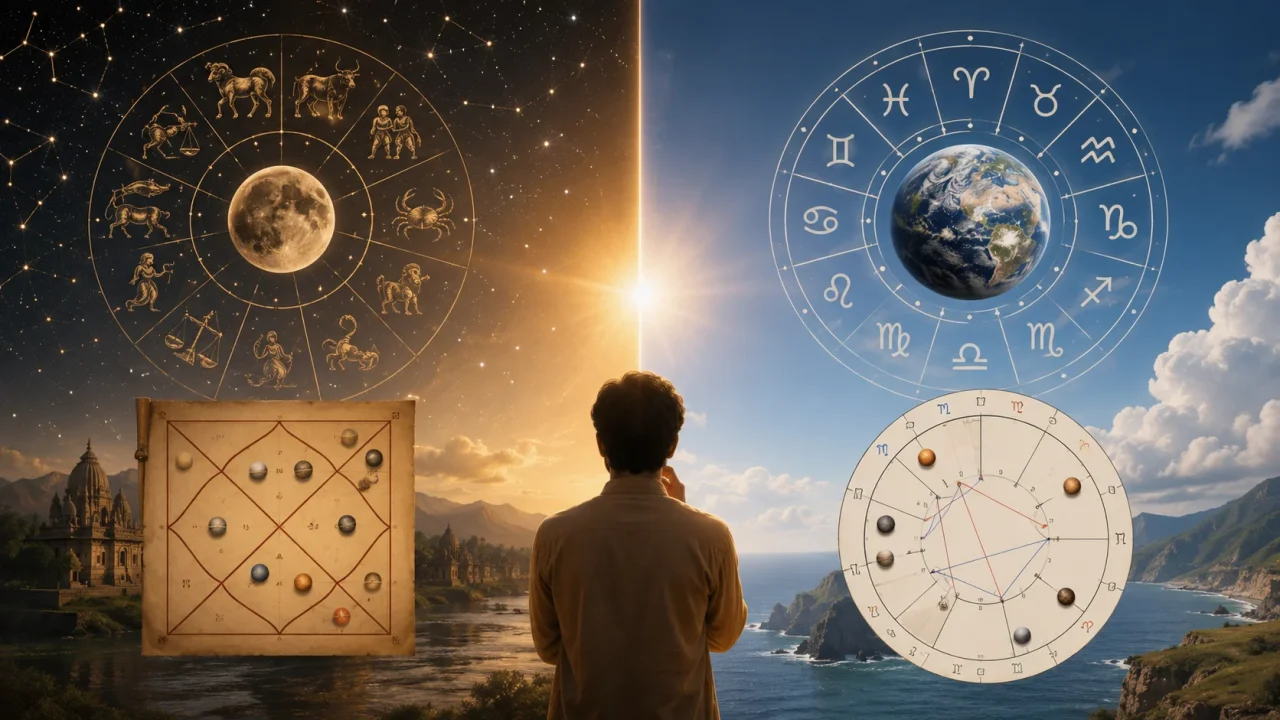
Western astrology begins the zodiac at the vernal equinox, the moment in March when day and night are equal. Whatever point in the sky the Sun occupies at that instant is called zero degrees Aries. This is called the tropical zodiac, and it is tied to the seasons.
Vedic astrology begins the zodiac from a fixed point measured against the actual stars. This is called the sidereal zodiac, and it is tied to the constellations themselves.
Now, if the equinox point stayed still against the stars, both systems would agree and there would be no article to write.
But it does not stay still. The Earth wobbles slowly on its axis, and because of that wobble the equinox point drifts backwards against the stars at roughly one degree every seventy two years. This is called the precession of the equinoxes and it is a measured astronomical fact, not a matter of opinion.
Two thousand years ago the two zodiacs were nearly aligned. Since then they have separated by about twenty four degrees.
Twenty-four degrees is most of a sign. Which is exactly why so many people find their sign has changed, and why those born in the later part of a Western sign usually shift back by one in the Vedic system.
That gap has a name. It is called the ayanamsha, and adjusting for it is the single calculation that converts one chart into the other.
So is one of them simply wrong
This is the question everybody wants answered, and the honest answer is more interesting than a verdict.
Both systems are internally consistent. Each one is measuring something real. The tropical zodiac measures the Sun’s relationship to the seasons and to the Earth’s tilt. The sidereal zodiac measures the Sun’s position against the actual constellations.
They are not two opinions about the same measurement. They are two different measurements.
Where the argument becomes fair is when you ask which one the ancient texts intended. The Vedic tradition consistently describes planets against named stars and nakshatras, which are physical star groups, and that points clearly to a sidereal framework. So within its own tradition, Vedic astrology is doing what its own literature describes.
Beyond that, I would rather judge each system by what it can actually do than by an argument about definitions. So let us look at that instead, because the zodiac question, honestly, is not even the most important difference.
The difference that matters far more than the zodiac
Vedic astrology has a timing system. Western astrology does not have an equivalent.
This is the point most comparison articles either miss or mention in one line, and it is the single largest practical difference between the two.
In Vedic astrology, the Vimshottari dasha divides a human lifetime of one hundred and twenty years into planetary periods, each of a fixed length, running in a fixed sequence, and the starting point is determined by exactly where the Moon sat at birth. Within each major period there are sub periods, and within those, further subdivisions. At any moment of your life, you can say which planets are currently in charge.
This is what allows a Vedic astrologer to say not merely that a person will face difficulty in career, but that it will surface in a specific stretch of years, and to be checkable about it.
Western astrology times events primarily through transits and through techniques like progressions. These are useful and they work in their own way, but they are a different kind of instrument. Transits tell you what is passing overhead. Dasha tells you which chapter of your own chart is currently open.
If you are asking which system predicts events better, this is where the honest answer lies, and it has nothing to do with which zodiac anybody uses.
The Sun and the Moon
Here is a difference that explains the entire flavour of each system.
Western astrology is built around the Sun. Ask somebody their sign in Europe or America and they will give you their Sun sign without hesitation.
Vedic astrology leans heavily on the Moon. In India, when somebody says their rashi, they usually mean their Moon sign. The dasha is calculated from the Moon’s nakshatra. A great deal of predictive work is done from the Chandra lagna, the Moon’s position treated as a starting point.
This is not a technical detail. It shapes what each system is naturally good at.
The Sun represents the essential self, the identity, the direction of the will. A system organised around it will naturally develop a rich vocabulary for character and purpose.
The Moon represents the mind, the emotions, the way experience is actually received. A system organised around it will naturally develop tools for tracking how life feels and how it moves, which is much closer to the ground where events actually happen.
Nakshatras
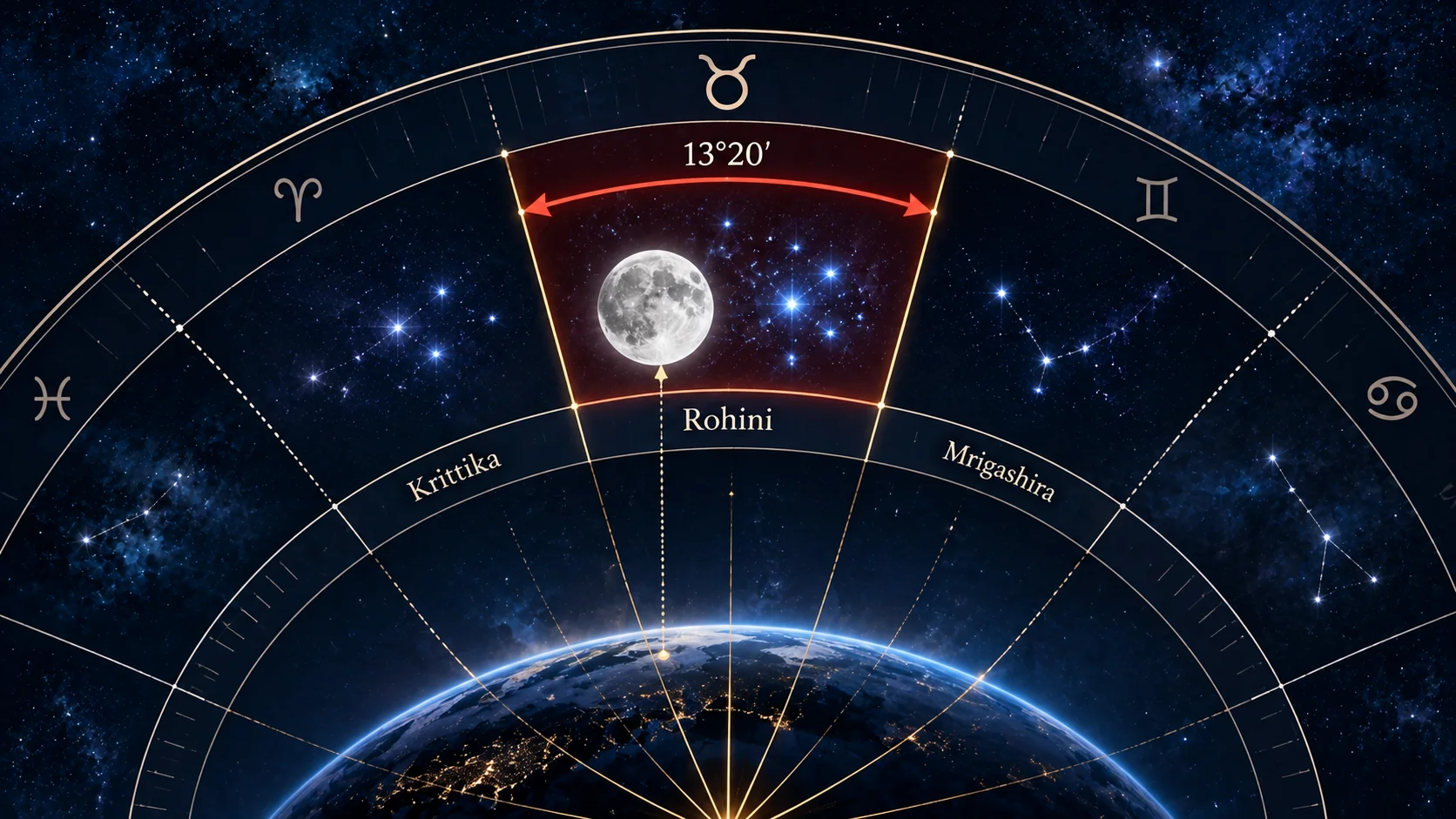
Vedic astrology divides the same circle a second time, into twenty seven nakshatras of about thirteen degrees each, each with its own ruling planet, its own nature and its own symbolism.
Western astrology has no working equivalent in general practice.
This is a genuine loss for the Western system, in my view, and I say that as somebody who does not enjoy scoring points. The nakshatra is the layer that explains why two people with apparently identical placements behave nothing alike. The sign gives you the broad territory. The nakshatra tells you which part of that territory the planet is standing in, and it often changes the reading completely.
Divisional charts
Vedic astrology takes the birth chart and generates further charts from it by dividing each sign into smaller parts. The Navamsha, dividing each sign into nine, is used for marriage and for the deeper strength of planets. The Dashamsha, dividing into ten, is used for career. There are many others.
The principle is that the birth chart makes an announcement and the relevant divisional chart confirms or refuses it.
Again, Western astrology has developed nothing that works like this. It reads one chart with great depth rather than generating a family of charts.
Aspects, which work quite differently
In Western astrology, an aspect is a specific angular relationship measured in degrees. Sixty degrees is a sextile, ninety a square, one hundred and twenty a trine, one hundred and eighty an opposition. Each has a distinct character, and a small margin of error is permitted around each.
In Vedic astrology, aspects work by sign rather than by exact degree, and they are not symmetrical. Every planet aspects the seventh house from itself. Beyond that, Mars additionally aspects the fourth and the eighth, Jupiter the fifth and the ninth, Saturn the third and the tenth.
Notice that Vedic aspects are one directional. A planet casts its glance forward. It does not necessarily receive the same glance back. This is quite alien to somebody trained in the Western system and it is one of the first things that confuses people crossing over.
The planets each system uses
Vedic astrology uses nine grahas. The seven visible bodies, plus Rahu and Ketu, the two points where the Moon’s path crosses the Sun’s. Rahu and Ketu are treated as full participants with enormous predictive importance, and no Vedic reading is complete without them.
Western astrology uses the same seven, plus Uranus, Neptune and Pluto, discovered in the modern era, and it has developed detailed meanings for them. It knows the lunar nodes but generally gives them far less weight than Vedic astrology does.
There is a real disagreement here and it is worth stating plainly. Traditional Vedic astrology does not use the outer planets at all. Some modern Indian astrologers have begun to, and it remains a live argument within the field.
Houses
Vedic astrology predominantly uses whole sign houses. The sign rising becomes the entire first house, the next sign the entire second, and so on. There is a separate refinement called the Bhava Chalit which checks whether a planet is really delivering the results of the house it appears to occupy, but the whole sign structure remains the backbone.
Western astrology most commonly uses house systems that produce unequal houses, of which Placidus is the most widely used. Houses can be of very different sizes, and a sign can be spread across two houses or swallowed entirely by one.
This means the same planet can genuinely sit in different houses in the two systems, on top of already sitting in a different sign.
What each one is actually good at
Here is where I will give you my honest assessment rather than a diplomatic non answer.
For predicting events and for saying when they will occur, Vedic astrology has tools that Western astrology simply does not possess. The dasha system, the nakshatras and the divisional charts together form a predictive apparatus of a different order. That is not a claim about which culture was cleverer. It is a description of what was built.
For understanding character, motivation and the inner psychological life, Western astrology has developed something genuinely valuable, particularly over the last century, when it absorbed a great deal from depth psychology. Its vocabulary for describing a personality is subtle and it is very good at helping a person understand themselves.
The systems answer different questions because they were built to answer different questions. Vedic astrology grew inside a framework of karma, where the chart shows what has been carried into this life and when it will surface. Western astrology, in its modern form, grew inside a framework of individual self development, where the chart shows who you are and what you might become.
Neither of those is a lesser question.
Should you learn both
Eventually, if you want to. But not at the same time, and definitely not at the beginning.
I say this from watching students try. The two systems use identical words for different things. The same person is a different sign, planets sit in different houses, aspects behave differently, and the entire method of timing is unrelated. A beginner holding both at once does not become broad-minded. He becomes confused, and he usually cannot tell which of his own conclusions came from where.
Choose one. Go deep enough in it that you can actually read a chart. Only then look across, and you will find the comparison genuinely interesting rather than destabilising.
If your interest is in prediction, in timing, in understanding karma and the sequence of events in a life, then learn Vedic astrology properly, in the right order, and give it the time it needs. If your interest is primarily in self understanding and psychological insight, the Western tradition may serve you better, and there is no shame in my saying so.
And about your sign changing
Since this is what brought most of you here, let me close on it.
You have not lost anything. You were never issued a fixed identity by either system, and no serious astrologer of either tradition would judge a person by their Sun sign alone. In Vedic astrology particularly, your Sun sign is a comparatively small part of the picture. The rising sign, the Moon, the nakshatra and the running dasha will tell you far more about your life than the sign you saw in a magazine ever did.
So the discovery that you are a different sign in the Vedic system is not bad news. It is usually the first sign that you have started looking at something with more in it than you expected.
 When the Remedy Do Not WorkMost people who ask this question have already spent money. A stone was bought and worn on the right finger on the right day. A pooja was done exactly…
 Why the Same Mahadasha Gives Two People Different LivesThe first article in this series ended on one sentence, and that sentence needs an article of its own. A dasha decides whose turn it is. It does not d…
 Vimshottari Dasha – Why It Starts From the Moon’s NakshatraMost students learn the dasha table before they learn what it is counting. The order gets memorised, the years get memorised, and the chart is never a…