The first article in this series ended on one sentence, and that sentence needs an article of its own. A dasha decides whose turn it is. It does not decide what the turn will bring.
That second half is where prediction actually happens. It is also where most readings go wrong, and they go wrong in the same way every time. Somebody looks up which dasha is running, remembers what that planet is supposed to mean, and says it out loud. Saturn means delay, so there will be delay. Jupiter means growth, so things will improve.
That is not reading a chart. That is reading a planet and hoping the chart agrees.
This article is about what actually decides the result of a dasha, and about the order in which those things should be asked.
The Dasha Lord is a Messenger, Not The Message
A planet running its period does not act for itself. It acts on behalf of the houses it owns, from the place where it is sitting, in the company it is keeping, and only as far as its own condition allows.
Four things, and they are not interchangeable. Each one answers a different question, and if you ask them out of order you will end up with a sentence that sounds like astrology and predicts nothing.
What does it own. Where does it sit. What reaches it. Can it deliver at all.
There is a fifth, what the planet stands for in itself, and it is kept for the end on purpose. It is the one most students reach for first, and reaching for it first is the single most expensive habit in this subject.
Take them one at a time.
One. What The Planet Owns
This is the first question and it is the one students skip most often, because it requires looking at the lagna before looking at anything else.
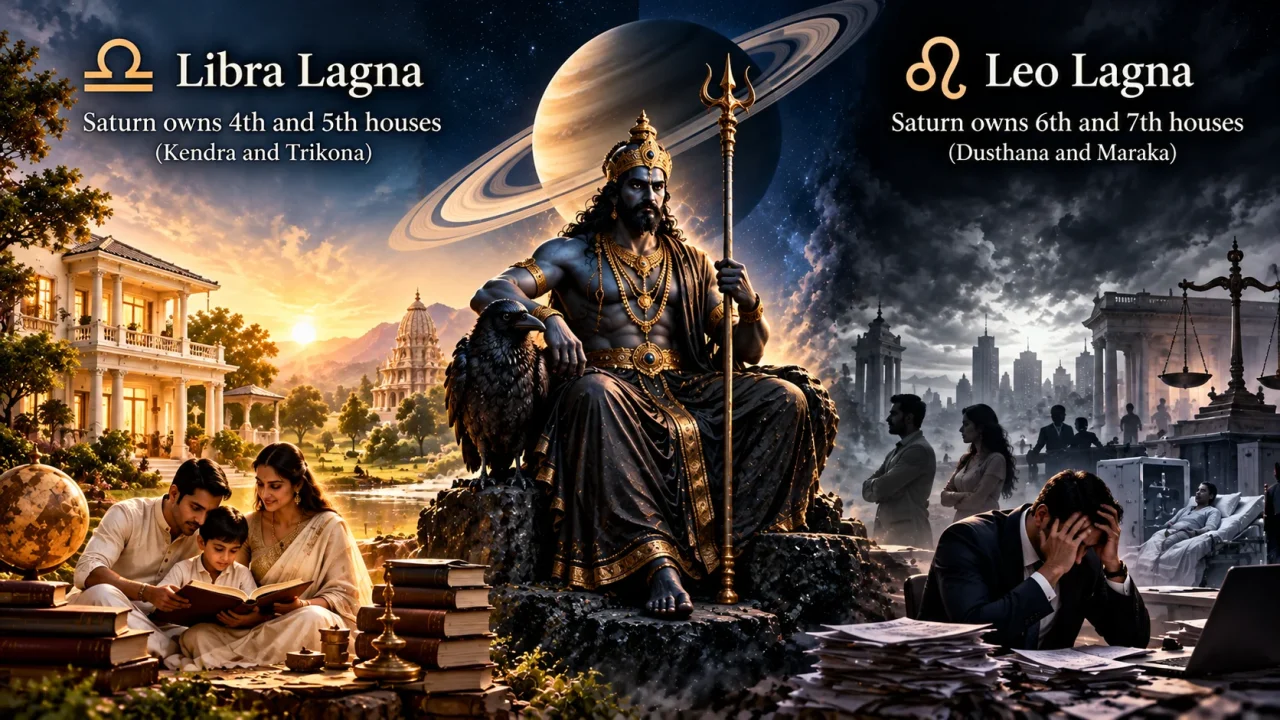
A planet is not a free agent in a chart. It is holding houses, and those houses change completely from one lagna to the next. Saturn is the clearest case, because nobody arrives at Saturn without an opinion already formed.
| Lagna | Houses Saturn owns | What that makes him |
| Libra | Fourth and fifth | A kendra and a trikona |
| Leo | Sixth and seventh | A dusthana and a maraka |
| Aries | Tenth and eleventh | Both houses of gain and work |
| Cancer | Seventh and eighth | A maraka and a dusthana |
Read that table slowly, because it settles an argument that otherwise runs for years.
For a Libra lagna, Saturn owns a kendra and a trikona at the same time. That is the one combination the texts single out, and such a Saturn is not a difficulty in that chart. It is the planet most capable of building something that lasts.
For a Leo lagna, the same Saturn owns the sixth and the seventh. The planet has not changed. Its job has.
So the sentence “Saturn mahadasha is running, therefore there will be trouble” is not a weak prediction. It is not a prediction at all, because it was made before the chart was opened.
Two. Where The Planet Sits
Ownership tells you what a planet is carrying. Placement tells you where it will put it down.
These are different questions and they often give different answers. A tenth lord is carrying work, position and public standing, whatever else is true of it. But a tenth lord sitting in the tenth and a tenth lord sitting in the twelfth are not going to hand over the same life. The first delivers at home. The second delivers somewhere far from where the person started, or quietly, or through an institution, or not in a form the family will recognise as success.
The promise is the same. The address is different.
This is also where most of the difference between two charts with identical lordships comes from. Two people can both have Jupiter as the ninth lord. In one chart it sits in the ninth. In the other it sits in the sixth. By the time Jupiter’s dasha arrives, those two people are not going to describe the same decade.
There is a second half to this that is easy to miss. The house a planet sits in does not only receive the result. It also becomes active in its own right during that dasha. A planet occupying the seventh will bring the seventh into the period even if it owns nothing to do with partnership, simply because that is where it has been standing all along.
So a dasha usually lights up three things at once. The houses the lord owns, the house it occupies, and the houses it is looking at. When a period feels like it is about four unrelated subjects at the same time, this is normally why, and the chart is not being inconsistent. It is being read too narrowly.
Three. What Reaches The Planet
No planet in a chart is alone. Something is sitting with it, something is looking at it, and both of those change what comes out when its turn arrives.
A planet that is otherwise capable can be held back by what it is sitting with. A planet that looked weak on paper can be carried by what is looking at it. This is ordinary chart reading and there is nothing special about it, except that it is routinely forgotten the moment a dasha is mentioned, as if the dasha lifts the planet out of the chart and lets it act alone.
It does not. The dasha only gives the planet the microphone. What the planet says is still decided by everything standing around it.
Worth separating the two kinds of contact, because they do not behave alike. A planet sitting with another shares its ground. The two of them have been mixed together since birth, and whatever one of them gives, the other is standing in the middle of it. An aspect is different. It arrives from a distance, it is one sided unless both planets look at each other, and it influences without sharing the ground.
In practice the difference shows in how clean the result is. A dasha lord sitting alone in a good house tends to give something recognisable. The same lord sitting with two other planets gives something mixed, where the person cannot easily say what the period was about, because it was about several things braided together.
Four. Whether The Planet Can Deliver at all
A planet can own the right houses, sit in the right place, and still arrive at its turn unable to do very much. Condition is the last question and it is the one that decides scale.
A planet in its own sign has its own ground under it. A planet in the sign of its exaltation is at its most capable. A planet in the sign opposite to that is working against the grain, and has to spend most of its period getting to where another planet would have started. A planet too close to the Sun is burnt and acts without being seen. A retrograde planet behaves in a way that deserves its own treatment and not a line in a list.
Now the caution, and it matters more than the list. Strength is capacity, not kindness.
A strong planet gives strongly. It does not give kindly. If what it is holding is difficult, a strong one will deliver that difficulty fully and on time. An exalted sixth lord is not a gift. It is a sixth lord that works well.
Students reverse this constantly. They see exaltation and relax. Exaltation only tells you the planet will do its job properly. What that job is was settled back in the first question.
And Last, What The Planet is in Itself
There is one more thing a planet carries, and it is deliberately placed at the end.
Every planet has subjects of its own, regardless of which chart it is in. Jupiter stands for children and for wealth. Venus stands for marriage and for comfort. The Sun stands for the father, the Moon for the mother. These do not change from lagna to lagna, and a dasha of that planet will usually touch its own subjects somewhere.
But this is the fifth question and not the first, and students who learn it first never recover from it. They see Venus mahadasha and say marriage. In that chart Venus may own the sixth and the eleventh, sit in the twelfth, and have nothing to do with the seventh at all.
A planet’s own subject tells you what it is interested in. Its lordship tells you what it is responsible for. When the two point in different directions, responsibility wins, and the planet’s own subject shows up only as a flavour running underneath.
The Mistake About Benefic and Malefic
Somewhere early in learning, every student is handed a list. Jupiter and Venus are benefics, Saturn and Mars are malefics, and so on. The list is not wrong, but it describes the planets in general, before any chart exists.
In an actual chart, ownership overrules nature.
Jupiter is a natural benefic in every chart ever cast. For a Sagittarius lagna it owns the first and the fourth, and there it is doing exactly what its reputation suggests. For a Taurus lagna the same Jupiter owns the eighth and the eleventh. Its nature has not changed. Its hands are full of something else.
So when Jupiter’s dasha arrives for those two people, the only honest thing to say before opening the chart is that Jupiter’s turn has come. Everything after that depends on which Jupiter you are talking about.
This is the whole reason a chart has to be read and cannot be looked up.
Two People, One Saturn Mahadasha
Put the four questions together on a single case and the point stops being theoretical.
Two people are both running Saturn mahadasha in the same year, and they are the same age.
The first has a Libra lagna. Saturn owns the fourth and the fifth, a kendra and a trikona, and it sits in Libra itself, the sign of its exaltation. Everything above lines up in the same direction. This is a planet carrying good houses, in strong condition, in a chart where it is one of the most capable things present.
The second has a Leo lagna. Saturn owns the sixth and the seventh and sits in the eighth with the eighth lord. Ownership is already difficult, placement makes it harder, and the company confirms it.
Same dasha. Same nineteen years. Same planet. Nothing else in common.
And notice what you had to know to say even this much. The lagna, the lordships, the placement, the condition and what else was sitting there. Five things, none of which the dasha itself tells you. The dasha told you only one thing, that it was Saturn’s turn.
Which Means The Usual Question Cannot be Answered
People ask whether Saturn’s dasha is bad, whether Rahu’s dasha is dangerous, whether Jupiter’s dasha is good. Asked that way the question has no answer, and giving one anyway is where an astrologer’s credibility quietly goes.
The answerable version of the question is longer. What is this planet holding in this chart, where is it placed, what is it with, what condition is it in, and what is it therefore in a position to deliver when its turn comes.
That version takes a chart and some time. The short version takes neither, which is exactly why it is so common.
Learn how to deal with Ketu Mahadasha
The Sub Periods Change The Picture Again
Everything above is about the mahadasha lord, and a mahadasha runs for years. Inside it, the antardasha lords take their own turns, and each of them brings its own set of four answers.
So a Saturn mahadasha is not one weather for nineteen years. It is Saturn’s subject matter, coloured in turn by every other lord in the chart, each of which has its own lordships and its own condition. The sub period lord can support what the mahadasha lord is trying to do, or work directly against it, and the difference between two years inside the same mahadasha often comes from nothing else.
That is the next article in this series.
Before You Move on
The method is short enough to keep in your head, and the order is the whole of it.
Find the lagna. Find what the dasha lord owns from that lagna. See where it sits. See what is with it and what looks at it. Judge its condition. And only at the end, remember what the planet stands for in itself. Until all six are done there is nothing worth saying out loud.
Do this on three charts whose lives you already know, before you do it on a chart you do not. If the method is sound it will describe what you already know about those three people. If it does not, something in the five steps was skipped, and it is almost always the first one.
 Ardra Nakshatra Compatibility Part 3 – (Moola to Revati)There is a result in this final group of nine that undoes a rule most students would have formed by now, and it is worth naming at the start. Ardra do…
 Ardra Nakshatra Compatibility Part 2 – (Magha to Jyeshta)Fourteen per cent. In all the years I have worked with these results I have not seen a lower figure anywhere, and it belongs to Ardra and Jyeshta, whi…
 Shakti Chakra Gazing – Myth vs Truth | Trataka, Sri Yantra & JyotishaSearch for Shakti Chakra gazing and the results settle quickly into a pattern. A circular black and white diagram appears, concentric rings and radiat…