This question arrives in my inbox in two very different tones.
Sometimes it is practical. There is no astrologer in the person’s town, the family has no connection to anybody in this field, and he simply wants to know whether books and the internet are enough.
And sometimes it is anxious. Somebody has told him that jyotish does not work unless it is received from a guru, that knowledge taken without permission does not bear fruit, and now he is worried that four years of his own sincere study have been wasted.
Both deserve an honest answer, and the honest answer has several parts.
Start with what you genuinely can learn alone
More than people admit.
Every rule in this subject is now available. Significations, house meanings, planetary conditions, aspects, nakshatras, dasha calculation, divisional charts, hundreds of yogas with their exact definitions. The classical texts have been translated. Software does in one second what once took an astrologer an hour with an ephemeris and a pencil.
Nothing is hidden any more. Whatever secrecy once surrounded this knowledge has been thoroughly dissolved by the printing press and then by the internet.
So if the question is whether the information is accessible without a teacher, the answer is plainly yes. A determined person sitting alone can acquire an enormous amount of correct astrological information, and I have met self taught astrologers who know more classical material than many people teaching courses.
That is not the difficulty. The difficulty is somewhere else entirely.
What you cannot get alone, and this is the whole problem
Five things. Read them carefully, because if you are studying by yourself, these are the exact places where you will lose years without noticing.
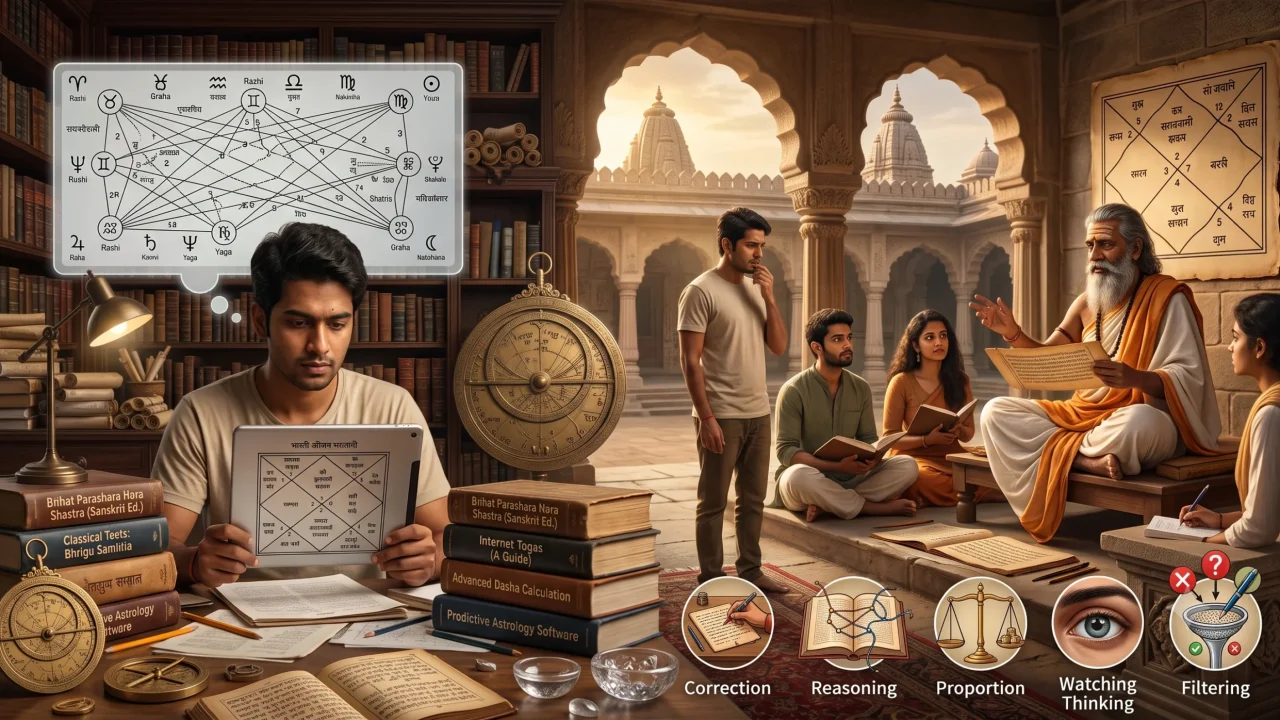
The first is correction.
When you are alone, nobody tells you that your reasoning is wrong. You reach a conclusion, it feels sound, you move on. If the logic underneath it is faulty, that fault stays. Then you build the next thing on top of it. Then the next. Five years later you have an elaborate structure standing on a mistake you made in the fourth month, and the terrible part is that it will feel exactly like progress the whole time.
A teacher’s real work is not handing you information. Information you can get anywhere. His work is catching the error you are structurally unable to see, because you are the one making it.
The second is the reasoning between the sutras.
The classical texts give you conclusions. They are compressed, deliberately, because they were composed to be memorised and then unfolded by somebody sitting in front of you. The reasoning that connects one sutra to the next was carried by voice and it is largely not on the page.
This is not a conspiracy against the modern student. It is simply how those books were built. But it means that a person reading them alone collects a very large number of conclusions with almost none of the logic that produced them, and conclusions without logic cannot be extended to a chart the book did not anticipate.
The third is proportion.
Alone, you have no idea what matters more. Everything in a book looks equally important, so you distribute your attention evenly. You will spend three months on a topic that deserved three days, and you will pass in one paragraph over something that deserved a month.
I see this constantly in students who come to me after years of self study. Their knowledge is not weak, it is oddly shaped. Extremely deep in two or three places they happened to find interesting, and unexpectedly thin in something basic that everything else depends on.
The fourth is watching somebody think.
You can read a finished chart analysis in a book. What you cannot see is how it was arrived at. Which factor did the astrologer look at first and why. What made him abandon his initial reading. Where did he hesitate. What did he decide to ignore, and on what basis.
The finished analysis shows you the destination. The thinking is the road, and books almost never print the road.
This is the one thing that only live teaching gives you, and it is the reason I refuse to convert my classes into recorded lectures. Thinking becomes visible only when somebody asks a wrong question out loud and it has to be untangled in front of everybody. That untangling is the actual lesson.
The fifth is filtering.
This one is new, and it has become the largest danger of self study in our time.
The problem today is not scarcity of astrological material. It is the flood of it. There are videos and articles and posts stating things with complete confidence that are simply incorrect, and a beginner has no equipment to tell the difference. Confidence reads as competence when you do not yet know the subject.
So the self learner absorbs good material and bad material at the same rate, and then spends years unable to work out why his predictions contradict each other. Half his rules are sound and half are not, and he cannot tell which half is which.
Now, about the word guru
Here I want to be careful, because this word carries weight and it also gets misused.
In the tradition, guru meant something specific and something serious. A relationship of transmission, over years, with responsibility flowing in both directions. That is a real thing and I have no interest in diminishing it.
But the word is also used today in a way that deserves plain speaking. It gets used to mean that you must not question. That the knowledge will not work for you unless it comes through a particular person or a particular line. That doubt is disrespect.
Please separate these two ideas, because they are not the same.
You need a teacher. That much is difficult to argue against, for all five reasons above.
Whether you need a guru in the full classical sense, with the surrender that word implies, is a separate question and a personal one. Some people find that relationship and it transforms them. Many perfectly competent astrologers never had it and read charts accurately for forty years.
What I will say plainly is this. A teacher who requires that you never question him is not protecting the tradition. Test whatever I teach you. I say that to every batch on the first day. If a classical rule does not hold in ten charts, bring those ten charts to me on Wednesday and we will look at them together. The rishis were recording observation. Observation is meant to be continued, not frozen.
And on the argument that knowledge received outside a lineage does not bear fruit, I would only say this. There is something real inside that idea, which is that a living line of transmission preserves method, refinement and accountability in a way books cannot. And there is something that has been added to it over time, which is gatekeeping and the manufacture of dependency. A sincere student can usually feel the difference between the two.
If you truly have no teacher, do these five things
I do not want this article to end by telling you to go and find a course. So here is what I would actually advise if you are on your own.
Pick one school and stay in it for a year. This is the most important instruction on the list. Self-learners destroy themselves by mixing five approaches simultaneously, because different schools use the same words to mean different things and different systems of house division and even different ayanamsha. Choose one author or one tradition, go deep, and only then look outward. Mixing is not open-mindedness at the beginning. It is confusion.
Find two or three serious peers. Not a large group. Two or three people at roughly your level who will actually examine your reasoning. This does not fully replace a teacher, but it recovers a meaningful part of correction, because another person can see your mistake far more easily than you can.
Keep a prediction notebook, dated, written before you learn the outcome. In the absence of a teacher, this notebook becomes your teacher. It is slower and less kind, but it is honest, and honesty is the scarce thing here.
Use free live teaching wherever you can find it. There is a great deal of it now, including my own Thursday sessions on YouTube, which have been running for years and cost nothing. Watching somebody handle a live question is the closest thing to a classroom that a self-learner can get for free.
And do not take paid consultations until your written predictions have proved themselves over at least a year. That is not about ethics alone. Reading for anxious people before you are ready is also the fastest way to develop bad habits, because you will start saying things to satisfy the person in front of you rather than because the chart says them.
So, the actual answer
You can learn a great deal of astrology without a teacher. Do not let anybody tell you your years of solitary study were wasted, because they were not.
But you will learn it slower, with more detours, and you will eventually arrive at one specific ceiling. It is the point at which you can no longer tell whether your own reasoning is sound. Your knowledge is large by then, your predictions are inconsistent, and you cannot diagnose yourself, because the instrument you would use to check your thinking is the thinking itself.
That ceiling is where a teacher stops being an advantage and becomes a necessity. Some people hit it in the second year and some in the seventh, but everybody who is serious hits it.
If you have hit it, you already know. The feeling is specific. You know a great deal, and you still cannot open an unfamiliar chart and say one confident sentence about it.
That is the moment to learn astrology under a teacher, not because the knowledge is being withheld from you, but because knowledge was never the part you were missing.
 Why the Same Mahadasha Gives Two People Different LivesThe first article in this series ended on one sentence, and that sentence needs an article of its own. A dasha decides whose turn it is. It does not d…
 Vimshottari Dasha – Why It Starts From the Moon’s NakshatraMost students learn the dasha table before they learn what it is counting. The order gets memorised, the years get memorised, and the chart is never a…
 Ardra Nakshatra Compatibility Part 3 – (Moola to Revati)There is a result in this final group of nine that undoes a rule most students would have formed by now, and it is worth naming at the start. Ardra do…