
There is a particular kind of student I meet every year, and you may recognise yourself in him.
He knows the grahas. He knows the bhavas and what each one governs. He can tell you which planet is exalted where. He has read about yogas, he understands Vimshottari dasha in principle, and he has a notebook that is genuinely impressive.
Hand him an unfamiliar horoscope and ask one simple question, and nothing comes.
He looks at the chart for a while. He says a few safe things. He may quote a rule or two. But he cannot arrive at an answer, and he knows he cannot, and that is the part that hurts.
If this is you, I want to tell you something first. Your problem is not that knowledge is missing. Almost nothing is missing from your notebook. Five things are going wrong, and none of them are about how much you know.
You never decided what the question is
Watch what you do when a chart opens in front of you. You try to read the chart.
That is not a task. A horoscope cannot be read in general. It can only be read against a question.
Will he get a job, will he become wealthy, and is his career stable are three completely different questions. They use different houses, different karakas, different dashas, and they can easily give three different answers in the same chart. A person can have a very stable job and very little wealth. Another can earn enormously and lose it twice.
So when you sit down with a chart and try to say everything about it, you end up saying nothing about it.
Pick one question. Answer that. Then pick the next one.
You have no fixed order of operations
This is the biggest one, and it is almost never taught.
Ask yourself honestly. When you open a chart, what do you look at first, and second, and third? Most students have no answer. They look at whatever catches the eye. A debilitated planet somewhere, a conjunction that looks interesting, a yoga they recently read about. Then they follow that thread, get lost, and start again.
Every chart becomes a fresh panic because there is no sequence.
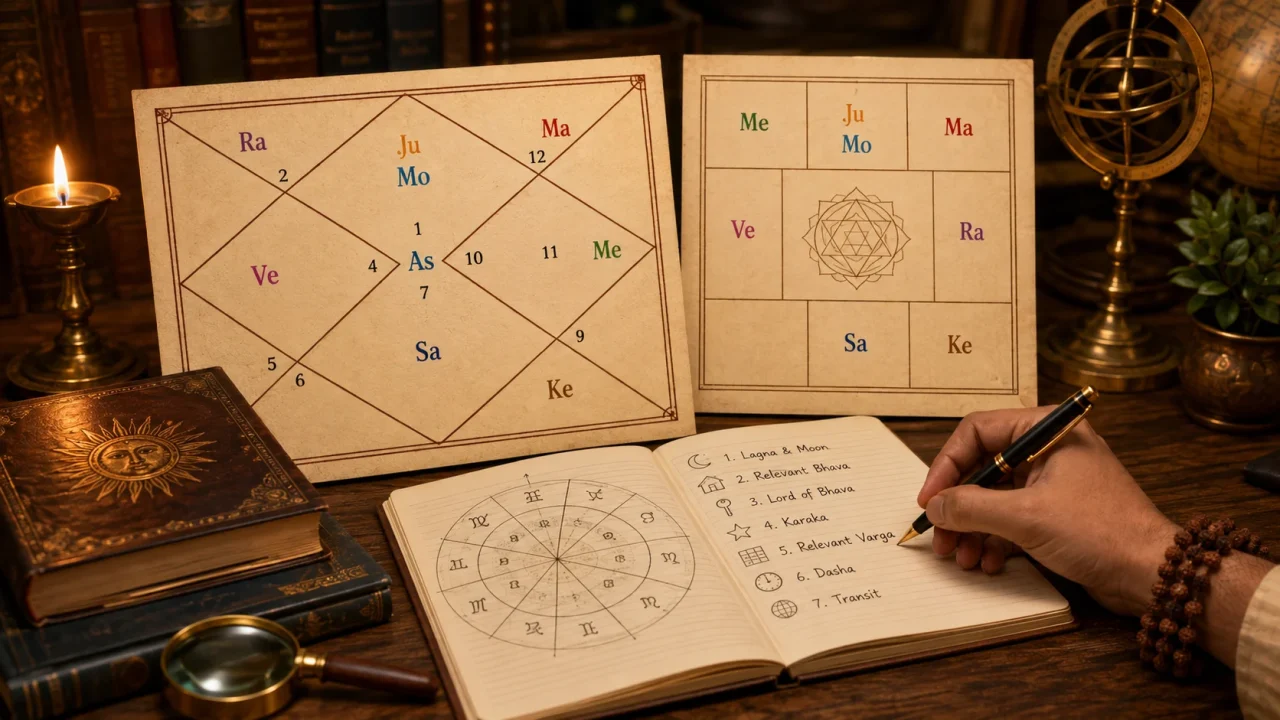
There has to be one. Lagna and Moon first, always, because you must know the person before you judge his events. Then the bhava the question belongs to. Then the lord of that bhava and where it has gone. Then the karaka. Then the relevant divisional chart. Then dasha. Then transit, last, because transit only triggers what has already been permitted.
And here you have to be careful about which bhava the question actually belongs to. A student once asked me about a job loss and went straight to the tenth house. But this man was a salaried employee, and service under another person is the sixth house far more than the tenth. The tenth carries profession, status and authority. Employment is sixth house work. He was reading the right chart and the wrong house.
Fifteen minutes of confusion, from one wrong starting point.
You are looking for confirmation, not evidence
This one is uncomfortable, so I will say it plainly.
Usually, before you have properly examined the chart, you already suspect what the answer is. Somebody told you the marriage is in trouble. The person sitting in front of you looks unwell. You heard the family situation before you saw the horoscope.
And from that moment, you are not reading the chart. You are searching it for support.
The trouble is that you will always find support. A horoscope has enough factors in it to justify almost any conclusion if you are willing to hunt long enough. This is exactly why two astrologers can look at the same chart, having heard two different stories, and confidently reach opposite predictions. Neither of them lied.
The discipline is to reach your reading before you learn the outcome, and to write it down before you find out. This is also why I insist that charts be opened cold in class, without preparation, because a prepared chart teaches nobody anything.
Nobody taught you how to weigh
Every chart contradicts itself. This is not a defect. It is normal.
One factor says the marriage is strong. Another says there is strain. A third says the timing has not arrived. Beginners freeze here, because they were taught rules and never taught precedence.
So let me give you the precedence, because it is rarely written down anywhere.
Dasha outranks promise. A beautiful yoga sitting in a chart does absolutely nothing until its period arrives. I have seen excellent marriage combinations deliver at forty two, and the yoga was never weak. The clock had simply not reached it.
The bhava outranks the karaka. If the seventh house and its lord are in good condition, a weak Venus will not prevent marriage. It will affect the flavour of it, not the fact of it. Students reverse this constantly and predict denial where there is only difficulty.
The divisional chart outranks the birth chart for its own subject. What the birth chart announces, the Navamsha confirms or refuses in matters of marriage, and the Dashamsha in matters of career. A promise that collapses in the relevant varga usually collapses in life.
And Chalit outranks the rashi chart when you are asking whether a planet is really giving the results of a house at all.
Learn these four and half of your contradictions resolve themselves. This kind of judgement is the actual content of a serious Vedic Astrology Course, and it is the reason a proper course runs for a year and not for three months.
You have never written a prediction down
This last one is practical, and it is the one almost nobody does.
Take a notebook. Before you check any outcome, write the date, the question, your reading, and the period in which you expect it. Then close the notebook and come back after six months.
Do this for a year and you will change as an astrologer.
Here is why it matters so much. Memory quietly edits itself. You remember the predictions that landed and you forget the ones that did not, and so year after year you feel you are getting better without any evidence that you are. Worse, you never find out which rules actually work in your hands and which ones you have been repeating on faith.
Confidence in this subject does not come from having read a rule. It comes from having personally watched a rule hold true thirty times. There is no shortcut to that, and there is no teacher who can hand it to you.
So what should you do now
Do not go looking for more material. That instinct is exactly what got you here.
Take one question. Take ten charts of people whose lives you actually know. Follow a fixed order every single time. Write down what you conclude before you check.
You will be wrong often at the start. That is not a problem, it is the method. Every wrong reading tells you precisely which link in your own reasoning is loose, and that is information you cannot get from any book.
You already know more astrology than you think. What you are missing is not knowledge.
It is the habit of thinking in a fixed order, under a specific question, with the honesty to be wrong on paper.
 Why the Same Mahadasha Gives Two People Different LivesThe first article in this series ended on one sentence, and that sentence needs an article of its own. A dasha decides whose turn it is. It does not d…
 Vimshottari Dasha – Why It Starts From the Moon’s NakshatraMost students learn the dasha table before they learn what it is counting. The order gets memorised, the years get memorised, and the chart is never a…
 Ardra Nakshatra Compatibility Part 3 – (Moola to Revati)There is a result in this final group of nine that undoes a rule most students would have formed by now, and it is worth naming at the start. Ardra do…

1 thought on “Why You Still Cannot Predict, Even After Learning Astrology”
This article is honestly an eye-opener. Mujhe realise hua ki problem astrology padhne ki nahi thi, balki analysis ke approach ki thi.Ye article sirf information nahi deta, sochne ka tareeka sikhata hai. Thank you, sir, for sharing such valuable guidance. 🙏🏻🙏🏻🙏🏻