The last article in this series ended on a problem it did not solve. A planet gets its turn, and what it gives depends on what it owns, where it sits, what touches it and whether it can act at all. But Saturn’s turn runs for nineteen years, and nobody lives nineteen years of one weather.
Something inside that period has to move, or the dasha would tell you a person’s decade and nothing finer.
That something is the antardasha.
Why a Mahadasha Has to Be Divided
Think about what you are actually being asked when somebody brings a chart. Not what the next nineteen years hold. He wants to know about this year, and usually about one thing in it.
A mahadasha cannot answer that. It is the right unit for the subject of a stretch of life and the wrong unit for an event.
So the period is divided again. The same nine lords take turns inside it, in the same order, each one holding the floor for a while. The mahadasha lord stays in charge throughout. The sub period lord is the one actually doing the work at any given moment.
Two people describe this difference without knowing it. When someone says a decade was hard but there were two good years in the middle of it, he is describing a mahadasha and the antardashas inside it.
There is a second reason, less obvious and more useful. A mahadasha can only tell you whose subject matter is in play. It cannot tell you when that subject will actually arrive, because the same planet is in office for the whole stretch and nothing about it changes from one year to the next. Something has to move for an event to have a date, and the only thing that moves inside a mahadasha is the sub period lord.
So the antardasha is not a refinement that careful astrologers add. It is the first level at which timing becomes possible at all.
The Arithmetic, in One Line
There is one rule and it does not change.
A lord’s turn inside a mahadasha is as large a share of that mahadasha as its own period is of a hundred and twenty years.
Written as a sum, the length of a sub period is the mahadasha years multiplied by the sub lord’s own years, divided by a hundred and twenty.
Nothing else is involved. No chart, no lagna, no planet’s condition. The lengths are the same for every person alive. What changes from one chart to another is only which mahadasha you are inside, and where in it you are standing.
This is worth saying because students expect the strong planet to get a longer turn. It does not. Strength decides what a planet does with its turn, never how long the turn is.
A Worked Example, and Why the Moon is Easiest
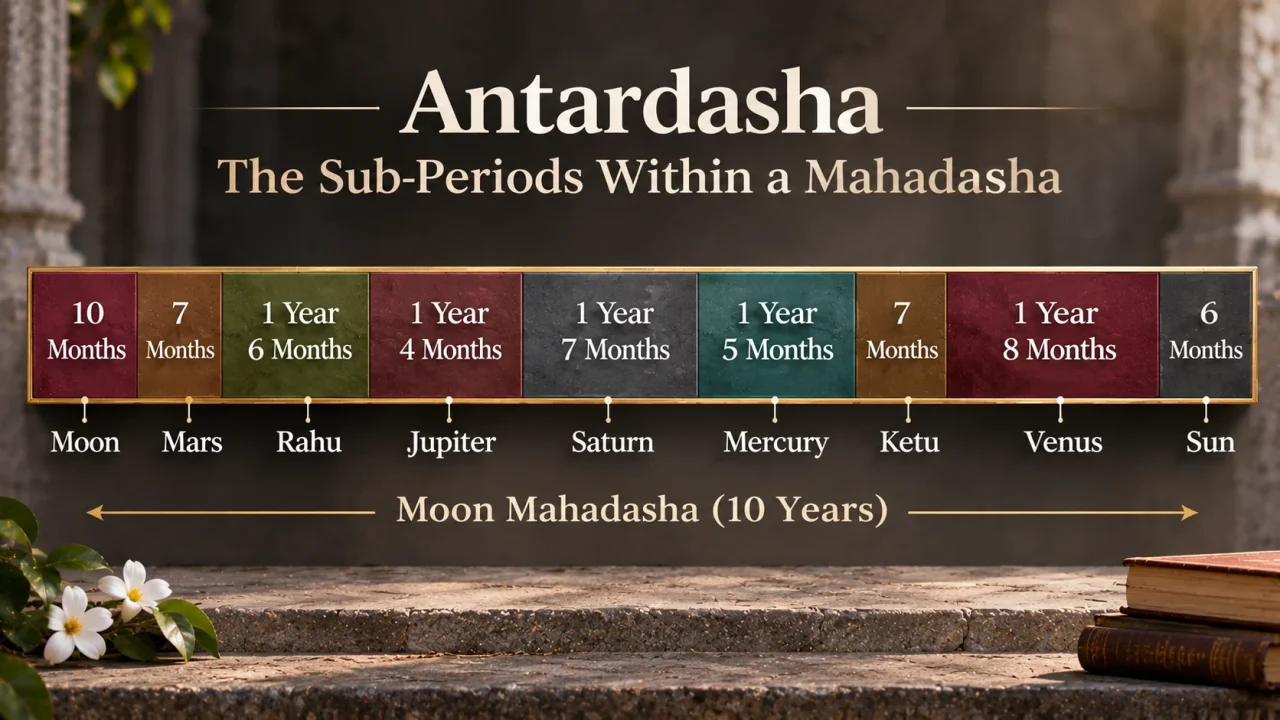
Take the Moon’s mahadasha, which runs ten years, and work out every sub period inside it.
| Sub period lord | Its own years | Length of its turn |
| Moon | 10 | 10 months |
| Mars | 7 | 7 months |
| Rahu | 18 | 1 year 6 months |
| Jupiter | 16 | 1 year 4 months |
| Saturn | 19 | 1 year 7 months |
| Mercury | 17 | 1 year 5 months |
| Ketu | 7 | 7 months |
| Venus | 20 | 1 year 8 months |
| Sun | 6 | 6 months |
| Total | 120 | 10 years |
Look at the two columns on the right and the whole thing gives itself away.
In the Moon’s mahadasha, each lord’s turn in months is exactly its own number of years.
Venus has twenty years, so it gets twenty months. Saturn has nineteen, so nineteen months. The Sun has six, so six months.
That is not a coincidence and it is not a rule of its own. The Moon has ten years out of a hundred and twenty, which is one twelfth. A twelfth of a year is a month. So anything measured in years becomes the same number in months.
Learn the Moon’s mahadasha this way and you never need a table for it again. More usefully, you will have understood the proportion itself, and the proportion is the whole method.
When the Numbers Are Not Tidy
Most mahadashas do not divide so politely. Saturn runs nineteen years, which is not a neat fraction of a hundred and twenty, so the sub periods come out in years, months and days.
Inside Saturn’s mahadasha, Saturn’s own turn is three years and three days. Mercury gets two years, eight months and nine days. The Sun gets eleven months and twelve days.
Do one of those by hand before trusting any table. Nineteen multiplied by six is a hundred and fourteen, divided by a hundred and twenty is nought point nine five of a year. Nought point nine five of twelve months is eleven point four months. The four tenths of a month is twelve days. Eleven months and twelve days.
The step that trips people is turning the leftover into days. A year has twelve months, so multiply the leftover part of a year by twelve and you have months. A month here is counted as thirty days, so multiply whatever is left after that by thirty and you have days. Nought point four of a month is twelve days. Nought point three is nine. That is all there is to it.
It is ordinary arithmetic, and the only reason it feels like something else is that most students meet it as a printed table and never see where the table came from.
And once you have done two or three by hand, the printed table stops being something you trust and becomes something you check.
The Order Inside a Mahadasha
The sub periods do not start from Ketu. They start from the mahadasha lord itself, and then continue in the usual order of the nakshatra lords, wrapping around to the beginning when they reach the end.
So a Moon mahadasha opens with Moon, then Mars, Rahu, Jupiter, Saturn, Mercury, Ketu, Venus and the Sun. When the Sun’s turn ends, the ten years are over and the Mars mahadasha begins, which will open with its own sub period of Mars.
The first sub period of any mahadasha therefore belongs to the lord of that mahadasha. This is a small thing and it explains something students notice without being able to name. The opening stretch of a period often feels like the period in its purest form, because for that while the same planet is holding both offices.
A Check That Catches Most Mistakes
There is a test you can run on your own working, and it costs nothing.
The nine sub periods must add up to the mahadasha exactly. Not nearly. Exactly.
In the Moon’s ten years the months were ten, seven, eighteen, sixteen, nineteen, seventeen, seven, twenty and six. That is a hundred and twenty months, which is ten years.
If your nine numbers do not come back to the mahadasha, something is wrong, and almost always it is one of two things. Either a lord’s years were remembered incorrectly, or the division was done against something other than a hundred and twenty.
Get into the habit of running this check. It is the only error in dasha work that announces itself, and it is a pity to waste it.
Reading the Sub Period Lord
Now the part that actually decides what happens, and it is the same work as before.
The five questions from the last article apply to the sub period lord exactly as they applied to the mahadasha lord. What does it own from this lagna. Where does it sit. What is with it and what looks at it. What condition is it in. And last, what does it stand for in itself.
Nothing new has to be learnt. The method is simply used twice.
But there is one question that only exists here, and it is the one that separates a reading from a recitation.
When the Two Lords Disagree
You now have two planets in office at the same time, and they may want different things.
Ask what each of them owns in the chart, and then ask whether those houses support one another or work against one another. A mahadasha lord carrying the tenth and a sub period lord carrying the sixth are not pulling the same way. A mahadasha lord carrying the ninth and a sub period lord carrying the fifth are.
Then ask where the sub period lord sits in relation to the mahadasha lord. A sub lord sitting with the mahadasha lord, or looking at it, is involved in what the mahadasha is doing. A sub lord sitting far away, in a house that has nothing to do with it, tends to pull the period off in its own direction for a while.
From this comes the practical rule, and it is worth holding on to.
The mahadasha decides what the period is about. The antardasha decides whether it moves, and in which direction.
Which is why a good sub period inside a difficult mahadasha gives relief rather than rescue. The subject of those years does not change. The pressure eases, something that was stuck moves, and then the next sub lord takes over and the subject is still there.
People feel this and misread it. They think the bad time ended and then came back. It never ended. The floor changed hands.
Not Every Sub Period Brings Something
One more thing has to be said, because students who have just learnt this tend to expect too much of it.
A period does not create. It releases. If a chart does not promise a thing at all, no sub period of any lord will produce it, however well placed that lord is and however long its turn runs. The sub period is a door being opened. What walks through it was already standing in the chart.
This is why some sub periods pass without anything in particular happening. The lord took its turn, it had nothing much to hand over in that chart, and the months went by. That is a correct reading, not a failed one.
The student who cannot say this out loud ends up inventing an event for every period, and that habit, once formed, is very hard to break.
How Far Down Should You Go
The same rule divides again. Inside a sub period, the nine lords take turns once more, in proportion, starting from the sub period lord. That third level is the pratyantar, and it can be divided a fourth and a fifth time after that.
The arithmetic never stops. Judgement has to.
Going down to the third level is reasonable when you are trying to narrow something that the first two levels have already pointed at. It is not reasonable as a way of finding something the first two levels never showed. If the mahadasha and the antardasha say nothing about marriage, the pratyantar will not produce a marriage out of nowhere.
And there is a limit underneath all of this that has nothing to do with method. Everything here rests on the balance of dasha at birth, and that rests on the birth time. An hour of error moves the whole sequence by months. Dividing a period that is already standing in the wrong place into days does not make the days true. It only makes the error look precise.
The first article in this series was about where the sequence starts. This is why that mattered.
Before You Move On
Take your own chart. Find the mahadasha you are running and work out all nine sub periods inside it by hand, with the proportion, not from a table. Check that they add back to the mahadasha.
Then mark where you are standing today, and look back at the sub period before this one.
If the method is sound, the change of floor between those two will be something you remember.
 Punarvasu Nakshatra Compatibility Part 2 – (Magha to Jyeshta)Two of the nine matches in this group are flagged as sexually incompatible, and both of those partners carry the same animal classification. Magha and…
 Punarvasu Nakshatra Compatibility Part 1 – (Ashwini to Ashlesha)Most nakshatras are given one ideal life partner. Punarvasu is given two, Bharani and Pushya, and both of them rate exactly seventy-six per cent. That…
 What a Remedy is Supposed to ChangeThe earlier article in this line asked whether a remedy was aimed at the right planet. That question is a real one and it settles a large number of ca…