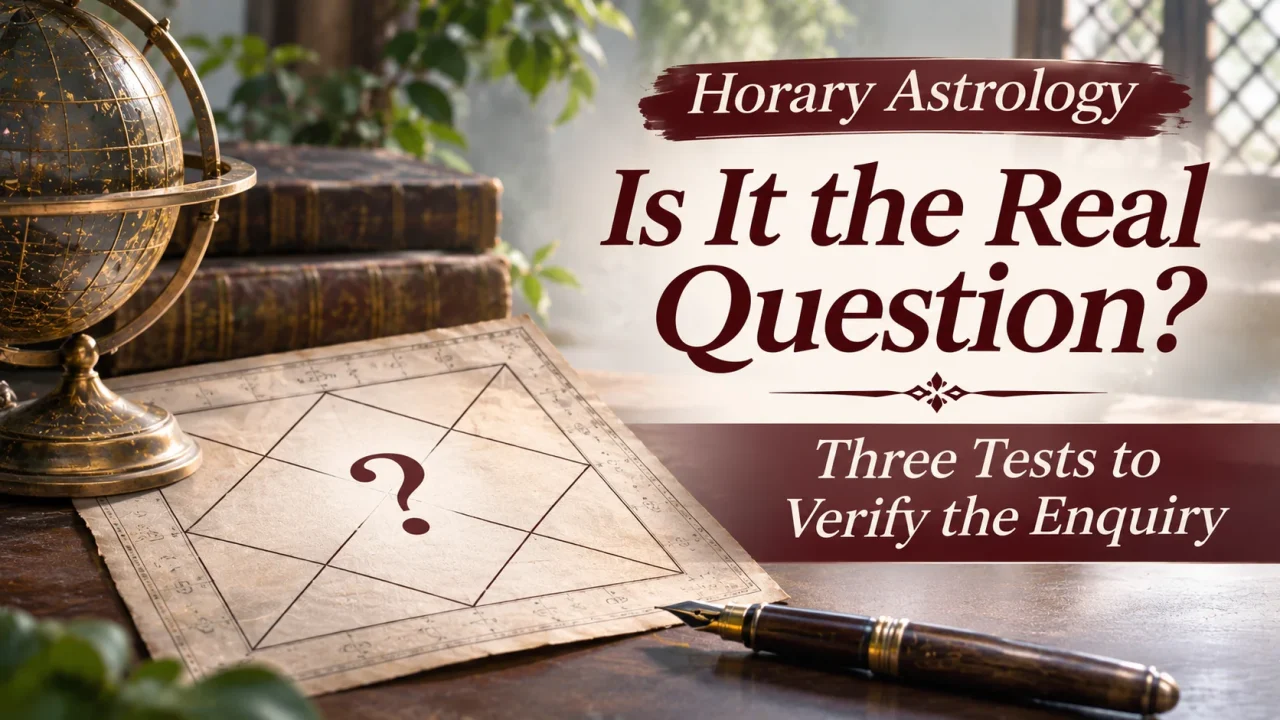
The Moment of the Question is Its Chart
Horary astrology rests on a single proposition, that the birth of a thought matters as much as the birth of a person. The moment a question forms in the mind and comes out in words, the planetary positions of that moment carry the fate of that question in the same way a birth chart carries the fate of a life. For this reason a horary chart is not read only for its answer. The nature of the question is read out of it as well.
One consequence of this principle receives far less attention than it deserves. If the moment of the question is the foundation of the chart, then the astrologer has to satisfy himself that the question placed before him is actually the question sitting in the mind of the person who brought it. Experience says that this is often not the case. One man holds back the real matter out of hesitation, another frames a crooked question to test the astrologer, a third conceals his position out of shame, and there are people who do not themselves know what is really troubling them. Where the words are accepted as the question, every calculation may be correct and the answer will still be of no use.
This is where the particular strength of Prasna appears, the strength that separates it from the study of a birth chart. The horary chart does more than answer. It tells you whether the question is honest, and in some cases it tells you what the question should have been. No outside guesswork does this. The indications within the chart do it, and there is a definite method for reading them.
That method is set out here in order. The first three sections carry the three levels of testing. After them comes a recorded example in which all three levels can be seen working together, and the article closes with a sequence for practice and a few cautions.
The First Test, the Ascendant and the Moon
Once the chart is cast, the first look belongs to the Ascendant and the Moon, not to the house of the matter enquired about. The Ascendant stands for the person asking and the Moon stands for his mind. When both carry affliction, the meaning is that the man is in real distress and that his mind is disturbed. A person who brings a question out of curiosity, or in order to test the astrologer, does not carry that distress at that moment, and as a rule you will not find affliction resting on both the Ascendant and the Moon in his chart.
The reasoning behind the rule should be understood, because without it the rule turns mechanical. The horary chart belongs to the moment at which unease turned into words. Where there is no unease in the mind, the moment of the question is not carrying any either. The test is therefore a test of the situation and not of the man’s character. Whether someone has come with bad intent is not something the Ascendant and the Moon will tell you. What they tell you is whether real pressure stands behind the question.
Noting that affliction is present is not enough, its nature has to be examined too. Which malefic is causing it, which houses that malefic rules, and whether the affliction comes by conjunction or by aspect, all three matter later in the reading. One indication is doing two jobs here. The first is to establish that genuine distress lies behind the question, and the second is to show how deep that distress runs and from which direction it is coming.
The limits of the test are worth knowing as well. Not every afflicted Ascendant means a serious crisis, and not every well placed one means the enquirer is joking. Where the question is ordinary and there is no doubt about the enquirer’s intention, the test need not be applied at all. It earns its place only when the intention is unclear, or when the question itself strikes you as unusual.
The Second Test, House, Lord and Karaka
The subject of the question decides which house is to be read. A question of marriage takes the seventh, a question of illness the sixth, a question of children the fifth, a question of employment the tenth. Everyone knows that much. The real rule comes after it, that the house is not to be read on its own. Three things have to be examined separately, the house itself, the lord of that house, and the karaka of that matter.
The three do not perform the same work, which is why they are not read as one. The house is the field in which the event has to occur, the lord is the force that runs that field, and the karaka is the standing significator that represents the matter in every chart. Strength in one does not cover affliction in another. Those who deliver a verdict on the karaka alone usually fail to see the obstruction sitting on the house, and those who read the house alone leave out the capacity lying in its lord.
Keep the order of enquiry like this. Who occupies the house and whose aspects fall on it. Where the lord has gone, what state it is in, and what surrounds it. Where the karaka is and what condition it carries. Writing down the answer for each of the three separately is a good habit, because it is only on paper that you see whether they agree with one another.
When all three point the same way the answer is simple. A benefic house with a strong lord and a well placed karaka will give the result, and all three afflicted will not. Charts like that do occur and there is no reason to labour over them. The difficulty begins when some indications are favourable and others are not, and this is the situation in most cases. The next section deals with it.
When the Indications Contradict Each Other
Suppose the karaka is well placed and the house lord is exalted, while malefics occupy the house and malefic aspects fall on the lord as well. What is to be said now? Most readers begin counting at this point. Two indications favour the matter and two oppose it, so whichever side looks heavier gets the verdict. That is the biggest mistake made here, and it is also the exact point at which the real work of Prasna begins.
The rule is to hold both sides true at once and ask what actual situation would make them both true. The chart is not wrong, our question is too narrow. When you ask whether the matter will come about or not, the chart has only two boxes to fill and it fills both of them. When you ask instead what the state of this matter is, those same two indications assemble into a single picture.
Take marriage as the example. If marriage is indicated and the seventh is afflicted, the possibilities can be listed. The marriage will take place but late. The marriage will take place against opposition. A marriage has already taken place and it ended badly. The marriage will take place but the circumstances of the other party will be unusual. All of these are possible together, and which of them is true gets narrowed down by the rest of the chart. Which planet is causing the affliction, which houses it rules, and whether that affliction belongs to time already past or time still to come, these three questions usually settle it.
A contradiction carries one further meaning that is commonly passed over. Sometimes two indications are true together because the question was put incompletely. What the man is asking is only one end of what is actually worrying him. In such a case the chart keeps answering his words while also showing the indication that belongs to the situation outside those words. Put the two together and the real question comes into view.
This is where the line falls between a practitioner and a beginner. Faced with a contradiction the beginner retreats into a vague answer, that there are some obstacles but the work will get done. An answer of that kind serves nobody. The practitioner treats the contradiction as information and uses it to narrow the situation, step by step, until a single picture is left standing.
A Recorded Example
What the whole method looks like when it works together can be seen in a recorded case. B. V. Raman set this one down in his memoirs, and its value lies in the fact that he recorded the full chain of reasoning alongside the conclusion. Cases documented in that way are uncommon, since an astrologer usually reports where he arrived and keeps the road to himself.
On 30 May 1932, at about half past one in the afternoon, a lecturer came and asked that the Kalatra Bhava in his horoscope be examined, because he wanted to get married. He was thirty six years old. Marriages in those years took place far earlier in life, so the doubt was natural, whether the question was serious or whether it was a joke at the astrologer’s expense. It was in that state of doubt that a horary chart was cast.
At the first test both the Ascendant and the Moon were found afflicted, so the question was genuine. At the second test Venus as Kalatrakaraka stood in the tenth and was fairly well placed, and Jupiter as lord of the seventh was exalted. Stopping there would have produced the answer that marriage would take place. But the seventh house held the Moon and Rahu, and that conjunction was aspected by Saturn and Jupiter. The lord of the seventh was receiving two aspects as well, one from Mars as lord of the third and the eighth, the other from Saturn as lord of the fifth and the sixth. This was exactly the contradiction described in the section above, and what came out of it was that the matter of marriage was not straightforward and that something must have gone before.
The birth chart repeated the same indication. Rahu occupied the second, the Moon as lord of the seventh was afflicted by its conjunction with Saturn and the aspect of Mars, and Venus the karaka was afflicted too. That repetition is the confirmation. Timing came next. Venus and Saturn placed in mutual kendras or trines give auspicious results, and on that dictum the sub period of Venus in the major period of Saturn must already have given the marriage. Venus stood in a common sign with the malefic Sun, which meant an intensification of distress attached to it.
On this footing it was declared that the man had married twice and that both wives were dead. It proved true. The first marriage took place in 1918 at the age of twenty two, in that same Venus period within Saturn, and after the birth of a child in 1920 the wife died. The second marriage took place in 1925, in the sub period of Rahu within Saturn, and in 1930 both the mother and the child were lost.
The second death had fallen in Mercury’s own major period and his own sub period, and this proved the hardest part. Mercury was lord of the ninth, placed in the fifth in a friendly sign and in parivartana with Venus, so the only flaw left was his lordship of the sixth, which was too thin to account for the death of a wife. After long cogitation a verse came to mind whose sense is that when Mercury occupies the fifth house and his dispositor is in the sixth, the wife dies in Mercury’s own Dasa and Bhukti. That combination was present in the chart.
The timing of the third marriage followed in this manner. Mercury was capable of granting marriage, and Venus as Kalatrakaraka was taken for the sub period, placed in the ninth from the Moon and the second from the major lord. That period fell in 1934. The finer timing came from transit, that the event would occur when Jupiter transited Libra, which gave the first quarter of 1934. The marriage took place in April 1934.
What This Example Yields
The most valuable part of the whole episode is the sentence spoken to the lecturer, that his question was not properly worded and that what he should have asked was whether he was going to get married again. The man who had come to ask whether a marriage would take place was in fact worried about something else, that what had happened twice should not happen a third time. He had not been able to say it himself, whether from reserve, or from shame, or perhaps from a fear that saying it would colour the answer he received.
Notice now how the three levels of the method did their work. The first level established that the question was genuine, so going further was worthwhile. The second level laid out both the favourable and the unfavourable indications. The third level, which is the reading of the contradiction, produced the conclusion that something had already occurred. And once that was in hand, the question changed by itself. Resolving the contradiction and rewording the question are not two separate operations. They are one operation known by two names.
The practical weight of this should be clear. Had the words been accepted as the question and had the reading gone no further than whether marriage was indicated, the answer would have been technically correct and practically worthless. The marriage would have come about anyway, and the man would have received no guidance at all on the thing he actually feared. With the real question in view, he was not merely given a date. The combination that had taken two lives was identified, and it was established that the combination had already run its course. That is the answer that was worth having.
There is an ethical side to this which deserves to be stated separately. It is not the astrologer’s business to open up a man’s concealed affairs in order to display his own skill. Raman writes that in those years he had a strong inclination to show what he could do, and in later life he regarded that inclination as arrogance. In this instance, though, reframing the question was not a performance. It was the condition on which help became possible, because until the real question was on the table no help could be given.
The distinction is worth teaching. A concealed matter is brought out when the answer would otherwise remain incomplete. A matter with no bearing on the answer is left alone even when the chart reveals it. The tradition has always taught that hard statements of this kind should be sugar coated before they are spoken, and that anything touching a person’s character should not be said at all unless it has been asked for.
A Sequence for Practice
The whole method can be set out in five steps. The sequence is meant for those situations in which the intention behind a question, or its completeness, is in doubt, and not for every ordinary question that comes your way.
- Cast a chart for the moment of the question and examine the Ascendant and the Moon. If both are afflicted there is real distress behind the question. Study the nature of the affliction as well, since that is what tells you how serious the problem is.
- Take the house of the matter enquired about, its lord, and its karaka, examine all three separately and write down the answer for each. Do not deliver a verdict on the strength or affliction of any one of them alone.
- If some of the three are favourable and some are not, do not choose a side by counting. Ask instead what actual situation would make both sets of indications true at the same time. This is what opens up the real nature of the question.
- Test whatever possibility emerges against the birth chart. What you are looking for is whether the indication of the horary chart repeats itself in the natal horoscope. The repetition is the confirmation.
- Once confirmed, work out the timing through Dasa and transit, taking the broad period from the Dasa first and the finer timing from the transit afterwards.
The third step is the hardest of these and also the most important. It is the part of the work that cannot be acquired by memorising slokas. For that you have to raise the same question again and again over the charts that come before you, asking when two opposite indications can be true together.
One Caution
The greatest danger is that the rules of horary and the rules of natal astrology get mixed together. The two have different work to do. The horary chart tells you what the enquirer’s position actually is at this moment and what is about to happen, while the birth chart tells you where that position sits in the sequence of a life. Drawing up the account of an entire life from a horary chart, and looking for a direct answer to today’s question in a birth chart, are both mistakes.
The second caution is that rewording a question and replacing it are two different things. Rewording happens when the indications of the chart themselves point to a situation lying beyond the words that were spoken. Replacing happens when the astrologer loads his own guess onto the chart. The first is practice and the second is conjecture. You can tell them apart by asking whether the reworded question rests on a clear astrological footing or only on a likelihood.
The third point is that not every question has something hidden behind it. Most questions are straightforward and their answers are straightforward too. Those who begin hunting for something concealed in every question will be right two or three times and will leave the enquirer confused on all the other occasions. Go deeper when the indications throw up a contradiction of their own accord, and not otherwise.
A closing word about the method itself. Raman’s book also records many occasions on which his inference turned out to be wrong, and in several places he concedes that knowledge of the rules was not enough. The capacity to see a chart whole has to come with it, and that capacity comes from practice. But practice does not mean merely looking at a large number of charts. Checking the outcome of every conclusion you have drawn, and tracing the reason wherever you went wrong, is what turns it into practice.
 Punarvasu Nakshatra Compatibility (Part 3) – Mula to RevatiPunarvasu is the nakshatra that leaves. It is named after the return of the light, it goes and it comes back, and when a relationship becomes intolera…
 Taurus AscendantThe usual description of a Taurus ascendant runs to about six words. Calm, patient, stubborn, fond of comfort, materialistic. Anybody who has met a fe…
 The Deities of Every Divisional Chart in BPHSMost students learn the Divisional Charts as a set of calculations. Divide the sign, find the starting point, count forward, note the sign. That is th…