Most students learn the dasha table before they learn what it is counting. The order gets memorised, the years get memorised, and the chart is never asked why the first period begins where it begins.
That beginning is not arbitrary. It is fixed by one thing in the chart, the position of the Moon, and once you see why, the whole scheme stops being a list to remember and becomes something you can work out yourself, on paper, without software.
This article is about that. Where the first dasha comes from, why the Moon decides it, where the hundred and twenty years come from, and how much of the first period is already finished by the time a person is born.
What a Dasha is Counting
A birth chart tells you what is possible. It does not tell you when.
Take a chart where the tenth lord is strong and well placed. Something is promised there. But the chart by itself says nothing about whether that promise arrives at twenty two or at forty one. The chart is a map. There is no clock in it.
Dasha is the clock. It cuts a life into periods and hands each period to one planet. For the length of that period, that planet gets its turn.
This is worth saying plainly, because it is where most of the confusion begins. A dasha does not bring anything of its own. Saturn’s dasha is not a bad period and Jupiter’s dasha is not a good one. The dasha only decides whose turn it is. What that planet then does depends entirely on what it is holding in that particular chart, and that is a separate question which the next article takes up.
Vimshottari is not the only such clock. Ashtottari, Yogini, Kalachakra and several others exist, each with its own span and its own starting rule. Vimshottari became the one in daily use, and for a working astrologer it is the one that has to be understood first and understood properly. Everything else can wait.
Why the Moon, and why its Nakshatra
Of everything in the chart, the Moon moves fastest. It crosses the whole zodiac in about twenty seven and a half days, while the Sun takes a year and Saturn takes close to thirty.
That speed is the reason it is used. Two children born in the same town on the same morning, an hour apart, will have almost every planet in the same place. Only the Moon will have moved appreciably. If you want a timing scheme that can tell one birth from another, you have to hang it on the fastest moving body in the chart.
There is a second reason, and it is the one worth sitting with. In this system the Moon stands for the mind. Events do not reach a person directly. They reach the mind first, and whatever the mind does with them is what the person actually lives through. Two people can lose the same amount of money in the same month and one of them is finished by it while the other has moved on by the next season. A scheme that is going to time lived experience, and not just outward events, has a reason to begin from the mind.
But the Moon’s sign is not fine enough. A sign is thirty degrees wide and the Moon crosses it in about two and a quarter days. Everybody born in those two days would get the same dasha, which is no use to anyone.
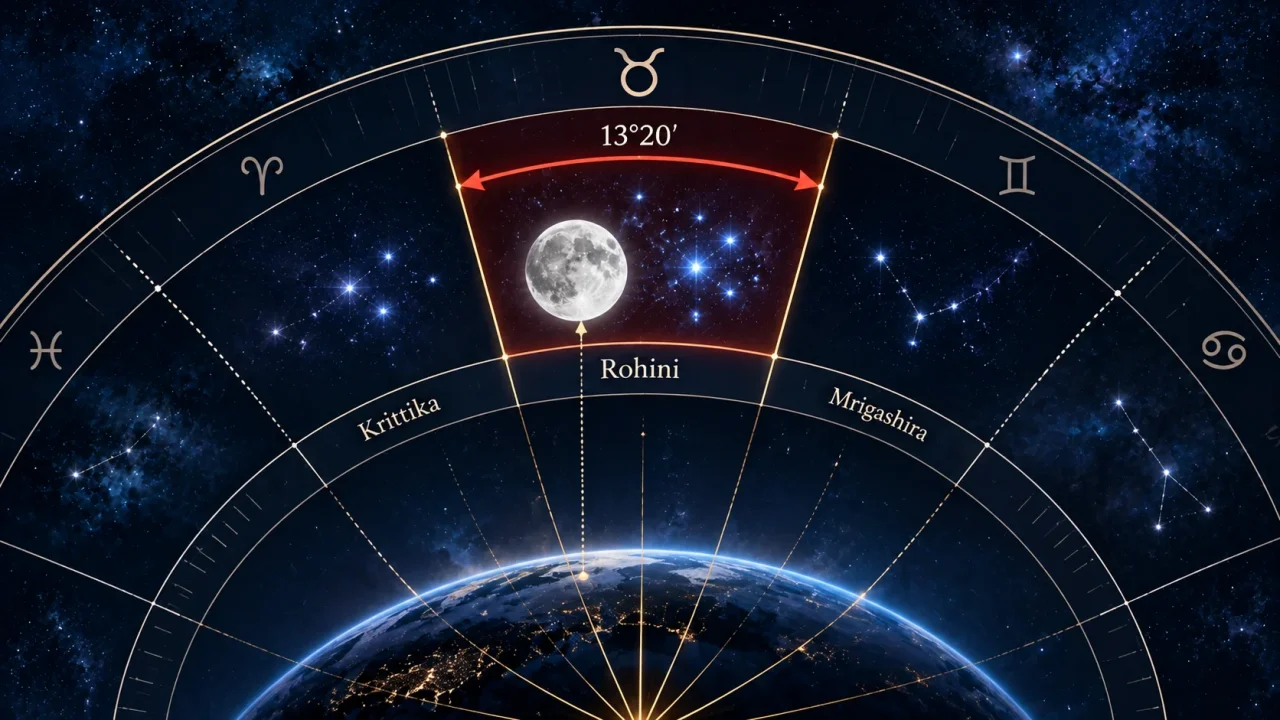
A nakshatra is thirteen degrees and twenty minutes wide. There are twenty seven of them around the zodiac, and every one of them has a lord. That last part is the point. The nakshatra is the smallest division of the zodiac that still has a planet owning it, and ownership is exactly what a dasha scheme needs. It has to know whose turn comes first.
Notice what this ownership is not. It is not the lord of the sign the nakshatra falls in. Rohini lies in Taurus, and Taurus belongs to Venus, but Rohini belongs to the Moon. The two layers run independently, and a student who mixes them will get the first dasha wrong every time. The sign tells you one thing about the Moon. The nakshatra tells you something else, and for dasha it is the nakshatra that decides.
So the question “which dasha was running at birth” turns into “which nakshatra was the Moon in”, and the answer to that is “whichever planet owns it”.
The Nine Lords and The Hundred and Twenty Years
Nine planets share the twenty seven nakshatras, and each of the nine is given a fixed number of years.
| Lord | Years | Lord | Years |
| Ketu | 7 | Rahu | 18 |
| Venus | 20 | Jupiter | 16 |
| Sun | 6 | Saturn | 19 |
| Moon | 10 | Mercury | 17 |
| Mars | 7 | ||
| Total | 120 |
Add them and the total is exactly one hundred and twenty. That is where the name comes from. Vimshottari means twenty and a hundred.
These numbers are not worked out from the chart. They are fixed, and they are the same for every person who has ever been born. What changes from one chart to another is only where you enter the cycle, and how much of the first period has already gone.
Students often ask why Venus gets twenty years and the Sun only six. It is a fair question and it deserves an honest answer. The figures come to us as given. They are not derived anywhere from the speed of the planet or its size or its distance, and any explanation of that kind you may read is somebody filling a gap by himself. What can be said is that the scheme has been used for a very long time, by people who kept records and corrected what did not work, and these are the numbers that survived that use. In practice you take them as they are and you test them on charts you know.
A hundred and twenty years is also longer than almost anyone lives, and that is deliberate. The scheme is not claiming a lifespan. It is laying out a full cycle so that whatever portion of it a life occupies is accounted for, and so that the sequence never runs out before the person does.
Why The Order is What it is
Students usually memorise the order Ketu, Venus, Sun, Moon, Mars, Rahu, Jupiter, Saturn, Mercury. There is no need to memorise anything. It is simply the order of the nakshatra lords.
Start at Ashwini and walk forward. Ashwini belongs to Ketu, Bharani to Venus, Krittika to the Sun, Rohini to the Moon, Mrigashira to Mars, Ardra to Rahu, Punarvasu to Jupiter, Pushya to Saturn, Ashlesha to Mercury. Nine nakshatras, nine lords. Then Magha starts the same nine again, and after Mula they run a third time, ending at Revati.
Twenty seven nakshatras, three rounds of nine. The dasha order is that round and nothing else.
It is worth saying what the order is not, because students go looking. It is not the order of the weekdays. It is not the planets arranged by speed, or by size, or by friendship. If you try to find a second pattern hiding inside it you will waste a week. The nakshatras are laid out in a fixed sequence from Ashwini to Revati, their lords repeat in a fixed group of nine, and the dasha sequence is simply that group read in order. Once the first lord is known from the Moon, every lord after it follows without a decision being made.
Once a student sees this, two things follow at once. He never needs the order written on a card again. And he can tell which dasha is running from the Moon’s nakshatra alone, without opening any software.
The Balance of Dasha at Birth
The Moon does not wait at the beginning of a nakshatra for someone to be born. By the time a birth happens it has already walked some way into that nakshatra, and that distance counts against the first period.
The rule is proportional. It is easier shown than described.
Suppose the Moon is at 16 degrees 40 minutes of Taurus.
Rohini runs from 10 degrees to 23 degrees 20 minutes of Taurus, so this Moon is in Rohini. Rohini belongs to the Moon, and the Moon’s period is ten years. The first dasha of this life is therefore the Moon’s.
Now see how much of it is left. The nakshatra is 13 degrees 20 minutes wide. The Moon has covered 6 degrees 40 minutes of it, from 10 degrees up to 16 degrees 40 minutes. That is exactly half.
Half the nakshatra is behind, so half the dasha is behind. Of ten years, five are already spent. The child is born with five years of Moon mahadasha remaining.
After that the table takes over in order. Mars for seven years, then Rahu for eighteen, then Jupiter for sixteen, then Saturn, Mercury, Ketu, Venus and the Sun, and by then a hundred and twenty years have passed.
Take a second case, because the first one was too tidy to teach much. Say the Moon is at 3 degrees 20 minutes of Gemini. Mrigashira begins at 23 degrees 20 minutes of Taurus and ends at 6 degrees 40 minutes of Gemini, so this Moon is in Mrigashira even though it has crossed into the next sign. The nakshatra does not stop at the sign boundary, and a student who assumes it does will land on the wrong lord. Mrigashira belongs to Mars, whose period is seven years. The Moon has covered 10 degrees of the nakshatra, which is three quarters of its width, so three quarters of the seven years are gone. One quarter remains, which is one year and nine months. This child is born with one year nine months of Mars mahadasha left, and then Rahu begins.
The figures in both examples were chosen to divide cleanly. A real Moon rarely lands on an exact half or an exact quarter, and the arithmetic is usually in degrees, minutes and seconds. The method does not change. Find what fraction of the nakshatra the Moon has crossed, take that fraction away from the lord’s years, and what remains is the balance at birth.
Why Birth Time Matters Most Here
The Moon covers roughly thirteen degrees in a day, which is about half a degree an hour.
Now put that against the calculation above. One hour of error in the recorded birth time moves the Moon about half a degree. Half a degree out of thirteen degrees twenty minutes is about four percent of the nakshatra. Four percent of a twenty year dasha is close to ten months.
Ten months is not a rounding error. It is the difference between a prediction landing and a prediction missing. And the error does not stay inside the first dasha. Every period after it is pushed by the same amount, for the whole of the life.
There is a worse case than being slightly out. If the Moon happens to sit near the edge of a nakshatra at birth, an hour of error does not shift the balance, it changes the lord. The first dasha becomes a different planet, the whole sequence after it is a different sequence, and no amount of careful reading afterwards can recover from that. This is why a chart whose Moon falls in the last degree or the first degree of a nakshatra deserves a second look at the birth time before anything is said about timing.
This is why settling the birth time is not a refinement for people who enjoy precision. If the birth time is uncertain, the dasha dates are uncertain, and everything built on those dates is uncertain along with them.
The Sub-Periods, in One Paragraph
A mahadasha of sixteen or nineteen years is too long to time anything with. So each mahadasha is divided again among the same nine lords, in the same order, starting with the lord of the mahadasha itself, and each one gets a share in proportion to its own years. Mercury’s share of any mahadasha is seventeen parts out of a hundred and twenty, Venus gets twenty, the Sun gets six. In the Moon’s ten year mahadasha, the Moon’s own sub period is ten months. These sub periods are called antardasha, they can be divided a third and fourth time by the same rule, and the division is where actual timing work gets done. The full treatment belongs in a later article in this series. For now it is enough to see that nothing new is introduced, the same nine lords and the same hundred and twenty are simply applied again at a smaller scale.
What Vimshottari Does Not Tell You
Everything above is machinery. It tells you whose turn it is, when the turn starts and when it ends. It tells you nothing at all about what the turn will bring.
Two people can be running Saturn’s mahadasha in the same year. In one chart Saturn owns the fourth and fifth houses and sits in its own sign. In the other it owns the sixth and the seventh and sits with the eighth lord. The dasha is the same. Nothing else about it is the same.
So a sentence like “Saturn’s dasha is going on, that is why the trouble is there” is not a reading. It is half a sentence. The half that does the actual work is what Saturn is carrying in that chart, and what it is in a position to deliver when its turn comes.
That is where the next article in this series begins.
Before You Move on
If you can take a chart, find the Moon’s nakshatra, name its lord, and work out how much of that lord’s period was left at birth, then this article has done its work.
Do it by hand on three or four charts before you go further. Software gives the answer in a second, and that second is exactly where the understanding gets lost.
 Ardra Nakshatra Compatibility Part 3 – (Moola to Revati)There is a result in this final group of nine that undoes a rule most students would have formed by now, and it is worth naming at the start. Ardra do…
 Ardra Nakshatra Compatibility Part 2 – (Magha to Jyeshta)Fourteen per cent. In all the years I have worked with these results I have not seen a lower figure anywhere, and it belongs to Ardra and Jyeshta, whi…
 Shakti Chakra Gazing – Myth vs Truth | Trataka, Sri Yantra & JyotishaSearch for Shakti Chakra gazing and the results settle quickly into a pattern. A circular black and white diagram appears, concentric rings and radiat…