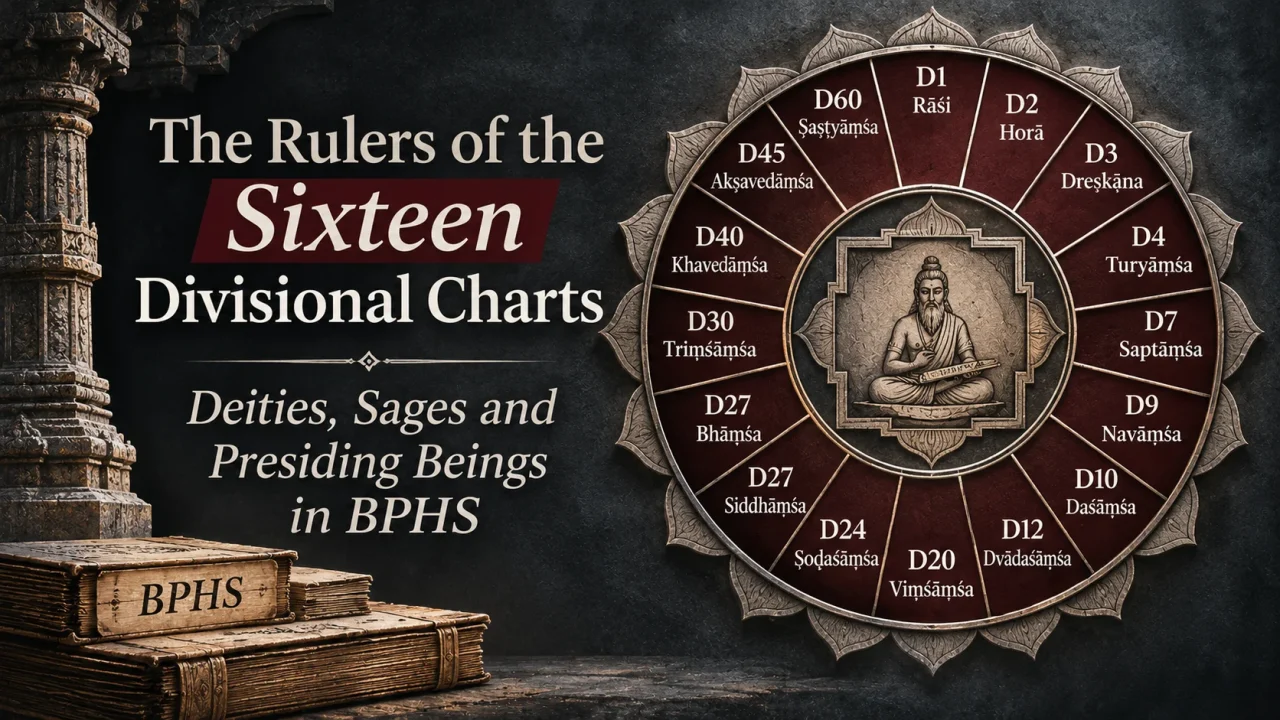
Most students learn the Divisional Charts as a set of calculations. Divide the sign, find the starting point, count forward, note the sign. That is the part used in daily practice, and it is the part most books spend their pages on. But Bṛhat Parāśara Horā Śāstra (BPHS) gives each of these small divisions something more: a presiding deity, sage or other being.
These rulers are rarely discussed. When they are, it is usually one chart at a time. The D60 names get attention because they are labelled good or bad, and the D20 names get attention because several of them are Tantric goddesses. Very few writers have put all of them side by side.
That is what this article does. It goes through the sixth chapter of BPHS, the chapter on the sixteen vargas, and lists the rulers of every divisional chart from the D2 to the D60. The Sanskrit has been checked in three printed editions. Along the way we will see how the rulers change in even signs, what kind of beings they are, how one planet can be followed through all fifteen sets of rulers, and what the text does and does not say about using them in prediction. The verses themselves are given in a separate section at the end.
Who Rules the Parts of a Sign?
Every division in BPHS has two kinds of ruler, and it helps to keep them apart from the start.
- The sign ruler. Each part of a sign falls into some zodiac sign, and the planet that owns that sign rules the part. This is what we use when we cast a Navamsha or Dashamsha chart. A planet in the Navamsha of Leo is “in the Sun’s Navamsha”.
- The presiding deity. In addition, BPHS names a deity or being for each part: Indra, Agni and the other guardians of direction for the D10, Brahmā, Viṣṇu, Śiva and Sūrya for the D16, and so on. These names do not depend on which sign the part falls in. They depend only on the number of the part, and sometimes on whether the sign being divided is odd or even, or movable, fixed or dual.
The first layer is used all the time. The second is the subject of this article. BPHS gives the deities in chapter 6 (Ṣoḍaśavarga Adhyāya) of R. Santhanam’s edition, in verses 6.5 to 6.41. The Rāśi chart (D1) itself has no deity, only its planetary lord. So there are fifteen sets of rulers, one for each varga from the D2 to the D60.
The Sixteen Vargas and What Each Is For
Before looking at the rulers, it is worth recalling what BPHS says each varga is used for. These purposes come from the next chapter, Varga Viveka Adhyāya (7.1 to 7.5).
| Varga | Size of each part | Used for (BPHS 7.1 to 7.5) |
|---|---|---|
| D1 Rāśi | 30° | The body |
| D2 Horā | 15° | Wealth |
| D3 Dreṣkāṇa | 10° | Happiness through siblings |
| D4 Turyāṃśa | 7°30′ | Fortune |
| D7 Saptāṃśa | about 4°17′ | Children and grandchildren |
| D9 Navāṃśa | 3°20′ | Spouse |
| D10 Daśāṃśa | 3° | Great results (status and achievement) |
| D12 Dvādaśāṃśa | 2°30′ | Parents |
| D16 Ṣoḍaśāṃśa | 1°52′30″ | Comforts, discomforts and vehicles |
| D20 Viṃśāṃśa | 1°30′ | Upāsanā (worship and spiritual practice) |
| D24 Siddhāṃśa | 1°15′ | Learning |
| D27 Bhāṃśa | 1°06′40″ | Strength and weakness |
| D30 Triṃśāṃśa | unequal (5°, 5°, 8°, 7°, 5°) | Misfortune |
| D40 Khavedāṃśa | 45′ | Auspicious and inauspicious effects |
| D45 Akṣavedāṃśa | 40′ | All matters |
| D60 Ṣaṣṭyaṃśa | 30′ | All matters |
One correction is worth making here. Many websites say the D20 shows comforts, vehicles and worship. In the verse (7.4), comforts and vehicles complete the previous line, which ends with the D16. Only worship belongs to the D20. This is explained fully in our article on the D20 Vimshamsha chart.
The Deities of Every Divisional Chart
Here is the full picture in one table. The rulers are listed in the order used for odd signs. The third column shows what changes in even signs.
| Varga | Rulers (order in odd signs) | In even signs | BPHS (Santhanam) |
|---|---|---|---|
| D2 | Sun’s Horā: the Devas. Moon’s Horā: the Pitṛs (ancestors) | Follows the planets, which swap | 6.5 to 6.6 |
| D3 | Nārada, Agastya, Durvāsā | No separate rule given | 6.7 to 6.8 |
| D4 | Sanaka, Sananda, Kumāra, Sanātana | No separate rule given | 6.9 |
| D7 | Kṣāra, Kṣīra, Dadhi, Ājya, Ikṣurasa, Madya, Śuddhajala | Reversed | 6.10 to 6.11 |
| D9 | Deva, Nara, Rākṣasa | No separate rule given | 6.12 |
| D10 | Indra, Agni, Yama, Rākṣasa, Varuṇa, Māruta, Kubera, Īśāna, Padmaja, Ananta | Reversed | 6.13 to 6.14 |
| D12 | Gaṇeśa, Aśvinīkumāras, Yama, Ahi (serpent), three rounds | No separate rule given | 6.15 |
| D16 | Aja (Brahmā), Viṣṇu, Hara (Śiva), Sūrya, four rounds | Reversed | 6.16 |
| D20 | Twenty feminine names, Kālī to Sumukhī | A separate list of twenty, Dayā to Aparājitā | 6.17 to 6.21 |
| D24 | Skanda, Parśudhara, Anala, Viśvakarmā, Bhaga, Mitra, Maya, Antaka, Vṛṣadhvaja, Govinda, Madana, Bhīma, two rounds | Reversed, starting from Bhīma | 6.22 to 6.23 |
| D27 | The deities of the nakṣatras, Dasra to Pūṣā | No reversal in the Sanskrit | 6.24 to 6.26 |
| D30 | Agni, Vāyu, Indra, Kubera, Varuṇa | Reversed | 6.27 to 6.28 |
| D40 | Viṣṇu, Candra, Marīci, Tvaṣṭā, Dhātā, Śiva, Ravi, Yama, Yakṣa, Gandharva, Kāla, Varuṇa | Same order (only the counting starts from Libra) | 6.29 to 6.30 |
| D45 | Brahmā, Śiva, Viṣṇu in movable signs; Śiva, Viṣṇu, Brahmā in fixed; Viṣṇu, Brahmā, Śiva in dual | Order depends on movable, fixed or dual, not odd or even | 6.31 to 6.32 |
| D60 | Sixty names, from Ghora, Rākṣasa, Deva, Kubera … to Candrarekhā | Reversed | 6.33 to 6.41 |
Now let us look at each varga in turn.
D2 Horā: Devas and Pitṛs
Each sign is split in half. In an odd sign the first half belongs to the Sun and the second to the Moon, and in an even sign it is the other way round. BPHS then adds one line: the lords of the Moon’s Horā are the Pitṛs, the ancestors, and the lords of the Sun’s Horā are the Devas, the gods. So the D2 has only two “deities”, and they are not individuals but whole classes of beings. This line is present in the Sanskrit of every edition checked, but it is missing from Santhanam’s English translation, which is why many students have never heard of it.
D3 Dreṣkāṇa: Three Sages
The three decanates of a sign go to the sign itself, the 5th sign from it and the 9th sign from it. Their presiding sages are Nārada, Agastya and Durvāsā. All three are famous ṛṣis of the Purāṇas: Nārada the wandering devotee and messenger, Agastya the sage linked with the south and with Tamil tradition, and Durvāsā the sage known for his temper and his curses.
There is a small textual question here. The verse ends with the word carādiṣu, “in the movable and other signs”. The printed editions read it as “Nārada, Agastya and Durvāsā rule the first, second and third decanates in order”. But the three decanates of any sign always fall in one movable, one fixed and one dual sign, so the word could also mean that Nārada rules whichever decanate falls in a movable sign, Agastya the fixed one and Durvāsā the dual one. For Aries both readings give the same result. For Taurus they differ. None of the editions takes the second reading, so it should be treated as an open question rather than a rule.
D4 Turyāṃśa: The Four Kumāras
The four quarters of a sign go to the sign and to the 4th, 7th and 10th signs from it. Their presiding beings are Sanaka, Sananda, Kumāra and Sanātana, the four mind-born sons of Brahmā who, in the Purāṇas, remain eternally young and devoted to knowledge. Some Hindi translations write Sanatkumāra for the third name; the Sanskrit simply has Kumāra.
D7 Saptāṃśa: The Seven Oceans
This is the most surprising list. The rulers of the seven parts of a sign are not deities at all but the seven oceans of Purāṇic geography: Kṣāra (salt), Kṣīra (milk), Dadhi (curd), Ājya (ghee), Ikṣurasa (sugarcane juice), Madya (wine) and Śuddhajala (pure water). The verse does not call them gods. It simply names them as the lords of the parts. In even signs the order is reversed, starting from Śuddhajala.
D9 Navāṃśa: Deva, Nara and Rākṣasa
The Navamsha parts are ruled by three classes of beings: Deva (divine), Nara (human) and Rākṣasa (demonic). The verse says only that these apply “in movable and other houses”. Santhanam explains it as a repeating cycle that starts with Deva in movable signs, with Nara in fixed signs and with Rākṣasa in dual signs. That explanation is his, not the verse’s, and the same carādiṣu question as in the D3 applies here. Students sometimes connect these three with the gaṇa matching used in marriage. The names are the same, but BPHS does not link the two.
D10 Daśāṃśa: The Guardians of the Ten Directions
The ten parts of a sign are ruled by the ten dikpālas, the guardians of the directions, taken in order from the east: Indra (east), Agni (south-east), Yama (south), Rākṣasa or Nirṛti (south-west), Varuṇa (west), Māruta or Vāyu (north-west), Kubera (north), Īśāna (north-east), Padmaja or Brahmā (above) and Ananta (below). In even signs the order runs backwards from Ananta.
D12 Dvādaśāṃśa: Gaṇeśa, the Aśvins, Yama and the Serpent
The twelve parts go to the twelve signs counted from the sign itself. Their rulers are Gaṇeśa, the Aśvinīkumāras, Yama and Ahi (the serpent), repeated three times. No change is mentioned for even signs. It is an unusual group: a god of beginnings, the twin physicians of the gods, the lord of death and a serpent. The text gives no explanation for the choice.
D16 Ṣoḍaśāṃśa: Brahmā, Viṣṇu, Śiva and Sūrya
The sixteen parts are counted from Aries, Leo or Sagittarius for movable, fixed and dual signs. The verse plays on the word aja: the first aja means Aries, the starting point of the count, and the second means Brahmā, the unborn creator. The rulers are Brahmā, Viṣṇu, Hara (Śiva) and Sūrya, repeated four times, and reversed (pratīpakam) in even signs.
D20 Viṃśāṃśa: Forty Feminine Names
The D20 is the only varga with two separate lists of rulers, one for odd signs and one for even signs, and the only one in which every ruler is feminine. The odd list runs Kālī, Gaurī, Jayā, Lakṣmī and so on to Sumukhī; the even list runs Dayā, Medhā, Chinnaśīrṣā and so on to Aparājitā. Six of the forty are exact names of Mahavidyas. The full list, the textual problems and the question of worship are covered in our D20 Vimshamsha article.
D24 Siddhāṃśa: Skanda to Bhīma
The twenty-four parts are counted from Leo in odd signs and from Cancer in even signs. Their rulers are twelve deities and figures, repeated twice: Skanda, Parśudhara (Paraśurāma), Anala (Agni), Viśvakarmā, Bhaga, Mitra, Maya, Antaka (Death), Vṛṣadhvaja (Śiva, whose banner bears the bull), Govinda, Madana (Kāma) and Bhīma. In even signs the order runs backwards from Bhīma. Note that Maya here is the masculine Maya, the architect of the asuras, and not the feminine Māyā. In English both are often written “Maya”, which causes confusion.
D27 Bhāṃśa: The Nakṣatra Deities
The twenty-seven parts are ruled by the deities of the twenty-seven nakṣatras, from Dasra (the Aśvins, for Aśvinī) to Pūṣā (for Revatī). The count starts from Aries for fire signs, Cancer for earth signs, Libra for air signs and Capricorn for water signs, as Santhanam’s table shows. The verse itself says only that the count runs from Aries and the other movable signs.
This varga has two textual surprises, which are discussed in the section on translations below. The Sanskrit list actually contains twenty-eight names, not twenty-seven, and the Sanskrit says nothing about reversing the order in even signs.
D30 Triṃśāṃśa: Five Elements and Their Gods
The Triṃśāṃśa divides an odd sign into five unequal portions of 5°, 5°, 8°, 7° and 5°, ruled by Mars, Saturn, Jupiter, Mercury and Venus. Their deities are Vahni (Agni), Samīra (Vāyu), Śakra (Indra), Dhanada (Kubera) and Jalada (Varuṇa). In even signs the portions, planets and deities are all reversed.
D40 Khavedāṃśa: Twelve Rulers in Rotation
The forty parts are counted from Aries in odd signs and from Libra in even signs. Twelve rulers rotate through them: Viṣṇu, Candra, Marīci, Tvaṣṭā, Dhātā, Śiva, Ravi, Yama, Yakṣa, Gandharva, Kāla and Varuṇa. Three full rounds cover thirty-six parts, and the fourth round ends at Tvaṣṭā. There is no reversal for even signs; only the starting sign changes.
D45 Akṣavedāṃśa: The Trimūrti
The forty-five parts are counted from Aries, Leo or Sagittarius for movable, fixed and dual signs. Only three deities are used, Brahmā, Śiva and Viṣṇu, repeated fifteen times, but their order depends on the nature of the sign: Brahmā, Śiva, Viṣṇu in movable signs; Śiva, Viṣṇu, Brahmā in fixed signs; and Viṣṇu, Brahmā, Śiva in dual signs. This is the only varga where the order of rulers changes by movable, fixed and dual rather than by odd and even.
D60 Ṣaṣṭyaṃśa: Sixty Qualities
The D60 has the longest list: sixty names, reversed in even signs. They begin Ghora (terrible), Rākṣasa, Deva, Kubera, Yakṣa, Kinnara, Bhraṣṭa (fallen), Kulaghna (destroyer of the family), Garala (poison), Vahni (fire), Māyā (illusion), and end with Candrarekhā (the crescent of the Moon). A few are deities, but most are qualities or states: soft, cool, nectar, death, fire, poison. BPHS 6.41 then says that planets in auspicious Ṣaṣṭyaṃśas give good results and those in cruel Ṣaṣṭyaṃśas destroy.
Translators label each of the sixty as benefic or malefic, but those labels are their own judgement based on the meaning of each name. The verse itself gives only the names and the general rule.
Odd and Even Signs – Three Different Rules
Read together, the verses show that BPHS does not handle even signs in one uniform way. There are three patterns.
- Reverse the list. In the D7, D10, D16, D24, D30 and D60 the same rulers are used in even signs, but in reverse order. The verses use different words for this: śuddhajalādikāḥ (starting from pure water), vyutkrameṇa (in reverse), pratīpakam (backwards), vilomena (against the order), viparyayāt and vyatyayāt (by inversion).
- Use a different list. Only the D20 gives a completely separate set of twenty names for even signs.
- No change, or a different principle. The D3, D4, D9, D12, D27 and D40 mention no change for even signs. The D45 changes the order by movable, fixed and dual signs instead. The D2 follows its planets, which swap between odd and even signs.
This matters in practice. A student who assumes that “even signs always reverse” will get the D12, D27 and D40 rulers wrong, and one who reverses the D20 list instead of switching to the second list will get every even-sign D20 ruler wrong.
How to Find the Ruler of Any Part
The same six steps work for every varga. Doing them by hand once or twice makes the rules much easier to remember than any table.
- Note the basic facts. Write down the degree of the planet within its sign, and whether that sign is odd or even, and movable, fixed or dual.
- Find the part number. Divide the degree by the size of one part in that varga and round up. At 16°20′ in the D10, 16.33 ÷ 3 = 5.44, so the planet is in the 6th part.
- Find the sign of the part. Apply the counting rule of that varga: from the sign itself, from the 9th sign, from Aries, Leo or Sagittarius, and so on. This gives the sign, and therefore the planetary lord, used in the varga chart.
- Find the ruler. Take the list of rulers for that varga and count to the part number. Where the list is shorter than the number of parts, it repeats: four names three times in the D12, four times in the D16, twelve names twice in the D24, twelve names round and round in the D40, three names fifteen times in the D45.
- Apply the even-sign rule. Reverse the list in the D7, D10, D16, D24, D30 and D60; switch to the second list in the D20; keep the same order in the D3, D4, D9, D12, D27 and D40; and in the D45 use the order for movable, fixed or dual signs.
- Keep the two results apart. The sign of the part is used for the varga chart. The ruler is the presiding deity of that part. One does not determine the other.
A practical warning for the smaller divisions: a D45 part is only 40′ and a D60 part only 30′. The Ascendant moves through a span like that in roughly two to three minutes of clock time, so the rulers of the Ascendant in these vargas are only as reliable as the birth time.
One Planet, Fifteen Rulers – A Worked Example
To see how this works, let us follow a single position through every varga: the Sun at 16°20′ Aries. Aries is a movable, odd, fire sign, so most counts begin from Aries itself. The table shows which part the Sun falls in, the sign of that part, and its presiding ruler.
| Varga | Part | Sign of the part | Presiding ruler |
|---|---|---|---|
| D2 | 2nd half (15° to 30°) | Moon’s Horā | Pitṛs |
| D3 | 2nd (10° to 20°) | Leo | Agastya |
| D4 | 3rd (15° to 22°30′) | Libra | Kumāra |
| D7 | 4th | Cancer | Ājya (the ocean of ghee) |
| D9 | 5th | Leo | Nara (following Santhanam’s cycle) |
| D10 | 6th | Virgo | Māruta (Vāyu) |
| D12 | 7th | Libra | Yama |
| D16 | 9th | Sagittarius | Aja (Brahmā) |
| D20 | 11th | Aquarius | Lalitā |
| D24 | 14th (counted from Leo) | Virgo | Parśudhara |
| D27 | 15th | Gemini | Marut |
| D30 | Jupiter’s portion (10° to 18°) | Sagittarius | Indra |
| D40 | 22nd | Capricorn | Gandharva |
| D45 | 25th | Aries | Brahmā |
| D60 | 33rd | Sagittarius | Dāvāgni (forest fire) |
Three small checks show how the even-sign rules change things. Put the same planet at 16°20′ Taurus, an even, fixed sign:
- D10: the count starts from the 9th sign, Capricorn, and the 6th part falls in Gemini. Because the list is reversed in even signs, the 6th ruler is Varuṇa, not Māruta.
- D16: the count starts from Leo for a fixed sign, so the 9th part falls in Aries. The reversed list makes its ruler Sūrya, not Brahmā.
- D20: the count starts from Sagittarius for a fixed sign, so the 11th part falls in Libra. Because Taurus is even, the ruler comes from the second list: Piṅgalā, not Lalitā.
The example also shows something easy to miss: the sign of a part and its ruler are independent. The Sun’s D3 part is in Leo, a sign of the Sun, but its ruler Agastya has nothing to do with Leo. The sign comes from the counting rule; the ruler comes from the list.
Gods, Sages, Oceans and Qualities – Sorting the Rulers
If we group the rulers by what they are, the variety becomes clear. The grouping below is our own; BPHS does not classify them.
| Kind of ruler | Vargas | Examples |
|---|---|---|
| Classes of beings | D2, D9 | Devas and Pitṛs; Deva, Nara, Rākṣasa |
| Sages | D3, D4 | Nārada, Agastya, Durvāsā; the four Kumāras |
| Substances (the seven oceans) | D7 | Salt, milk, curd, ghee, cane juice, wine, water |
| Vedic gods and guardians | D10, D30, D40 | Indra, Agni, Yama, Varuṇa, Vāyu, Kubera; Marīci, Tvaṣṭā, Dhātā |
| Major Purāṇic gods | D12, D16, D45 | Gaṇeśa, Yama; Brahmā, Viṣṇu, Śiva, Sūrya |
| A mixed group | D24 | Skanda, Paraśurāma, Bhaga, Mitra, Maya, Govinda, Kāma |
| Nakṣatra deities | D27 | The Aśvins to Pūṣā |
| Feminine Śakti names | D20 | Kālī, Tārā, Bagalāmukhī, Dhūmāvatī, Vārāhī and others |
| Qualities and states | D60 | Terrible, poison, nectar, soft, cool |
Why the D20 Stands Apart
Once all fifteen lists are side by side, the D20 is clearly unusual. Count the feminine names across the whole chapter:
| Varga | Feminine names | Out of |
|---|---|---|
| D20 | All of them (Jayā appears twice) | 40 |
| D27 | Aditi | 28 |
| D60 | Māyā, Sudhā, Candrarekhā | 60 |
| All other vargas | None |
Outside the D20 there is no group of goddesses anywhere in the chapter, and no Mahavidya name appears in any other varga. The D20 is also the only varga with a separate even-sign list, and the only one whose rulers clearly match its purpose: it is the varga of upāsanā, and its rulers are all Śakti names.
So the D20 list was not produced by the same simple pattern as the others. Whoever framed it seems to have chosen these names deliberately for the varga of worship. That is an interpretation, but it rests on the comparison above, which anyone can check against the text. For the details of the forty names, read our article on the D20 Vimshamsha chart and its forty deities.
Do the Deities Change the Reading?
This is the practical question, and the honest answer is: mostly, the text does not say.
In chapter 6 and in the opening verses of chapter 7, BPHS uses the rulers for prediction in only one place. For the D60 it says that planets in auspicious Ṣaṣṭyaṃśas give good results and planets in cruel ones destroy. There the name of the ruler directly colours the result. For every other varga the rulers are named, but no rule is given for using them.
Some modern writers have filled this gap. One may read that a planet in Indra’s Dashamsha brings authority, or that a planet in the Kumāra part of the Chaturthamsha shows learning. These ideas may be useful as a way of thinking, but they are later interpretations, not statements of BPHS. When you meet such a rule, ask where it comes from before relying on it.
The same caution applies to the D20. The text gives the D20 the purpose of upāsanā and gives it forty feminine rulers, but it never says that the ruler of a planet’s D20 part is the deity a person should worship.
Three Things Translations Leave Out
Checking the Sanskrit against the English and Hindi translations brought up three points that most students will never have seen.
- The deities of the D2. BPHS 6.6 says that the Moon’s Horā is ruled by the Pitṛs and the Sun’s Horā by the Devas. The line is in the Sanskrit of Santhanam’s own edition, but his English translation leaves it out. The Khemraj Hindi translation includes it.
- The twenty-eighth name in the D27. Count the names in BPHS 6.24 to 6.26 and you will find twenty-eight: after Viśve (the Viśvedevas) comes Aja, and then Govinda. Aja appears to be the deity of Abhijit, the extra nakṣatra used in some traditions. All three editions checked have it in the Sanskrit, yet both Santhanam’s English and the Khemraj Hindi quietly drop it to make the list fit twenty-seven parts. The verse does not say how twenty-eight names are to be fitted into twenty-seven parts.
- The “reversal” in the D27. Santhanam’s English says the D27 deities are counted in reverse order for even signs. None of the three Sanskrit texts contains any word for reversal, and neither the Khemraj nor the Pāṭhaka Hindi mentions it. This appears to be the translator’s own addition.
None of these changes the calculation of the varga charts themselves. But they show why it is worth reading the Sanskrit, or at least comparing more than one translation, before quoting a rule.
Frequently Asked Questions
Does the D1 Rāśi chart have a presiding deity?
Are the deities of the D9 the same as the gaṇas used in marriage matching?
Do all even signs reverse the order of deities?
Why are the D7 rulers oceans rather than gods?
Which varga has the most feminine rulers?
Why does the D27 list have twenty-eight names?
Can I predict from the deity of a part?
Key Takeaways
- BPHS chapter 6 names presiding rulers for fifteen vargas, from the D2 to the D60. The D1 has none.
- The rulers are of many kinds: classes of beings, sages, the seven oceans, Vedic and Purāṇic gods, nakṣatra deities, Śakti names and qualities.
- Even signs follow three different rules: reverse the list (six vargas), use a separate list (D20 only), or no change (six vargas), with the D45 following movable, fixed and dual signs instead.
- The D20 is the only varga whose rulers are all feminine and the only one whose rulers clearly match its purpose.
- BPHS ties the ruler directly to the result only in the D60. Other uses of the rulers in prediction are later interpretations.
- Translations omit or add things: the D2 deities, the twenty-eighth D27 name, and a D27 reversal that the Sanskrit does not contain.
The divisional charts, their calculation and how to read them alongside the main chart are taught step by step in the Divisional Charts Course at Shatabhisha Astrology.
The Sanskrit Verses and Printed Editions
This section gives the verses that name the rulers, as printed in R. Santhanam’s edition, with transliteration and translation. Only the lines naming the rulers are given for each varga. For the D20 verses, see the D20 article.
BPHS 6.6: D2 Horā
पितरश्चन्द्रहोरेशा देवाः सूर्यस्य कीर्तिताः ।
pitaraś candrahoreśā devāḥ sūryasya kīrtitāḥ |
“The Pitṛs are the lords of the Moon’s Horā; the Devas are declared to be those of the Sun’s.”
BPHS 6.8: D3 Dreṣkāṇa
स्वपंचनवमानां च राशीनां क्रमशश्च ते ।
नारदागस्तिदुर्वासा द्रेष्काणेशाश्चरादिषु ॥८॥
svapañcanavamānāṃ ca rāśīnāṃ kramaśaś ca te |
nāradāgastidurvāsā dreṣkāṇeśāś carādiṣu ||
“They belong in order to the sign itself, the 5th and the 9th. Nārada, Agasti and Durvāsā are the lords of the decanates in the movable and other signs.”
BPHS 6.9: D4 Turyāṃśa
स्वर्क्षादिकेन्द्रपतयस्तुर्यांशेशाः क्रियादिषु ।
सनकश्च सनन्दश्च कुमारश्च सनातनः ॥९॥
svarkṣādikendrapatayas turyāṃśeśāḥ kriyādiṣu |
sanakaś ca sanandaś ca kumāraś ca sanātanaḥ ||
BPHS 6.11: D7 Saptāṃśa
क्षारक्षीरौ च दध्याज्यौ तथेक्षुरससम्भवः ।
मद्यशुद्धजलावोजे समे शुद्धजलादिकाः ॥११॥
kṣārakṣīrau ca dadhyājyau tathekṣurasasambhavaḥ |
madyaśuddhajalāv oje same śuddhajalādikāḥ ||
“Salt and milk, curd and ghee, that born of sugarcane juice, wine and pure water in an odd sign; in an even sign, beginning from pure water.”
BPHS 6.12: D9 Navāṃśa
देवा नृराक्षसाश्चैव चरादिषु गृहेषु च ॥१२॥
devā nṛrākṣasāś caiva carādiṣu gṛheṣu ca ||
BPHS 6.13 to 6.14: D10 Daśāṃśa
दश पूर्वादिदिक्पाला इन्द्राग्नियमराक्षसाः ॥१३॥
वरुणो मारुतश्चैव कुबेरेशानपद्मजाः ।
अनन्तश्च क्रमादोजे समे वा व्युत्क्रमेण तु ॥१४॥
daśa pūrvādidikpālā indrāgniyamarākṣasāḥ ||
varuṇo mārutaś caiva kubereśānapadmajāḥ |
anantaś ca kramād oje same vā vyutkrameṇa tu ||
BPHS 6.15: D12 Dvādaśāṃśa
द्वादशांशस्य गणना तत्तत्क्षेत्रादि निर्दिशेत् ।
तेषामधीशाः क्रमशो गणेशाश्वियमाहयः ॥१५॥
dvādaśāṃśasya gaṇanā tattatkṣetrādi nirdiśet |
teṣām adhīśāḥ kramaśo gaṇeśāśviyamāhayaḥ ||
BPHS 6.16: D16 Ṣoḍaśāṃśa
अजसिंहाश्वितो ज्ञेया षोडशांशाश्चरादिषु ।
अजविष्णू हरः सूर्यो ह्योजे युग्मे प्रतीपकम् ॥१६॥
ajasiṃhāśvito jñeyā ṣoḍaśāṃśāś carādiṣu |
ajaviṣṇū haraḥ sūryo hy oje yugme pratīpakam ||
BPHS 6.22 to 6.23: D24 Siddhāṃśa
सिद्धांशकानामधिपाः सिंहादोजभगे ग्रहे ।
कर्काद्युग्मभगे खेटे स्कन्दः पर्शुधरोऽनलः ॥२२॥
विश्वकर्मा भगो मित्रो मयोऽन्तकवृषध्वजाः ।
गोविन्दो मदनो भीमः सिंहादौ विषमे क्रमात् ॥
siddhāṃśakānām adhipāḥ siṃhād ojabhage grahe |
karkād yugmabhage kheṭe skandaḥ parśudharo ‘nalaḥ ||
viśvakarmā bhago mitro mayo ‘ntakavṛṣadhvajāḥ |
govindo madano bhīmaḥ siṃhādau viṣame kramāt ||
BPHS 6.24 to 6.26: D27 Bhāṃśa
भांशाधिपाः क्रमाद्दस्रयमवह्निपितामहाः ।
चन्द्रेशादितिजीवाहिपितरो भगसंज्ञिताः ॥२४॥
अर्यमार्कत्वष्टृमरुच्छक्राग्निमित्रवासवाः ।
निरृत्युदकविश्वेऽजगोविन्दो वसवोऽम्बुपः ॥२५॥
ततोऽजपादहिर्बुध्न्यः पूषा चैव प्रकीर्तिताः ।
नक्षत्रेशास्तु भांशेशा मेषादिचरभक्रमात् ॥२६॥
bhāṃśādhipāḥ kramād dasrayamavahnipitāmahāḥ |
candreśāditijīvāhipitaro bhagasaṃjñitāḥ ||
aryamārkatvaṣṭṛmarucchakrāgnimitravāsavāḥ |
nirṛtyudakaviśve ‘jagovindo vasavo ‘mbupaḥ ||
tato ‘japād ahirbudhnyaḥ pūṣā caiva prakīrtitāḥ |
nakṣatreśās tu bhāṃśeśā meṣādicarabhakramāt ||
Note viśve ‘ja: Viśve (the Viśvedevas) followed by Aja. This makes twenty-eight names. The last line says only that the nakṣatra lords are the Bhāṃśa lords, counted from Aries and the other movable signs. There is no word for reversal.
BPHS 6.28: D30 Triṃśāṃśa
वह्निः समीरशक्रौ च धनदो जलदस्तथा ।
विषमेषु क्रमाज्ज्ञेयाः समराशौ विपर्ययात् ॥२८॥
vahniḥ samīraśakrau ca dhanado jaladas tathā |
viṣameṣu kramāj jñeyāḥ samarāśau viparyayāt ||
BPHS 6.30: D40 Khavedāṃśa
विष्णुश्चन्द्रो मरीचिश्च त्वष्टा धाता शिवो रविः ।
यमो यक्षश्च गन्धर्वः कालो वरुण एव च ॥३०॥
viṣṇuś candro marīciś ca tvaṣṭā dhātā śivo raviḥ |
yamo yakṣaś ca gandharvaḥ kālo varuṇa eva ca ||
BPHS 6.31 to 6.32: D45 Akṣavedāṃśa
तथाक्षवेदभागानामधिपाश्चरभे क्रियात् ।
स्थिरे सिंहाद् द्विभे चापात् विधीशविष्णवश्चरे ॥३१॥
ईशाच्युतविरिञ्च्येशा विष्णुकेशाः स्थिरे द्विभे ।
देवाः पंचदशावृत्त्या विज्ञेया द्विजसत्तम ॥३२॥
In movable signs Vidhi (Brahmā), Īśa (Śiva) and Viṣṇu; in fixed signs Īśa, Acyuta (Viṣṇu) and Viriñci (Brahmā); in dual signs Viṣṇu, Ka (Brahmā) and Īśa; repeated fifteen times. The Khemraj edition has surajyeṣṭha in place of viriñci, which also means Brahmā.
BPHS 6.34, 6.40 and 6.41: D60 Ṣaṣṭyaṃśa
घोरश्च राक्षसो देवः कुबेरो यक्षकिन्नरौ ।
भ्रष्टः कुलघ्नो गरलो वह्निर्माया पुरीषकः ॥३४॥
ghoraś ca rākṣaso devaḥ kubero yakṣakinnarau |
bhraṣṭaḥ kulaghno garalo vahnir māyā purīṣakaḥ ||
The list continues to verse 6.39. Verse 6.40 says the order is reversed in even signs, and 6.41 says: “Planets joined with auspicious Ṣaṣṭyaṃśas give auspicious results; those joined with cruel Ṣaṣṭyaṃśas destroy.”
 Aries AscendantAlmost everything written about Aries ascendant can be reduced to four words. Bold, impatient, fiery, direct. A reader takes those four words away, fi…
 Reading a Birth Chart Without the PlanetsOpen any software, put in the date and the time and the place, and press the button. The chart appears with nine grahas already sitting in it. Within …
 Neptune in Vedic AstrologySearch for Neptune in Vedic astrology and you will get the same article twelve times over. Neptune in Aries. Neptune in Taurus. One paragraph for each…