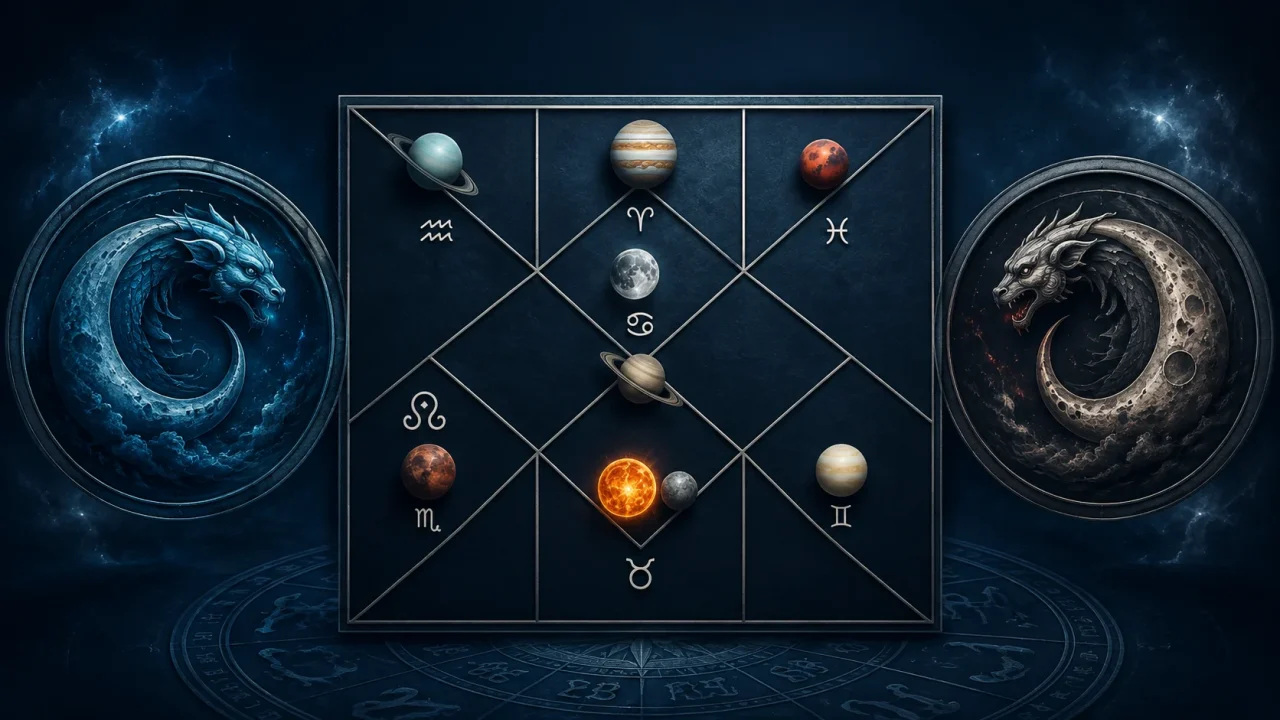
Set an Aquarius ascendant in two different astrology programs and you may get two different lagna lords. One will show Saturn. The other will show Rahu. The same thing happens with a Scorpio ascendant, where you will be shown either Mars or Ketu.
This is not a small difference. The sign lord decides which dasha you weigh most heavily, which yogas form and which do not, whose strength you calculate, and who acts as dispositor for every planet sitting in that sign. If the lord changes, the reading changes.
Students ask about this often, and the answers they get are usually confident in one direction or the other. Some teachers say the idea has no basis in the classics at all. Others say Rahu is a co-lord of Aquarius and treat it as settled. Both sides usually argue from English translations.
This article goes to the Sanskrit instead. I have used two editions of Brihat Parashara Hora Shastra, the R. Santhanam edition and the Girish Chand Sharma edition, and I have compared them with Jataka Parijata, Uttara Kalamrita and Brihat Jataka. What follows is what the verses say, with the words laid out so that you can check them yourself.
The scheme nobody disputes
Every classical text gives the twelve signs to the seven visible planets. Aquarius belongs to Saturn, Scorpio to Mars, and there is no sign left without an owner. Nothing in this article removes that scheme, and no text I have examined replaces it.
The question is whether anything is placed alongside it, and if so, for what purpose.
The first passage: the chapter on dasha results
The verses people usually quote sit in the chapter on the results of dashas. In the R. Santhanam edition this is chapter 47, around page 581. In the Girish Chand Sharma edition the same chapter is numbered 49, around page 123. The verses are 34 to 36.
एवं राहोश्च केतोश्च कथयामि गृहादिकम् ।
तयोर्दशाफलज्ञप्त्यै तवाग्रे द्विजनन्दन ॥ ३४ ॥
राहोस्तु वृषभं केतोर्वृश्चिकं तुङ्गसंज्ञकम् ।
मूलत्रिकोणकं ज्ञेयं युग्मं चापं क्रमेण च ॥ ३५ ॥
कुम्भाली च गृहौ प्रोक्तौ कन्या-मीनौ च केनचित् ॥ ३६ ॥
Verse 34 should be read before anything else, because Parashara says in it why he is giving the list at all.
गृहादिकम् the house and so on, meaning the whole set of dignities that follows
तयोर्दशाफलज्ञप्त्यै so that the results of their dasha may be known
The purpose is stated inside the verse. It is not a note added by a translator or a commentator. Parashara is about to explain what happens in the mahadasha of Rahu and of Ketu, and before he can do that he has to say where they stand in a chart.
Verse 35 gives exaltation and moolatrikona. Taurus is Rahu’s exaltation and Scorpio is Ketu’s. Gemini and Sagittarius are their moolatrikonas in that order.
Verse 36 gives the assignment everyone quotes.
कुम्भ + अलि Aquarius and Scorpio, ali being a standard word for Vrischika
गृहौ प्रोक्तौ are declared to be the two houses
कन्या-मीनौ च केनचित् and by some, Virgo and Pisces
Two words in that line are worth slowing down for.
The first is गृह, house. The tradition has a more technical term for own sign, स्वक्षेत्र, and it is not used here. I would not push this too far, because गृह, भवन and क्षेत्र are often interchangeable in Jyotisha Sanskrit. But it is worth noticing, and it will matter later in this article, because Jataka Parijata does use स्वक्षेत्र in the same discussion and uses it for a different sign.
The second is केनचित्, by some. Parashara is recording a view held by others. He is not stating it as his own conclusion, and he places it next to the Aquarius and Scorpio assignment as an alternative.
There is one more thing, and it is easy to miss. The moment the assignment finishes, the same verse turns to results: तद्दाये बहुसौख्यं च, in its dasha there is much happiness and wealth. Nothing stands between the list and the use it was collected for.
A warning about the English editions
Before going further, there is something that anyone reading only the English needs to know.
The Sanskrit of verse 35 is identical in both editions. It says वृषभ for Rahu and वृश्चिक for Ketu. Santhanam translates it correctly. The Girish Chand Sharma edition prints the exaltations the other way round in its English, against the Sanskrit that appears on its own page.
| Rahu exalted in | Ketu exalted in | |
| Sanskrit, both editions | वृषभ Taurus | वृश्चिक Scorpio |
| Santhanam, English | Taurus | Scorpio |
| G. C. Sharma, English | Scorpio | Taurus |
This is not a manuscript variant. It is an error in one English translation. A student who learns the exaltations of the nodes from that page will learn them backwards, and will carry the mistake into every chart.
I mention it here because it sets the standard for the rest of this discussion. On a question like this, a translation is not enough.
The second passage: the strongest wording in the text
There is a second place where the nodes are given Aquarius and Scorpio, and the language there is much stronger. It sits in the chapter on dasha systems, in the section on Chara Dasha. Santhanam numbers it chapter 46, verse 157, around page 553. Sharma places it in volume 2 under the heading Signs of dual lordship, around page 82.
वृश्चिकाधिपती द्वौ च केतु-भौमौ स्मृतौ द्विज ।
शनि-राहू च कुम्भस्य स्वामिनौ परिकीर्तितौ ॥ १५७ ॥
वृश्चिक + अधिपती the two adhipatis, lords, of Scorpio
केतु-भौमौ स्मृतौ Ketu and Mars are held to be
कुम्भस्य स्वामिनौ the two svamis, owners, of Aquarius
परिकीर्तितौ are declared
Here the words are अधिपति and स्वामिन्. These are the ordinary technical terms for a sign lord, the same words used for Saturn and Mars everywhere else. There is no hedging in this verse. Anyone who says the classics never give the nodes lordship of a sign has not read it.
So the verse should be granted in full. Then the next verse should be read.
द्विनाथक्षेत्रयोरत्र क्रियते निर्णयोऽधुना ।
द्वावेवाधिपती विप्र ! युक्तौ स्वर्क्षे स्थितौ यदि ॥ १५८ ॥
द्विनाथक्षेत्रयोः of the two signs that have two lords
अत्र here, in this context
क्रियते निर्णयोऽधुना the determination is now being made
अत्र is the word that decides the scope, and it is there in the text. Parashara names the category, the two signs with two lords, and says the ruling is being made here, in this place.
This is worth stating carefully, because the two editions handle it differently. Santhanam translates verse 157 as In this system Mars and Ketu are both lords of Scorpio. Those first three words are not in verse 157. They come from अत्र in verse 158, and he has carried them up one verse. He is representing the passage fairly. The Sharma edition leaves the word out altogether.
What the next nine verses do
Verses 158 to 166 follow immediately, and every one of them is arithmetic.
- 158 and 159: if both lords are together in their own sign, the sign gets twelve years.
- 159: if one lord is in its own sign and the other is elsewhere, count up to the second one.
- 160 and 161: if both are in other signs, count up to whichever is stronger, forward or in reverse.
- 161 and 162: a lord with a planet is stronger than one without; more planets is stronger; if equal, decide by the strength of the sign.
- 163: movable, then fixed, then dual, in increasing strength; if the signs are equal, the one giving more years wins.
- 164 and 165: prefer the exalted planet, add one year for exaltation and subtract one for debilitation.
- 166: having weighed all of this, declare the results.
Not one of these verses discusses bhava lordship, yoga formation, or how to judge the sign in an ordinary reading. They exist for a narrower reason. A sign with two lords breaks the counting rule that Chara Dasha depends on, and the counting rule needed a fix. These nine verses are that fix.
So the strongest ownership language in the whole text sits inside a dasha chapter, is marked by अत्र in the verse that follows it, and is followed by nine verses of dasha year arithmetic and nothing else.
Jataka Parijata says something different
Parashara recorded an alternative view with केनचित्, by some. That view is not vague, and it is not lost. Jataka Parijata holds it, in chapter 1, verses 26 to 28, in the V. Subrahmanya Sastri edition.
Kumbha, Aquarius, is given as the moolatrikona of Rahu. Mithuna, Gemini, is the exaltation sign. Kanya, Virgo, is called the स्वक्षेत्र, the own house.
Here the technical word does appear, and it is given to Virgo, not to Aquarius. The two texts are not saying the same thing in different words. They are placing the same signs in different categories.
| Rahu | Exaltation | Moolatrikona | Own sign |
| BPHS 47.35 and 47.36 | Taurus | Gemini | Aquarius (गृह) |
| Jataka Parijata 1.26 to 28 | Gemini | Aquarius | Virgo (स्वक्षेत्र) |
Read those two rows together and the picture changes. Aquarius is not disputed as a sign that belongs to Rahu in some way. What is disputed is what kind of relationship it is. One text calls it his house, the other calls it his moolatrikona and gives his own house to Virgo.
Where the claim is not found
I searched three more texts for any assignment of a sign to Rahu or Ketu, and found none: Uttara Kalamrita in the P. S. Sastri edition, Brihat Jataka in the P. S. Sastri edition, and volumes two and three of Jataka Parijata. The nodes are discussed at length in all of them, in houses, in aspects, in results and in dashas, but not as sign lords.
Among the texts examined here, the assignment appears in Brihat Parashara Hora Shastra and in the first chapter of Jataka Parijata, and the two do not agree.
What this settles, and what it does not
Two claims that are commonly made can now be set aside.
The claim that there is no classical basis at all is wrong. There are two passages in Parashara, and one of them uses अधिपति and स्वामिन्, the full vocabulary of sign lordship. Whoever says the texts are silent has not read the chapter on dasha results or the section on Chara Dasha.
The claim that the classics establish Rahu as a general lord or co-lord of Aquarius is also wrong. The first passage states its own purpose, the results of their dasha. The second is bounded by अत्र and followed by nine verses of dasha arithmetic. Neither passage extends the assignment to ordinary chart reading, and neither says it should be.
What the texts actually give is narrower and more specific than either side usually admits. Parashara assigns Aquarius and Scorpio to the nodes as an instrument for dasha work, and uses full ownership vocabulary while doing it. Whether that assignment carries outside dasha work is a question the text does not answer.
That unanswered question is where the entire modern debate lives. Part two takes up how it came to be answered in English, with a word that is in none of these verses.
Shatabhisha Research Observation
Classical Fact
Brihat Parashara Hora Shastra gives Aquarius and Scorpio to Rahu and Ketu in two places. In the chapter on dasha results the word is griha, and the verse states its own purpose as knowing the results of their dasha. In the Chara Dasha section the words are adhipati and svamin, and the following verse marks the context with atra, after which nine verses deal only with dasha year computation. Parashara also records an alternative view, by some, giving Virgo and Pisces. Jataka Parijata holds that alternative, and calls Virgo the svakshetra of Rahu while making Aquarius his moolatrikona. Uttara Kalamrita and Brihat Jataka assign the nodes no sign at all.
Modern Opinion
Many practising astrologers treat Rahu as a lord or co-lord of Aquarius and Ketu of Scorpio, and apply it to ordinary chart reading. Others reject the idea completely and say the classics never mention it. The verses above show that neither position matches the text. What co-lord means, and where the word came from, is the subject of part two.
 How to Read Planetary Combinations and Chains in Bhrigu Nandi Nadi For Prediction (Part 8)In Bhrigu Nandi Nadi, a planetary combination should not be treated as a fixed prediction. The real meaning develops when we follow the planetary sequ…
 Bhrigu Nandi Nadi – Combinations of Planets (Part 7)We completed 6 parts of Bhrigu Nandi Nadi Article. This article will cover planets and their combinations in Bhrigu Nandi Nadi (BNN). We will talk abo…
 Bhrigu Nandi Nadi – Planetary Combinations and Results (Part 6)In this series, we have completed 5 parts; today we will move into the 6th part, which is about planetary combinations of Mars and Mercury with other …