In Bhrigu Nandi Nadi, a planetary combination should not be treated as a fixed prediction. The real meaning develops when we follow the planetary sequence, understand the common field of significations, examine the sign and house context, and see how additional planets modify the original combination. This approach helps us move from simply identifying combinations to understanding how a planetary story can become an actual event.
This is Part 8 of a part-wise series. Start with the complete guide to Bhrigu Nandi Nadi.
Two Planets to a Planetary Story in BNN
The real strength of Bhrigu Nandi Nadi becomes visible when we stop treating planetary combinations as isolated pairs and start tracing the connections between planets. Two planets may establish a basic theme, but when a third planet joins the sequence, it can change the direction of the entire interpretation.
For example, Mercury represents communication, calculation and business, while Venus represents beauty, relationships, comforts, luxury and refinement. When Mercury and Venus are connected, we may therefore think of communication related to Venusian subjects, commercial creativity, design, fashion, entertainment or the business side of art.
Now suppose Saturn becomes connected with the same combination.
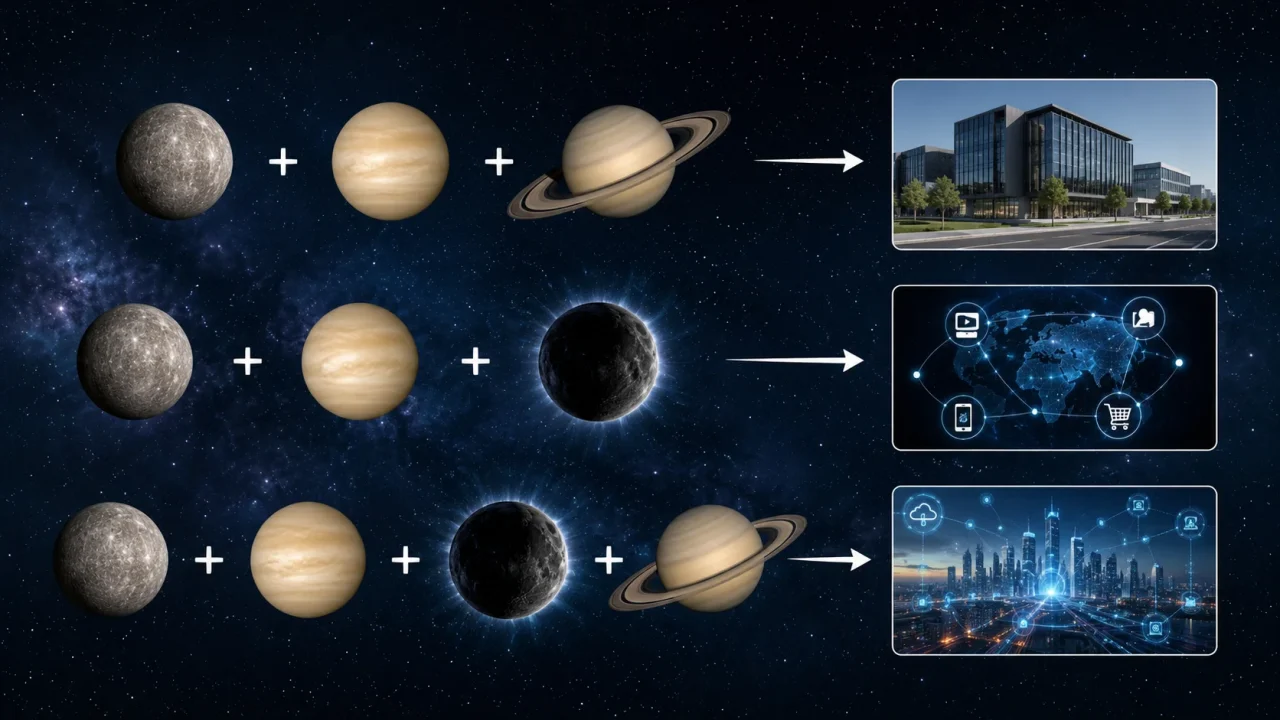
Mercury + Venus + Saturn
Here Mercury brings communication and commerce, Venus brings beauty, relationships and luxury, while Saturn introduces structure, work, discipline, manufacturing and the masses.
The interpretation therefore moves beyond simply saying “Mercury and Venus give creativity.” Saturn tells us that this creativity may have to be organized, commercialized or produced on a larger and more structured scale.
Possible manifestations may include:
- Commercial design
- Luxury business
- Structured artistic professions
- Fashion manufacturing
- Professional communication involving women or luxury products
- Design related industrial work
The important point is that Saturn has not simply added another isolated meaning. It has modified the way Mercury and Venus operate together.
Now replace Saturn with Rahu.
Mercury + Venus + Rahu
Mercury and Venus continue to represent communication, commerce, beauty, relationships and creativity. But Rahu changes the environment in which these significations operate. It can take the combination toward modern technology, digital platforms, unconventional markets, foreign connections and subjects that attract large numbers of people.
The same Mercury and Venus combination may therefore manifest through:
- Digital media
- Online marketing
- Unconventional art
- Foreign commercial relationships
- Entertainment technology
- Intense relationship communication
- Digital luxury or fashion businesses
Notice that Mercury and Venus have not changed. What has changed is the third planet connected with them.
This is a very important point in practical Nadi analysis. We should not memorize Mercury plus Venus as giving one fixed result. Their combination establishes a basic field, and the next connected planet tells us how that field develops.
The same principle can be extended further. Suppose Mercury, Venus and Rahu are connected, and Saturn then becomes part of the same planetary chain. Now the story may move toward large-scale digital production, technology driven luxury businesses, structured media organizations or mass-oriented creative industries.
This is how a planetary combination gradually becomes a planetary story.
The first planet gives one part of the subject. The second planet modifies it. The third planet gives another direction, and further connections can make the indication still more specific.
This is why I consider planetary chains more informative than isolated conjunctions. A conjunction tells us that planets are together. Nadi analysis becomes much more interesting when we understand what those planets are doing together and what happens when another planet enters their chain.
The final prediction still has to be checked against the houses, signs, planetary strength, ownership and the overall horoscope. But once this way of thinking develops, the chart stops looking like a collection of separate planetary combinations and starts revealing a connected sequence of meanings.
That is where the real predictive value of Bhrigu Nandi Nadi begins.
Importance of Planetary Sequence in BNN
Advanced Nadi interpretation requires us to look beyond the simple question of which planets are connected. We also have to understand how their significations move from one planet to another and how the sequence ultimately produces an event.
Suppose Jupiter, Mercury and Venus are connected. It would be very easy to memorize their individual significations and say that the combination represents education, communication and relationships. But this does not really explain how the combination will work in a horoscope.
A better approach is to follow the planetary sequence and ask a few basic questions:
- What is the starting significator?
- Which planet modifies or receives that influence?
- Where does the planetary chain finally lead?
- Which house or area of life is being investigated?
- Is another planet strengthening, activating or obstructing the chain?
The starting planet is important because it establishes the subject. The next planet can change the manner in which that subject develops, while another connected planet may show the final direction in which the energy is expressed.
For example, if Jupiter begins the sequence, knowledge, teaching, wisdom or expansion may form the initial subject. When Mercury becomes connected, that knowledge may move toward communication, calculation, writing or business. When Venus then becomes involved, the final expression may connect that knowledge and communication with relationships, creativity, finance, beauty or comforts.
But if the order of influence changes, the story may also change. This is why simply collecting planetary keywords is not sufficient. The astrologer has to understand the relationship between the planets and follow the chain through the horoscope.
The house being investigated also changes the interpretation. The same Jupiter-Mercury-Venus sequence can produce a very different result when it operates through the Fifth House compared with the Seventh or Tenth House. In the Fifth House, education and creativity may become important. In the Seventh House, relationships, counselling or business partnerships may come forward. In the Tenth House, teaching, consulting, communication or a Venusian profession may become the visible result.
Another planet can further alter the story. Saturn may slow the development or make the result dependent upon sustained effort. Rahu may take the same chain toward technology, foreign connections or unconventional circumstances. Mars may introduce action, competition or technical activity.
Therefore, the planetary sequence should be read as a developing story rather than a list of meanings.
This is also where the difference between memorizing Nadi rules and actually reading a horoscope through Nadi logic becomes clear.
A student who memorizes rules may say, “Jupiter means knowledge, Mercury means communication and Venus means relationships.”
A student who understands Nadi logic will ask, “How is the knowledge being communicated, through what subject, in which area of life, and what is the final result of this planetary connection?”
That shift in thinking is extremely important. The objective is not to remember more combinations. The objective is to understand how planets interact and how their combined significations develop into an actual life event.
Five Rules to Decode BNN Planetary Combinations
Before predicting from any planetary combination, I would suggest following a fixed sequence of analysis. This prevents us from jumping directly from a combination to a prediction. In practical astrology, the same two planets can produce very different results in different horoscopes, so the process of interpretation is as important as the combination itself.
Rule 1: Identify the Natural Significations
First understand what each planet naturally represents. There is no need to begin with a memorized prediction. Start with the basic nature of the planets.
For example, Mars represents action, courage, machinery, competition and initiative, while Venus represents relationships, comforts, vehicles, beauty and refinement. Once these basic significations are clear, the possible interaction between them becomes much easier to understand.
Rule 2: Identify the Common Field
The next step is to find where the significations of the planets naturally overlap. This is where many useful Nadi observations emerge.
Take Mars and Venus again. Mars can signify machinery and mechanical activity, while Venus can signify vehicles and comforts. Their connection can therefore become relevant to automobiles, mechanical design or vehicle-related activity when the houses and other factors support the indication.
The important point is that the result does not come from memorizing “Mars plus Venus equals automobiles.” We arrive at the possibility by finding the common field between their natural significations.
Rule 3: Examine the Sign Environment
The same planetary combination can behave differently in different signs. The sign provides the environment in which the planetary energies operate.
Mars and Mercury connected in Aries may express their energy very differently from the same combination in Virgo or Pisces. The planets remain the same, but the environment changes their expression.
Therefore, after identifying the planetary combination, examine the sign carefully. The sign can give an important clue about the manner in which the planetary significations will develop.
Rule 4: Add the Third Planet
This is one of the most useful steps in practical Nadi analysis. A two-planet combination often gives a broad field, while the third planet can considerably narrow the possible manifestation.
For example, Mercury and Venus together can indicate communication, commerce, creativity, beauty, relationships or business. There are many possibilities.
When Saturn becomes connected with Mercury and Venus, the story may move toward structured creative work, manufacturing, professional design or organized luxury business.
If Rahu becomes connected instead, the same Mercury-Venus combination may move toward digital media, online commerce, unconventional creativity, foreign markets or technology-driven entertainment.
The third planet therefore does not simply add another keyword. It can change the direction in which the original combination expresses itself.
Rule 5: Verify Against Reality and Classical Principles
Finally, test the interpretation against the actual horoscope and the native’s life. Do not force the chart to produce a result simply because a book or teacher has given a particular combination.
Classical principles can also be used at this stage to examine planetary strength, dignity, house placement, aspects and relevant Yogas. If the Nadi interpretation and classical factors support each other, the indication becomes stronger.
Most importantly, a technique should be tested across many horoscopes. One successful example proves very little. A genuine astrological principle becomes meaningful only when it repeatedly produces observable results under different circumstances.
This is how I would approach planetary combinations in research-oriented Nadi astrology. First understand the planets, then find their common field, examine the sign environment, follow the planetary chain, and finally compare the interpretation with the actual life of the native.
The objective is not to make every horoscope fit a rule. The objective is to discover whether the rule actually works.
The Greatest Mistake – One Combination, One Prediction
One of the biggest mistakes students make while learning astrology is searching for a single combination that will give a definite event. Questions such as “Which combination gives divorce?”, “Which combination gives a government job?” or “Which combination gives foreign settlement?” are understandable in the beginning, but this way of thinking can make astrology unnecessarily mechanical.
A planetary combination does not usually have only one possible outcome. Every planet represents a field of significations, and when two or more planets come together, those fields can overlap in several different ways. The horoscope decides which possibility becomes relevant in the life of a particular native.
For example, Saturn and Venus are often associated with delay in marriage, but the same combination can also describe responsibility within marriage, a mature partner, relationships connected with work, disciplined artistic activity, luxury industries or gradual acquisition of comforts. Delay is only one possible expression, and it should be predicted only when the other marriage factors support it.
Rahu and Venus provide another good example. Their connection can certainly intensify desires and may sometimes indicate unconventional relationships. But it can also become important for luxury, entertainment, beauty, digital media, foreign markets or unusual creative interests. We cannot take one possibility and make it the permanent meaning of the combination.
Similarly, Sun and Mars do not automatically mean a government career. Their combination can produce authority and action, but that energy may express itself through administration, entrepreneurship, engineering, military or police work, technical professions, competitive fields or leadership. The houses and the rest of the planetary chain tell us where that energy is actually going.
Mercury and Jupiter can certainly support teaching and education, but the same combination can also operate through writing, consulting, accounting, philosophy, research, financial analysis or advisory work. The planets provide the material from which the prediction is constructed, not a ready-made prediction.
This is why I prefer to think of planets as possessing fields of significations, rather than one-line definitions.
Prediction becomes much stronger when different factors in the horoscope repeatedly point toward the same theme. If one combination suggests education, another planetary connection supports teaching, the relevant house is involved, and the dasha activates the same significators, then we are no longer depending upon one isolated rule. We are seeing repetition of the same story from different parts of the horoscope.
This repetition is extremely important in practical Nadi analysis.
Suppose Mercury and Jupiter suggest knowledge and communication. If the Fifth House, Ninth House and Tenth House also become connected with these significators, and the relevant planetary periods activate them, the possibility of teaching or knowledge-based profession becomes considerably stronger. The prediction is not coming from Mercury-Jupiter alone. It is coming from the repetition of the same theme.
The same principle can be applied to marriage, profession, wealth, foreign travel, property or any other major event.
A responsible Nadi astrologer therefore does not ask, “Which one combination gives this event?”
The better question is:
“How many independent planetary connections are repeating the same story?”
When the same theme appears again and again through planets, houses, planetary chains and timing factors, confidence in the prediction naturally increases.
This is where astrology moves away from memorized combinations and becomes an exercise in observation, correlation and judgment.
From Combinations to Prediction
The purpose of studying planetary combinations is not simply to produce impressive interpretations. The real purpose is to understand how those combinations become visible in the actual life of the native. In other words, we have to move from identifying a planetary combination to understanding the event that it can produce.
For this, I find it useful to look at the horoscope at three different levels.
Level One: Potential
First we have to understand what the natal combination is capable of producing. This is the promise contained in the horoscope. If Mercury and Jupiter are strongly connected, for example, knowledge, teaching, communication, analysis or advisory work may form part of the native’s potential. But this does not mean that the person will necessarily become a teacher. We are only identifying what the planetary combination can provide.
Level Two: Context
The next question is where that potential is likely to operate. The houses become extremely important at this stage. The same Mercury-Jupiter combination can produce education when connected with the Fifth or Ninth house, while its connection with the Tenth house may bring that knowledge into the profession. If the Seventh house becomes involved, consulting, counselling or business relationships may become more relevant.
This is where planetary significations have to be connected with the actual subject being investigated. A planet gives its natural significations, but the house and the other connected planets tell us the field in which those significations are likely to become visible.
Level Three: Activation
Even after identifying the potential and its field of operation, we still have to answer the most important question: when will it happen?
A natal combination may remain dormant for many years. The event becomes visible when the relevant planetary chain is activated through dasha, antardasha, transit or other appropriate timing factors. This is the stage where interpretation becomes prediction.
This distinction is very important for students of Bhrigu Nandi Nadi. Seeing a combination in the birth chart is not the same thing as predicting an event from that combination.
A natal combination may describe the script, but the astrologer still has to understand when the actors enter the scene and under what circumstances the story becomes visible.
For example, suppose a horoscope contains a strong combination connecting Jupiter, Mercury and the Tenth house. We may identify knowledge, communication and professional activity as a potential theme. But if we want to predict a specific career development, we have to find when those planets become active and whether other planetary connections support the same event at that time.
This is why the next stage of Bhrigu Nandi Nadi becomes so important. We now have to move beyond individual combinations and study planetary chains, event significators and the interaction of multiple planets.
The real question is no longer simply, “What does this combination mean?”
The question becomes:
“How does this combination become an event in the life of the native, and when does that event become active?”
That is the point at which planetary interpretation begins to turn into prediction.
 Nakshatras Compatibility Guide For Krittika Nakshatra – Part 2 (Magha to Jyeshtha)In the previous article, we discussed Krittika Nakshatra and explored its compatibility with other Nakshatras, from Ashwini to Ashlesha. If you have n…
 Vedic and Western Astrology – What Is Actually DifferentMost people arrive at this question the same way. They knew their sign all their life, they saw a Vedic chart somewhere, and suddenly they were told t…
 Can You Learn Astrology Without a Guru ? An Honest AnswerThis question arrives in my inbox in two very different tones.
Sometimes it is practical. There is no astrologer in the person's town, the family h…
Can You Learn Astrology Without a Guru ? An Honest AnswerThis question arrives in my inbox in two very different tones.
Sometimes it is practical. There is no astrologer in the person's town, the family h…