
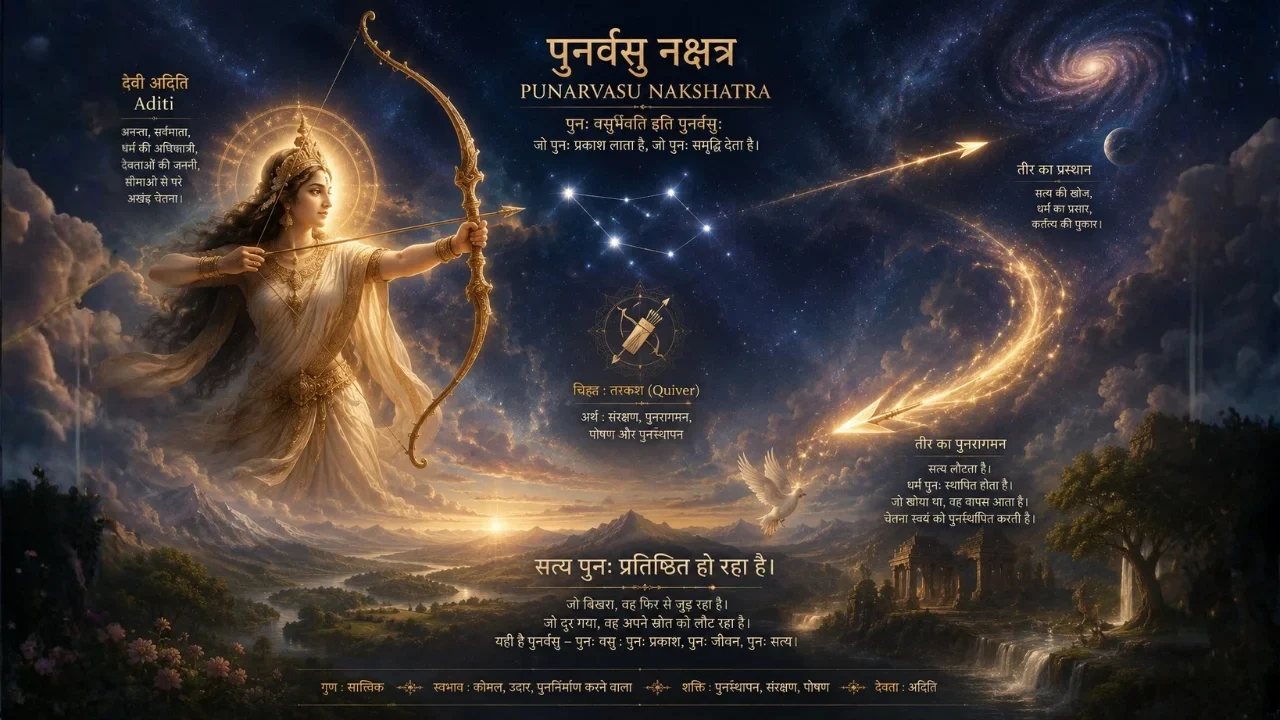
Punarvasu Nakshatra is one of the most misunderstood Nakshatras in Vedic Astrology. Most descriptions focus on positive qualities such as optimism, kindness, generosity, spirituality, and adaptability. While these traits certainly belong to Punarvasu, they barely scratch the surface of its true astrological significance.
The real predictive power of Punarvasu emerges when we study its presiding deity, Goddess Aditi.
Ancient sages never assigned deities to Nakshatras randomly. Every deity carries a symbolic story. Hidden within that story are predictive principles that repeatedly manifest in human lives.
When astrologers understand the mythology behind a Nakshatra, they gain access to layers of prediction that cannot be discovered through sign placement alone.
Punarvasu is ruled by Jupiter and spans from 20 degrees Gemini to 3 degrees 20 minutes Cancer. Its symbol is traditionally represented by a quiver of arrows or a house. Both symbols point toward a profound theme: return.
The Sanskrit word Punarvasu can be divided into two parts.
“Punar” means again.
“Vasu” means light, wealth, goodness, prosperity, or dwelling.
Thus, Punarvasu literally signifies the return of light, the return of prosperity, the return of happiness, or the restoration of what was lost.
This simple meaning becomes extraordinarily powerful when examined through the story of Aditi.
The Story of Aditi and Its Astrological Meaning
Aditi occupies a unique place in Vedic literature. She is known as the Mother of the Adityas, the divine forces responsible for maintaining cosmic order. The word Aditi itself means boundless, limitless, unrestricted, or infinite.
Throughout the Puranic and Vedic narratives, Aditi repeatedly appears during times when the forces of light have been defeated by forces of darkness. Whenever divine order collapses, Aditi intervenes. Whenever prosperity disappears, Aditi works toward restoration. Whenever the Devas lose their kingdom, Aditi becomes the force behind its recovery.
This theme appears again and again. The most famous example involves the birth of Vamana, the fifth incarnation of Lord Vishnu. When King Bali gained control over the three lokas(worlds), the Devas lost their celestial kingdom.
Aditi observed the suffering of her children and performed severe austerities. Her prayers eventually resulted in the birth of Vamana, who restored cosmic balance and returned the heavenly kingdom to the Devas.
This story contains the greatest predictive secret of Punarvasu Nakshatra. The life of a Punarvasu native rarely follows a straight line. Instead, life repeatedly moves through a cycle:
- Loss
- Separation
- Waiting
- Restoration
- Recovery
- Renewal
Many astrologers notice the restoration but fail to recognize the preceding loss. Without understanding the first phase, the prediction remains incomplete.
The Law of Restoration
The Hidden Gift of Punarvasu Nakshatra
One of the most remarkable predictive principles associated with Punarvasu Nakshatra is what may be called the Law of Restoration. This principle is not discussed frequently in classical interpretation, yet it becomes visible again and again when studying real horoscopes over long periods of time.
In practical chart analysis, planets placed in Punarvasu often indicate areas of life that experience disruption, loss, separation, or temporary decline. At first glance, the events may appear unfortunate. The native may feel that something important has been taken away. However, when the entire life story is observed rather than a single event, a fascinating pattern emerges. What is lost often returns later in a more refined, suitable, or meaningful form.
This does not mean that every loss is reversed exactly as it was before. Punarvasu rarely restores the past in an identical shape. Instead, it restores the essence while improving the form. The lesson is not about returning backward, it is about rebuilding forward.
A relationship may end painfully, leaving the individual emotionally devastated. Yet after a period of growth and self-understanding, a healthier and more compatible relationship often appears. Employment may be lost unexpectedly, creating fear and uncertainty. Later, a career path emerges that aligns far better with the person’s abilities and inner purpose. Financial setbacks may force the native to start from zero, but over time wealth gradually returns, often with greater stability and wisdom than before.
The same pattern can be observed in matters of health. Periods of illness, weakness, or physical struggle may arise, but recovery frequently follows. The individual does not merely return to their previous condition; they often develop a deeper appreciation for life, discipline, and well-being as a result of the experience.
What makes this principle so fascinating is that Punarvasu natives rarely remain permanently defeated. They may suffer setbacks that would discourage many others. They may experience repeated interruptions, delays, or reversals. Yet somewhere within them exists a remarkable capacity to rebuild. Even when life appears to have dismantled everything, a hidden force slowly guides them toward renewal.
This restorative quality reflects the deeper symbolism of Punarvasu itself. The energy of this nakshatra is not about avoiding loss. It is about proving that loss is not always the end of the story. Life may remove something temporarily, but it also provides opportunities for regeneration. The native learns that endings are often disguised beginnings.
This does not mean life becomes easy for those strongly connected to Punarvasu. In fact, many experience repeated cycles of construction and reconstruction throughout their lives. Their karma frequently places them in situations where they must start again after disappointment, failure, separation, or collapse.
Yet this repeated beginning carries an important spiritual and psychological lesson. Each cycle teaches greater resilience, greater faith in renewal, and a deeper understanding that external circumstances do not define the ultimate outcome. What matters is the ability to rise after falling.
For this reason, one of the hidden blessings of Punarvasu is not protection from hardship, but protection from permanent defeat. The native may bend, retreat, lose, or struggle—but somehow life repeatedly offers another chance to rebuild. And through those repeated restorations, they gradually discover one of the deepest truths of human existence: the capacity to begin again is often a greater gift than never falling at all.
Why Punarvasu People Often Experience Repeated Beginnings
One of the most fascinating patterns observed in the lives of Punarvasu natives is the frequency with which they are required to begin again. Students often notice that individuals with important planets placed in this nakshatra seem to experience repeated restarts in significant areas of life. Projects are abandoned and restarted. Careers change direction. Relationships end and new ones emerge. Businesses fail and are rebuilt. Even spiritual journeys often pass through multiple phases before finding their true path.
To understand this phenomenon, one must look deeper into the symbolism of Aditi, the presiding deity of Punarvasu. Aditi is often associated with protection, nourishment, and abundance, but her deeper function is restoration. She does not simply preserve what already exists. She has the power to rebuild what has been broken and renew what has been lost.
This distinction is extremely important. Restoration can only occur when something has first experienced disruption. There can be no rebuilding without a prior collapse. There can be no renewal without a period of loss. As a result, the life journey of many Punarvasu natives naturally contains cycles of interruption followed by recovery.
The first attempt often serves as a lesson rather than a destination. A business may be launched with enthusiasm only to encounter obstacles that force its closure. A relationship may appear promising but dissolve unexpectedly. A career path may initially seem perfect yet gradually reveal itself to be misaligned with the person’s deeper nature. At the time, these experiences can feel frustrating or even unfair. The native may wonder why life repeatedly requires them to start over.
However, when viewed from a longer perspective, a pattern becomes visible. The second attempt is often stronger than the first. The rebuilt business is managed with greater wisdom. The later relationship is healthier and more compatible. The revised career path aligns more naturally with the individual’s talents and purpose. What appeared to be failure often becomes preparation.
This is why Punarvasu natives frequently discover that their most meaningful achievements emerge after disappointment rather than before it. Their growth rarely follows a straight line. Instead, it unfolds through a series of endings and beginnings, each one refining their understanding and strengthening their resilience.
In many charts, this pattern becomes especially pronounced when the Ascendant lord, Moon, Sun, Atmakaraka, or key house lords occupy Punarvasu. The individual repeatedly encounters situations that demand adaptation. Life seems to dismantle one structure only to guide them toward a more suitable one. The process can feel disruptive in the moment, but its deeper purpose is constructive.
Psychologically, this creates a remarkable quality within many Punarvasu natives: the ability to recover. They learn that a setback is not necessarily a final verdict. A closed door does not always signify permanent loss. Through repeated experiences of rebuilding, they gradually develop faith in their capacity to begin again.
This is one of the hidden gifts of Punarvasu. While other nakshatras may emphasize stability, achievement, or continuity, Punarvasu teaches renewal. Its natives often discover that life is not measured by how many times they avoid failure, but by how many times they rise after it. The horoscope repeatedly places them in cycles of destruction and renewal, not to weaken them, but to reveal a profound truth: sometimes the path that ultimately succeeds is the one that emerges after everything else has fallen apart.
The Hidden Meaning of the Quiver of Arrows
The traditional symbol of Punarvasu is a quiver filled with arrows. Most astrological descriptions mention this symbol briefly and then move on, leaving its deeper meaning unexplored. Yet within this simple image lies one of the most profound secrets of the nakshatra.
An arrow that has already been released has completed its journey. Once it leaves the bow, it cannot be recalled. If it misses its target, the opportunity associated with that particular arrow is gone. But the symbol of Punarvasu is not a single arrow. It is a quiver—a container holding many arrows waiting to be used.
This distinction changes everything.
The quiver represents reserve resources. It symbolizes the ability to continue even after a setback. It suggests that failure is not the end because additional possibilities remain available. Life may consume one opportunity, but the quiver reminds us that not all opportunities have been exhausted.
This symbolism reflects the lives of many Punarvasu natives with remarkable accuracy. They often experience situations that appear final to others. A business may fail. A relationship may end. A career path may collapse. A long-term plan may suddenly disintegrate. From the outside, observers may assume that the story is over.
Yet something unusual often happens.
The native discovers resources that were not previously visible. They find strength they did not know they possessed. New opportunities emerge from unexpected directions. What seemed like a complete ending gradually reveals itself to be only one chapter in a much larger journey.
This is why many Punarvasu individuals possess an extraordinary capacity for recovery. Their resilience is not always obvious during stable periods. It becomes visible when life tests them. Under pressure, hidden reserves begin to emerge. They may feel exhausted, disappointed, or temporarily defeated, yet they rarely remain without options for long. Somewhere within their psyche exists another arrow waiting to be drawn.
In practical chart analysis, planets placed in Punarvasu often indicate areas of life where these hidden reserves become especially important. During difficult periods, resources suddenly appear that help the individual recover and move forward. These resources may take many forms.
Sometimes they are financial. Money arrives from an unexpected source just when it is most needed. Sometimes they are emotional. Support comes from family, friends, or an inner resilience that had remained dormant until challenged. Sometimes they are intellectual. The person discovers new ideas, skills, or solutions that transform a seemingly impossible situation.
In other cases, the reserve resource is spiritual. A deeper faith, wisdom, or understanding emerges during adversity, allowing the individual to endure circumstances that once seemed unbearable. And occasionally, the resource appears karmic in nature, where life itself seems to provide a second chance after a period of apparent closure.
This is the hidden teaching of the quiver. Punarvasu is not merely the nakshatra of renewal. It is the nakshatra of reserve capacity. It reminds us that life often contains more possibilities than we can see in moments of despair.
When others believe all arrows have been used, Punarvasu quietly reaches into the quiver and discovers another one.
And that ability to find hidden strength after disappointment is one of the greatest blessings bestowed by this remarkable nakshatra.
The House Symbol and Multiple Homes
The second traditional symbol of Punarvasu is a house. At first glance, this may appear simple, even obvious. However, when examined through the lens of predictive astrology, this symbol reveals a fascinating and often overlooked pattern. Just as the quiver symbolizes restoration and renewed opportunity, the house symbolizes return, shelter, belonging, and the repeated search for a place that truly feels like home.
One of the most interesting observations in practical chart analysis is that strong Punarvasu influence frequently appears in the horoscopes of individuals whose lives involve unusual residential patterns. These people often experience multiple chapters connected with property, relocation, family roots, or changing living environments. Their concept of home rarely follows a simple or linear path.
Many Punarvasu natives spend significant periods away from their place of birth. They may relocate repeatedly due to education, career, marriage, or personal circumstances. Some live in different cities throughout life, while others settle in foreign countries for many years. Yet despite these movements, a curious pattern often emerges: life repeatedly pulls them back toward something familiar.
In numerous charts, strong Punarvasu placements have appeared in individuals who eventually return to ancestral property after years of separation. Others inherit family homes they never expected to own. Some restore neglected or abandoned houses, bringing life back to places that had been forgotten. There are also cases where individuals build more than one residence, creating multiple places of belonging throughout their journey.
What makes this symbolism unique is that the emphasis is not merely on acquiring property. The deeper theme is restoration of connection. The house in Punarvasu represents more than a physical structure. It represents a return to roots, identity, memory, and emotional continuity. Even when life takes the native far away, circumstances often arise that reconnect them with a place, a family history, or a sense of belonging they thought had been left behind.
This recurring pattern reflects the deeper nature of Punarvasu itself. The nakshatra is strongly associated with cycles of departure and return. Just as opportunities return after loss and strength returns after adversity, home also tends to reappear in unexpected ways. The native may leave, wander, explore, and build a life elsewhere, yet some thread remains connected to the past.
Psychologically, this symbolism can also manifest as a lifelong search for inner home. Many Punarvasu natives spend years seeking fulfillment through external movement, only to discover that what they were truly searching for was a deeper sense of belonging within themselves. The outer return often mirrors an inner return.
This is why the house symbol of Punarvasu should never be interpreted only in literal terms. While it frequently produces remarkable results related to property, residence, and relocation, its deeper message concerns the restoration of connection. Life repeatedly teaches these natives that no matter how far they travel, certain parts of their journey eventually bring them back to what is essential.
And in true Punarvasu fashion, the return is rarely a step backward. It is a return with greater understanding, greater maturity, and a deeper appreciation of what home truly means.
Jupiter’s Influence on Punarvasu
Why Recovery Comes Through Grace Rather Than Struggle
The restorative power of Punarvasu cannot be fully understood without appreciating the role of its planetary ruler, Jupiter. While the symbolism of Aditi explains the principle of renewal, Jupiter explains how that renewal unfolds. The ruling planet shapes the method through which the Nakshatra expresses its deepest karmic themes.
This distinction is important because restoration can occur in many different ways. If a Nakshatra governed by Saturn experiences loss, recovery often comes slowly through patience, endurance, and prolonged effort. If Mars were the ruler, restoration might occur through confrontation, decisive action, or struggle against obstacles. But Punarvasu follows a different path.
Jupiter restores through wisdom, guidance, faith, understanding, and what many would describe as grace. The recovery process often involves learning rather than fighting. It involves insight rather than force. This is one of the reasons why many Punarvasu natives possess a remarkable ability to remain hopeful even during difficult periods of life.
To outside observers, this optimism may sometimes appear unrealistic. The individual may be facing setbacks, uncertainty, financial pressure, relationship difficulties, or professional instability, yet a quiet belief remains that circumstances will eventually improve. Interestingly, this belief is often validated by future events.
The reason is deeper than simple positive thinking. In many cases, the optimism reflects the karmic structure of the Nakshatra itself. Punarvasu repeatedly teaches the native that endings are rarely final. After experiencing several cycles of loss followed by restoration, faith gradually becomes rooted in lived experience rather than blind hope. The person begins trusting that recovery is possible because life has demonstrated it repeatedly.
One of the most fascinating patterns observed in charts with strong Punarvasu influence is the appearance of assistance at critical moments. Just when a situation seems impossible, support arrives from an unexpected source. A teacher enters the person’s life. A mentor offers guidance. A friend provides help. An opportunity appears that changes the direction of events. A solution emerges where none seemed visible before.
These interventions often occur at moments when the native has exhausted ordinary options. From a purely logical perspective, the timing can seem extraordinary. Yet such occurrences appear frequently enough in Punarvasu-related charts that they deserve serious attention in predictive analysis.
This phenomenon reflects the deeper mythological symbolism of Aditi herself. In the ancient narratives, Aditi repeatedly intervenes to restore balance and protect the Devas during periods of crisis. The same principle appears symbolically in the lives of many Punarvasu natives. When circumstances become overwhelming, some form of support often emerges that helps restore movement and hope.
This does not mean that Punarvasu natives are protected from suffering. They experience setbacks, losses, disappointments, and periods of uncertainty like everyone else. The difference lies in the pattern that follows. Their lives frequently contain moments where wisdom arrives precisely when confusion peaks, guidance appears when direction is lost, and opportunities emerge when defeat seems inevitable.
For this reason, Jupiter’s influence gives Punarvasu a unique quality among the Nakshatras. Its restoration is rarely based solely on personal effort. Instead, it often combines effort with guidance, perseverance with understanding, and struggle with grace. The native learns that recovery is not always a matter of fighting harder. Sometimes it comes through seeing more clearly, trusting more deeply, and remaining open to help when it arrives.
And that may be the greatest gift Jupiter bestows upon Punarvasu: the ability to believe in renewal even when the evidence seems absent, and the experience of discovering that life often provides support at the exact moment it is most needed.
Punarvasu and Divine Protection
The Protective Grace of Aditi.
Aditi is often described as the divine mother, but this description captures only part of her significance. In the deeper symbolism of Punarvasu, Aditi represents a cosmic force of protection, restoration, and renewal. Her role is not merely to nurture life but to preserve its continuity even after periods of disruption. This protective quality forms one of the most remarkable and frequently overlooked characteristics of Punarvasu.
Because of this symbolism, many individuals strongly influenced by Punarvasu seem to experience unusual forms of protection throughout their lives. This does not mean they are exempt from suffering, failure, loss, or hardship. In fact, many face significant challenges. The difference lies not in what happens initially, but in how the story ultimately unfolds.
A recurring observation in practical chart analysis is that situations often appear far more threatening than the final outcome. A crisis emerges that seems capable of causing complete devastation. The native fears total loss, permanent failure, or irreversible damage. Yet as events unfold, the actual result proves less destructive than expected.
The person may lose something important, but not everything. A relationship may end, but emotional recovery follows more quickly than anticipated. A financial setback may occur, yet the individual retains enough resources to rebuild. A career disruption may appear disastrous, only to open the door to a more suitable opportunity later. The threat is real, but the final damage is often reduced.
This pattern appears so consistently in many Punarvasu-related charts that it deserves serious consideration in predictive work. The protective influence does not eliminate difficulty; it limits its final impact. What initially appears as destruction frequently becomes redirection. What looks like a permanent setback often becomes a temporary interruption.
Many astrologers miss this quality because they focus heavily on the event itself. They identify the loss, the challenge, or the period of instability, but they fail to follow the story far enough to see the restoration that follows. As a result, the prediction becomes incomplete. The event is described accurately, but the deeper outcome is overlooked.
The true signature of Punarvasu is not the absence of adversity. Difficulties still occur. Challenges still arise. Losses still happen. But behind these experiences exists a remarkable tendency toward recovery, repair, and renewal. Life repeatedly finds a way to restore what is essential, even if the form changes along the way.
This is why Punarvasu should never be interpreted through the lens of difficulty alone. Its deeper promise is not protection from all suffering. Rather, it is protection from permanent defeat. The native may be tested, delayed, disappointed, or temporarily broken by circumstances, but some unseen force often guides them toward reconstruction.
In this sense, divine protection under Punarvasu does not mean being spared from life’s storms. It means possessing a mysterious capacity to emerge from those storms with more remaining than expected. The crisis occurs, the lesson unfolds, and the loss is felt—but restoration follows.
And that is the hidden blessing of Aditi. She does not always prevent the fall. She ensures that after the fall, there remains something from which life can begin again.
The Psychological Pattern of Punarvasu
Emotional Elasticity, Faith, and the Shadow of Excessive Optimism.
The mythology of Aditi does not only reveal predictive themes; it also provides profound insight into the psychology of Punarvasu natives. At its core, Aditi represents boundlessness, expansion, and an almost infinite capacity to contain experience without becoming permanently damaged by it. This symbolism manifests in a distinctive psychological pattern that is frequently observed in individuals strongly influenced by Punarvasu.
One of the most remarkable qualities of these natives is what may be called emotional elasticity. Life may disappoint them, but they rarely remain disappointed for long. They may experience setbacks that would leave others bitter or defeated, yet somehow they regain hope and continue moving forward. Their emotional system possesses an unusual ability to absorb shocks and gradually return to equilibrium.
This quality often makes them more forgiving than many other Nakshatras. They are capable of seeing beyond immediate mistakes and recognizing the larger human story behind a person’s actions. They tend to adapt quickly to changing circumstances, recover from emotional losses, and maintain faith even when external evidence appears discouraging. While others may become cynical after repeated disappointments, Punarvasu natives often retain a belief that improvement remains possible.
At their highest expression, this becomes one of their greatest gifts. Such individuals naturally encourage others during difficult times. They become sources of reassurance, optimism, and emotional support. Their presence reminds people that setbacks are temporary and that recovery remains possible. Many naturally gravitate toward teaching, mentoring, counseling, healing, or guiding roles because they possess an instinctive faith in growth and renewal.
However, every strength carries a shadow, and Punarvasu is no exception.
The same expansive optimism that creates resilience can sometimes create vulnerability. Because these individuals often believe in second chances, they may offer them too freely. They may continue trusting people long after trust has been broken. They may repeatedly invest energy, time, or emotion into situations that no longer deserve their commitment. Their faith in restoration can occasionally prevent them from recognizing when something has truly reached its natural conclusion.
Some Punarvasu natives remain attached to relationships that consistently disappoint them because they believe improvement is just around the corner. Others continue pursuing unrealistic goals despite clear signs that a different direction would be healthier. Their optimism becomes less a source of wisdom and more a reluctance to acknowledge reality.
This is why the condition of Jupiter becomes critically important when analyzing Punarvasu. Since Jupiter governs the Nakshatra, its strength or weakness dramatically influences how the native expresses these qualities. A well-placed and strong Jupiter tends to balance faith with discernment. The person remains hopeful, but also knows when to step back, when to redirect effort, and when to accept that a chapter has ended.
An afflicted or weakened Jupiter, however, may distort the positive qualities of Punarvasu. Faith can become wishful thinking. Compassion can become poor boundaries. Optimism can become denial. The individual may repeatedly place trust where caution is required, believing that every situation can be restored even when circumstances clearly suggest otherwise.
For this reason, the psychological analysis of Punarvasu should never stop at simple descriptions such as “optimistic” or “positive.” The deeper question is whether that optimism is guided by wisdom or disconnected from reality. When Jupiter functions properly, the native develops mature hope—a hope that understands both possibilities and limitations.
Ultimately, the greatest psychological gift of Punarvasu is not optimism itself. It is the ability to remain open-hearted after disappointment without becoming blind to reality. When this balance is achieved, the native embodies the highest expression of Aditi: expansive enough to forgive, resilient enough to recover, and wise enough to know where faith should—and should not—be placed.
Predictive Secret and The Return Principle
One of the Most Valuable Predictive Secrets of Punarvasu.
Among the many predictive patterns associated with Punarvasu, perhaps none is more consistently observable than what may be called the Return Principle. This principle emerges repeatedly in chart analysis and often becomes one of the defining signatures of the Nakshatra.
The essence of the Return Principle is simple: when important planets occupy Punarvasu, matters connected to those planets frequently return after a period of separation, interruption, or apparent closure. What seems finished often proves unfinished. What appears lost often finds a way back into the native’s life.
This does not necessarily mean events repeat in exactly the same form. The return may be literal, symbolic, emotional, karmic, or circumstantial. The outer appearance may change, but the underlying theme remains connected to something from the past seeking completion.
A relationship that ended years ago may unexpectedly reappear through renewed contact, reconciliation, or unfinished emotional lessons. An old career path that seemed permanently abandoned may become relevant again under different circumstances. A childhood aspiration that was forgotten during adulthood may suddenly regain importance and become a central life direction.
The same principle frequently appears in education. Many individuals with strong Punarvasu influence interrupt their studies for various reasons, only to return years later and complete what was left unfinished. Abandoned projects often re-emerge after long periods of inactivity. Family relationships that experienced separation may gradually heal and reconnect. Even financial opportunities sometimes return in a modified form after previously being lost.
What makes this principle remarkable is its consistency. Over time, the astrologer begins noticing that Punarvasu rarely accepts permanent closure without first determining whether genuine completion has occurred. The Nakshatra carries a natural tendency toward revisiting, restoring, and completing unfinished cycles.
This is why caution is required when making definitive predictions involving strong Punarvasu placements. A chapter that appears completely closed may not be truly finished. An opportunity that seems lost may not be permanently gone. The visible ending may simply represent a pause in a larger karmic process.
The deeper reason behind this pattern lies in the nature of restoration itself. Punarvasu does not merely create new beginnings; it reconnects the native with experiences that still contain unfinished growth. Life circles back, not because it is moving backward, but because something remains incomplete. The return provides another opportunity for understanding, correction, fulfillment, or closure.
From a predictive perspective, this principle is extraordinarily valuable. Many astrologers focus only on the moment of loss, separation, or interruption. They accurately identify the ending but fail to anticipate the later return. As a result, their interpretation captures only half of the karmic story.
A more refined approach recognizes that when Punarvasu is strongly involved, endings should be treated with caution. The astrologer must always ask a deeper question: Is this truly over, or is it simply waiting for the right time to return?
In many cases, the answer becomes clear only years later when the native discovers that what seemed permanently lost was merely undergoing a period of distance before re-entering life in a new form.
This is the hidden wisdom of the Return Principle. Punarvasu teaches that some karmas do not disappear when interrupted. They circle back until their purpose has been fulfilled. And understanding this single principle can dramatically improve the astrologer’s ability to see beyond temporary endings and recognize the larger cycle unfolding beneath them.
The Spiritual Message of Aditi
The Wisdom of Renewal and the Infinite Nature of Consciousness.
Beyond the predictive rules, symbols, and life events associated with Punarvasu lies a much deeper spiritual teaching. The mythology of Aditi is not merely a story about protection, restoration, or divine intervention. At its highest level, it describes the infinite capacity of consciousness to heal, renew itself, and continue evolving despite periods of fragmentation.
Every human life contains moments when things fall apart. Relationships end. Careers collapse. Dreams fail to materialize. Plans that once seemed certain suddenly disappear. There are phases when identity itself feels fractured and the future appears unclear. These experiences are universal. No one moves through life without encountering loss, disappointment, or uncertainty.
Yet the deeper mystery of existence is that life rarely ends where the breakdown occurs.
Something within the human spirit continues searching for meaning, growth, and renewal. Even after periods of profound suffering, new possibilities begin emerging. What appeared to be the end often becomes the beginning of a different chapter. This is the essential lesson that Aditi represents.
Punarvasu teaches that spiritual growth does not usually arise through uninterrupted success. Constant success may build confidence, but it does not always build wisdom. Wisdom often develops when life removes something we believed we could not live without. It emerges when expectations collapse and the individual is forced to discover a deeper source of strength.
This is why restoration is such a central theme of the Nakshatra. The soul matures not simply because it succeeds, but because it learns how to rebuild after failure. Each cycle of loss followed by recovery expands consciousness. Each return after defeat reveals a hidden reservoir of resilience. Over time, the individual begins to trust not external circumstances, but their own capacity to rise again.
Many highly evolved spiritual seekers display strong Punarvasu influences for this very reason. Their path often involves repeated lessons in surrender, renewal, and reconstruction. Life teaches them that security cannot be found in temporary forms because all forms eventually change. What remains constant is the capacity of consciousness itself to adapt, heal, and continue growing.
At a deeper level, every restoration carries a spiritual message. When something lost returns, it teaches that absence is not always permanent. When something broken heals, it demonstrates that damage is not always final. When forgotten wisdom re-emerges, it reveals that truth can remain dormant without ever being destroyed.
This is why the story of Aditi should not be viewed merely as mythology. It is a symbolic description of one of the most fundamental laws operating within human experience. Life moves in cycles of expansion, contraction, loss, and renewal. What appears finished from one perspective may simply be entering a period of transformation.
Punarvasu reminds us that endings are often misunderstood. The human mind tends to see closure where life sees preparation. It sees loss where life sees reorganization. It sees failure where life is quietly creating the conditions for a more meaningful beginning.
The deepest spiritual message of Aditi is therefore one of hope, not blind optimism, but a profound understanding of how existence works. What is lost can return in a wiser form. What is broken can heal with greater strength. What is forgotten can be remembered when the time is right. And what appears to be the end may simply be the pause that precedes renewal.
This is the eternal promise hidden within Punarvasu. life may take away, life may interrupt, life may dismantle, but it also restores. And through that restoration, consciousness gradually remembers its own infinite nature.
To be continued..
Read :- Ardra Nakshatra | Yoga to Become an Astrologer
Learn Vedic Astrology – Zero to Advance Course By Neeraj Verma




1 thought on “The Hidden Predictive Secrets of Punarvasu Nakshatra – Decoding Destiny (Part-1)”
👍 nice