
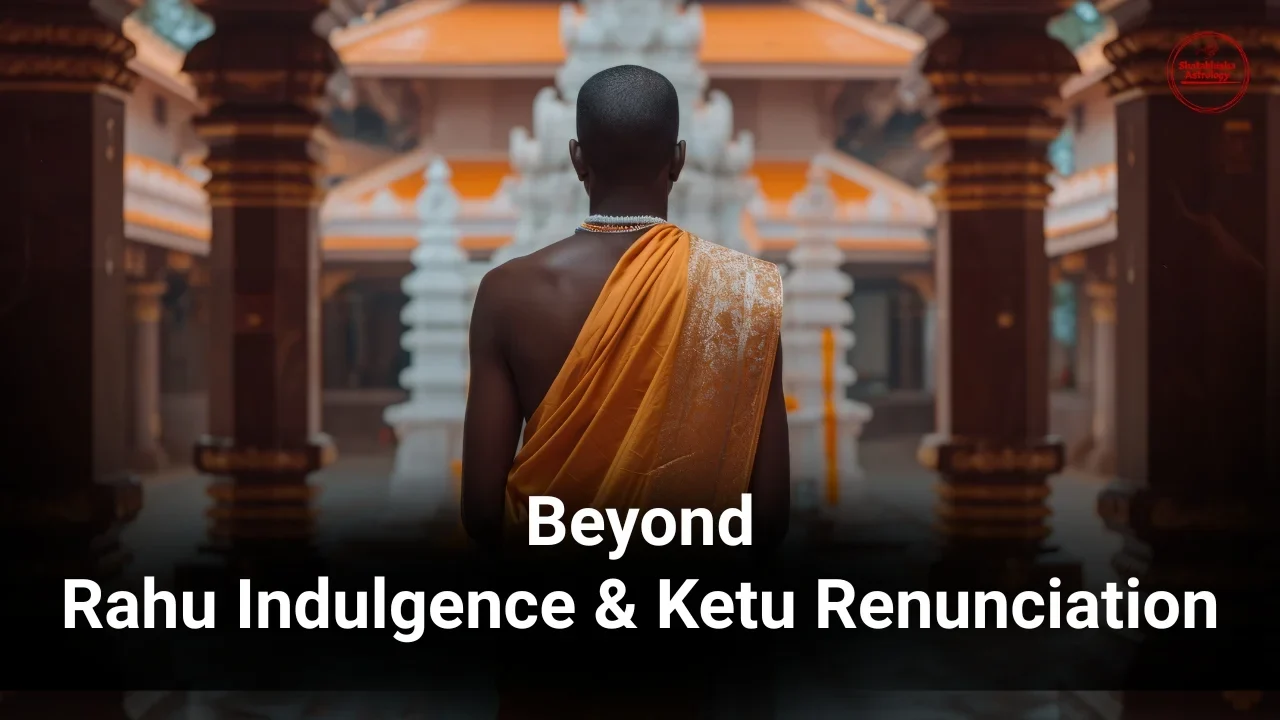
Beyond Rahu Indulgence & Ketu Renunciation
Most people move through life swinging between two extremes. When the pull of wanting becomes stronger, they indulge, chasing experiences, achievements, relationships, or a sense of control. When exhaustion sets in or disappointment follows, they swing to the opposite side and withdraw. They detach, shut down, or distance themselves from life. This movement feels natural, almost automatic, and for many, it becomes a lifelong pattern.
What is rarely noticed is that even our learning often strengthens this oscillation. Many teachings unknowingly reinforce the idea that one side must be corrected by the other. Desire is treated as a problem to be suppressed, while withdrawal is glorified as wisdom. The language may sound refined, but the inner effect is the same: people keep jumping from indulgence to renunciation, never truly understanding either.
The deeper question is almost never asked. What happens when neither indulgence nor withdrawal actually resolves the inner tension? What happens when chasing more leaves you empty, and stepping away leaves you numb? At that point, the old solutions stop working, and confusion begins. But that confusion is not failure. it is a signal that a different way of living is trying to emerge.
This is where the third path begins, not as an idea to be adopted or a belief to be followed, but as something lived and experienced. In this space, desire is neither blindly acted out nor forcefully denied. Detachment is neither escape nor superiority. Both are seen, understood, and integrated. When this integration happens, life stops swinging between extremes. Instead of reaction, there is awareness. Instead of oscillation, there is presence. This is not a theory. It is the quiet maturity that grows when the inner axis finally becomes whole.
Why the First Two Paths Always Fail
Let us be very honest, without softening the truth. The first two paths fail not because they are wrong, but because they are incomplete. Each carries a truth, but when lived alone, that truth turns against the person. What was meant to teach becomes a trap.
Path 1: Rahu Indulgence
Experience Without End
This path encourages full engagement with desire. The idea sounds attractive: fulfill your wants, live intensely, and happiness will follow. At first, there is excitement and movement. Life feels alive. But Rahu has no natural point of completion. Each fulfillment only creates the appetite for the next experience. There is always something more to chase.
Over time, indulgence turns into exhaustion. The nervous system gets overstimulated, attachments deepen, and identity begins to inflate around achievement, pleasure, or recognition. Along with this comes a constant fear of loss, because everything gained feels temporary. People walking this path often reach a confusing moment where they ask themselves why satisfaction has still not arrived, even after “having it all.”
The reason is simple. Rahu never promised fulfillment. It promised experience. Experience expands awareness, but it does not settle the heart. When experience is mistaken for completion, emptiness becomes inevitable.
Path 2: Ketu Renunciation
Release Without Presence
The second path appears wiser on the surface. It advises letting go, stepping back, and withdrawing from desire. But when detachment happens too early, it becomes another form of escape. Instead of understanding desire, the person tries to rise above it. Instead of engaging consciously, they disengage completely.
This leads to dryness inside. Emotional color fades. Life begins to feel distant rather than peaceful. Engagement reduces, and meaning slowly leaks away. Beneath the calm exterior, there is often unacknowledged bitterness, a sense that something vital was missed or suppressed. People on this path quietly wonder why nothing excites them anymore, or why life feels strangely hollow despite all the letting go.
The reason lies in a misunderstanding. Ketu never promised meaning. It promised release. Release without awareness creates emptiness, not freedom. When renunciation is used to avoid life rather than to understand it, it cannot lead to wholeness.
———————
Both paths fail because they are lived in isolation. One chases endlessly, the other retreats prematurely. Neither allows true integration. And until integration begins, satisfaction remains out of reach, no matter which extreme a person chooses.
The Core Mistake – Treating Rahu and Ketu as Opposites Energy
The most fundamental misunderstanding is seeing Rahu and Ketu as enemies, as if one must be defeated for the other to succeed. In reality, they are not opposing forces fighting each other. They are two polar movements of the same inner current. When this is not understood, a person keeps swinging between extremes, never finding stability.
Rahu moves toward experience. It pushes life outward, into contact, into intensity, into discovery. Without it, growth would stagnate and awareness would remain limited. Ketu, on the other hand, moves away from attachment. It pulls energy inward, dissolving identification with what has already been known. Without it, experience would turn into endless bondage. Both movements are necessary, and both belong to the same process.
The problem begins when one is chosen and the other is rejected. When experience is pursued without the ability to release, life becomes heavy and compulsive. When release is embraced without fully living, life becomes dry and disconnected. In both cases, imbalance is unavoidable because half of the inner movement is being denied.
The third path begins only when this imagined opposition collapses. When experience and release are no longer seen as contradictory, but as complementary, something settles inside. Desire can be lived without slavery, and detachment can exist without withdrawal. This is not a compromise between two extremes, but it is their integration. And only from this integration does a stable, conscious way of living emerge.
What the Third Path Is Not – and Why It Cannot Be Reached Alone
Before the Third Path can be genuinely understood, certain deeply rooted misunderstandings must be dissolved. Most people approach it with assumptions shaped by moral conditioning and psychological habit. They imagine it as a refined version of balance, and living carefully, avoiding extremes, or maintaining a polite moderation between indulgence and renunciation. Some see it as a disciplined lifestyle where desire is allowed in measured doses, and detachment is practiced selectively.
This view completely misses the essence.
The Third Path is not about moderation.
It is not about compromise.
It is not a negotiated settlement between attachment and renunciation.
Any method that calculates how much desire is “acceptable” and how much withdrawal is “safe” is still operating within the same old inner conflict. The struggle may appear calmer, more spiritual, or more intellectual—but it remains a struggle. Control has simply replaced chaos. Regulation has replaced indulgence. The battlefield has not disappeared; it has only become subtler.
The Third Path does not ask you to manage desire, nor does it ask you to cultivate detachment as a virtue. Both of these efforts keep the ego quietly active, constantly monitoring, correcting, and judging itself.
What truly changes in the Third Path is not outer behavior, but inner relationship.
Desire is no longer something to obey compulsively, nor something to suppress with force. Detachment is no longer an escape route, a spiritual posture, or an identity one wears to feel superior. Instead, both desire and detachment are met with clear awareness. They are seen as movements arising in consciousness, not enemies, not commandments.
When this clarity arises, judgment dissolves. Doubt dissolves. Fear dissolves. Reaction dissolves.
And because of this, the Third Path cannot be practiced as a technique. It cannot be reduced to rules, habits, or disciplines. Any attempt to “do” the Third Path immediately turns it into another strategy of the mind.
The Third Path emerges only when the inner tug-of-war between holding on and letting go comes to an end. When that conflict dissolves, desire and detachment lose their authority. They no longer dominate your decisions or define your identity. They become phenomena that are understood rather than impulses that are obeyed or resisted.
This is not moderation.
This is a transformation of orientation.
The Essential Role of the Guru in Discovering the Third Path
At this point, one truth must be stated very clearly: the Third Path is extremely difficult to recognize without a Guru.
Why?
Because the mind is clever. It can disguise attachment as devotion and detachment as wisdom. It can turn renunciation into pride and desire into justification. When one walks alone, it is very easy to believe one has transcended something, while in reality one has only shifted to a subtler form of the same bondage.
The Guru’s importance lies precisely here.
A true Guru keeps a sharp, compassionate watch over the seeker’s journey of consciousness. The Guru observes not just your actions, but the direction of your inner movement. The moment you begin to drift slightly, leaning toward indulgence or subtly escaping into detachment, the Guru intervenes.
Sometimes this intervention is gentle.
Sometimes it is uncomfortable.
But it is always precise.
The Guru stops you when you begin to justify Rahu with spiritual logic.
The Guru stops you when you begin to take shelter in Ketu as an escape.
The Guru stops you when Rahu starts appearing reasonable, necessary, or inevitable.
The Guru stops you when Ketu starts becoming a hiding place rather than clarity.
The Guru stops you when Rahu quietly reclaims authority over your awareness.
The Guru stops you when Ketu turns into a subtle form of avoidance.
This is why surrender to the Guru makes the Third Path accessible. Not because the Guru gives you a formula, but because the Guru prevents unconscious deviation. The Third Path is narrow, and it is not because it is strict, but because it requires constant clarity. Alone, clarity flickers. Under the Guru’s gaze, it stabilizes.
When surrender deepens, the seeker no longer has to constantly self-correct. The Guru becomes the mirror that reveals even the smallest inner movement away from awareness. In this atmosphere of trust and guidance, the inner struggle naturally weakens. The effort to choose between desire and detachment fades.
And then, without force, without strategy, without self-congratulation, the Third Path begins to reveal itself.
Not as a lifestyle.
Not as an ideology.
But as a quiet, unwavering alignment with truth.
What the Third Path Actually Is
The Third Path is only presence, not as a concept to be understood, not as a belief to be adopted, but as a lived state of being. Presence does not mean withdrawing from life, nor does it imply passivity or indifference. It means participating fully, intensely even, while remaining inwardly unentangled. Life is met directly, moment by moment, without being swallowed by reactions, expectations, or borrowed identities.
Here, the guidance of the Guru becomes subtle but crucial. The Guru does not pull you away from life; instead, the Guru continuously brings you back into presence when you unconsciously drift into habit, reaction, or self-deception. Presence matures not through effort alone, but through repeated realignment, and this realignment is where the Guru’s role becomes indispensable.
In this state, action continues to happen. Sometimes it is forceful, sometimes gentle, sometimes outwardly intense, sometimes almost invisible. But action no longer possesses the person. There is movement without inner compulsion. Desire still arises, because desire is a natural current of life itself but it no longer dictates identity, worth, or direction. Desire is seen, felt, and understood. Under the watchful eye of awareness and often under the silent correction of the Guru, it loses its authority to command.
Detachment also arises, but it is no longer used as a hiding place from discomfort, responsibility, or relationships. It is not worn as a spiritual mask. With the Guru’s guidance, detachment is refined into clarity rather than withdrawal. The Guru prevents the seeker from slipping into subtle avoidance, where renunciation becomes a refuge for fear rather than insight.
What transforms in the Third Path is not what you do, but how you stand in relation to what you do. Experience is allowed without clinging. Letting go happens without violence or suppression. The inner tug-of-war between holding on and pushing away gradually loses its emotional charge, because both movements are seen clearly, in real time. And often, it is the Guru who points out what the seeker cannot yet see, those blind spots where attachment or detachment is still quietly operating.
In this clarity, there is no longer a need to choose sides.
This state cannot be transmitted through slogans, techniques, or step-by-step instructions. It cannot be copied, imitated, or mechanically practiced. It unfolds organically, but it unfolds faster and more truthfully in the presence of a Guru. The Guru does not give you the Third Path; the Guru removes what is false so that the Third Path can reveal itself.
It emerges only after Rahu and Ketu have both been faced honestly, after desire has been lived consciously and detachment has been understood deeply. When both forces are observed without fear, justification, or judgment, their grip naturally weakens. And under the steady guidance of the Guru, this observation remains clean, uncompromised, and awake.
What remains then is presence alertness, grounded, responsive, and quietly free.
Not imposed from outside.
Not claimed by the ego.
But stabilized through awareness, humility, and surrender to right guidance.
How the Third Path Forms Astrologically
This point is especially important for astrologers to understand. What follows is not a rulebook or a formula, but a way of seeing energy flow within a chart. Every chart carries multiple possibilities. Nothing is fixed in a mechanical sense, and you know I don’t believe in mechanical combinations. Even strong karmic patterns can be met consciously, and even supportive placements can be lived unconsciously. The third path emerges not from planetary strength alone, but from how planetary energy is related to.
The third path does not arise simply because Rahu becomes weak or Ketu becomes strong. That is a common misunderstanding. Weakening desire does not automatically bring awareness, and strong detachment does not guarantee clarity. In fact, these conditions often create an imbalance in a subtler form. Suppressed desire and forced withdrawal can delay integration rather than support it.
What actually creates the third path is conscious engagement. Rahu must be experienced, not avoided and not indulged blindly. Its pull toward experience, ambition, or intensity has to be lived with observation. When desire is seen while it is happening, without justification and without guilt, it begins to lose its compulsive edge. At the same time, Ketu must be used consciously, not as an escape, but as a lens of clarity. Its withdrawing energy then becomes insight rather than numbness.
Astrologically, this shift often happens after a Rahu–Ketu crisis, because crisis breaks unconscious living. Many people enter the third path during the later part of Rahu major periods, when experience has been exhausted and understanding starts replacing hunger. Others arrive there in the middle to later phases of Ketu major periods, when withdrawal matures into awareness instead of emptiness. These timings are common, but they are not guarantees.
Timing alone never creates integration. Two people can go through the same period and arrive at completely different outcomes. One becomes bitter or confused, the other becomes clear and grounded. The deciding factor is awareness. When planetary movements are met with observation rather than reaction, energy reorganizes itself naturally. This is how the third path forms astrologically, not through favorable combinations, but through a conscious relationship with the forces already present in the chart.
Integrated Rahu vs Suppressed Rahu
One of the most common mistakes is assuming that growth means weakening Rahu. In reality, suppressing Rahu does not purify desire; it distorts it. When Rahu is pushed underground, it does not disappear. It turns inward and becomes obsession, fear-driven wanting, and compulsive behavior. The person feels controlled by urges they do not fully understand, and desire starts carrying anxiety rather than vitality.
Suppressed Rahu always operates in urgency. There is a constant sense of “I need this, otherwise something is wrong.” Wanting becomes tight, desperate, and emotionally charged. Because it is denied consciously, it acts unconsciously. This is where fixation, inner restlessness, and repeated dissatisfaction are born. The problem is not desire itself, but the lack of clarity around it.
Integrated Rahu looks very different. Desire is still present, sometimes strongly, but it is no longer blind. Ambition becomes strategic rather than frantic. Innovation replaces imitation. There is courage to cross false limits, but not at the cost of inner stability. The person knows why they want something and is no longer enslaved by the wanting itself.
This is why integration does not kill desire; it clarifies it. The shift is subtle but profound. Instead of saying, “I must have this,” the person says, “I choose this, and I can let it go.” Desire becomes a conscious direction, not an inner command. And that single difference changes everything because freedom is not the absence of desire, but the absence of compulsion.
Integrated Ketu vs Escapist Ketu
Ketu is often misunderstood as wisdom by default. In reality, Ketu can either liberate or numb, depending on how it is lived. When Ketu is used unconsciously, it becomes a tool for escape rather than clarity. This is what can be called escapist Ketu. Life feels distant, emotions are flattened, and withdrawal is mistaken for peace. There may be a spiritual tone on the surface, but underneath, there is avoidance of engagement.
Escapist Ketu expresses itself as apathy, disengagement, and a quiet refusal to participate fully in life. Instead of understanding pain or complexity, the person steps away from it. Over time, this creates dryness and hidden dissatisfaction. The mind says, “Nothing matters,” but the body and emotions do not feel free but they feel disconnected.
Integrated Ketu is entirely different in quality. Here, withdrawal is not running away, but stepping back with awareness. Inner freedom develops because attachment loosens naturally, not forcefully. Clarity replaces confusion, and silence is experienced without emptiness. The person can be present without becoming absent. There is depth without dullness.
This is why integration does not kill engagement, but it purifies it. Life is lived more selectively, not less sincerely. Instead of dismissing everything, the person begins to recognize what truly deserves attention. The inner statement shifts from “Nothing matters,” to “I know what matters – and why.” That clarity is the gift of an integrated Ketu: presence without attachment, and meaning without dependence.
The Axis Becomes a Wheel, Not a Tug-of-War
Before integration, the Rahu–Ketu axis is experienced as a struggle. One force pulls forward, demanding movement, experience, and expansion. The other pulls backward, asking for release, distance, and withdrawal. The person feels stretched between the two, as if life itself is a constant conflict. Every choice feels heavy because whichever direction is taken, the other side resists.
In this phase, Rahu creates restlessness and Ketu creates dissatisfaction. Moving forward feels compulsive, stepping back feels empty. The inner sense is of being torn rather than guided. This is why life feels exhausting during long periods of unconscious oscillation.
After integration, the same axis functions very differently. Rahu no longer drags the person forward blindly. It becomes momentum for the energy to act, explore, and create. Ketu no longer pulls backward in rejection. It becomes a direction for the clarity that keeps movement aligned and unnecessary attachment in check. The forces stop opposing each other and start working together.
When this shift happens, life no longer feels like a tug-of-war. It feels centered. Action and awareness move in the same direction. The person is not pushed or pulled; they move with intent. This is the third path only and not a compromise between extremes, but a transformation of how the axis itself is lived.
House-Based Examples of the Third Path
Rahu in the 10th – Ketu in the 4th
Career vs Inner Life
Before integration, this axis creates a split between outer achievement and inner grounding. Life tilts too far in one direction. Either the person becomes consumed by work, status, and responsibility, or they withdraw emotionally, disconnecting from their inner needs. In both cases, something essential is missing. Work becomes a way to avoid feeling, or withdrawal becomes a way to avoid responsibility. The inner home remains unattended while the outer structure keeps expanding or collapsing.
When this imbalance dominates, success feels hollow, and rest feels restless. Even achievements do not bring peace, and emotional distance does not bring clarity. The person is either constantly busy or emotionally unavailable, but never truly settled. The conflict is not between career and personal life; it is between identity and inner belonging.
After integration, the axis reorganizes itself. Work is no longer driven by fear, compensation, or the need to prove worth. It becomes purpose-driven. There is clarity about why effort is being made. At the same time, emotional availability returns. The person is present with themselves and others, without feeling threatened by vulnerability.
This is where success no longer requires self-loss. Ambition exists without burnout. Responsibility is carried without emotional abandonment. The inner life becomes a source of stability rather than something sacrificed for achievement. When Rahu provides momentum in the outer world and Ketu provides grounding in the inner world, career and home stop competing. They begin to support each other.
Rahu in the 7th – Ketu in the 1st
Relationship (Spouse) vs Self
Before integration, this axis creates confusion around identity and connection. The person swings between needing others too much and pulling away completely. In one phase, relationships become the source of validation and stability, leading to dependency and fear of loss. In the other, isolation feels safer, and independence becomes a shield rather than a strength. Both states arise from the same root: an unstable sense of self.
In this phase, closeness feels consuming, and distance feels empty. Relationships are either overinvested in or emotionally avoided. The person does not truly stand on their own, nor do they relate freely. The struggle is not about relationships themselves, but about who the person becomes inside them.
After integration, the dynamic changes completely. Partnership no longer demands self-erasure. The person can connect deeply without losing their center. Needs can be expressed without fear, and closeness does not threaten individuality. At the same time, autonomy no longer turns into loneliness. Being alone feels complete rather than abandoned.
Here, relationships become a meeting of two whole individuals, not a rescue operation or a battleground. The self is stable enough to relate, and the connection is safe enough to deepen. When Rahu’s pull toward partnership and Ketu’s call for self-definition work together, love becomes grounded rather than overwhelming, and independence becomes peaceful rather than isolating.
Rahu in the 5th – Ketu in the 11th
Expression vs Validation
Before integration, this axis creates confusion between self-expression and external approval. The person either over-identifies with being seen, appreciated, or admired, or they swing to the opposite side and emotionally detach from audiences, groups, or recognition altogether. In one form, expression becomes dramatic and attention-seeking. In the other, creativity dries up because the person convinces themselves that nothing is worth sharing.
In this phase, joy is conditional. Creativity feels alive only when it is noticed, praised, or validated. When appreciation is missing, motivation collapses. Or the person withdraws completely, rejecting feedback, communities, or collective spaces as a defense against disappointment. The real conflict is not between creativity and society, but between authentic expression and the need to be approved.
After integration, the expression returns to its natural state. Creativity becomes joyful rather than performative. The person creates because something wants to be expressed, not because it needs applause. There is playfulness, sincerity, and emotional presence in what they do. At the same time, engagement with groups and audiences becomes healthy. Contribution happens without hunger for validation.
Here, recognition can come or not come. It no longer defines self-worth. Expression stands on its own. The person shares their creativity freely and allows it to serve others without bargaining for approval. When Rahu’s urge to express and Ketu’s detachment from validation align, creativity becomes generous, alive, and deeply satisfying.
Rahu in the 6th – Ketu in the 12th
Discipline vs Escape or Fight vs Flight
Before integration, this axis often manifests as a struggle between daily responsibility and the urge to escape. On one side, pressure builds through work, health concerns, conflicts, or constant problem-solving, creating anxiety and mental strain. On the other hand, there is a pull toward withdrawal, distraction, or avoidance, anything that provides temporary relief from demands. The person swings between over-engagement and complete disengagement, never finding stability.
In this phase, discipline feels oppressive and escape feels necessary. Routines are followed only until exhaustion sets in, after which avoidance takes over. Anxiety grows because there is no steady rhythm to life. Problems pile up when ignored, and facing them feels overwhelming. The real conflict is not between effort and rest, but between conscious structure and unconscious avoidance.
After integration, this axis finds balance in a deeper way. Structure is no longer imposed through fear or pressure; it becomes supportive. Daily routines, responsibilities, and service-oriented actions create stability rather than stress. At the same time, inner peace is no longer sought through escape. Stillness becomes grounded, present, and restorative.
Here, discipline supports freedom instead of restricting it. The person knows when to act and when to rest, without guilt or avoidance. Anxiety fades because life has a clear, workable rhythm. When Rahu brings focused effort into daily life and Ketu offers genuine inner quiet, discipline and peace stop competing. They reinforce each other, creating a life that is both functional and inwardly calm.
Why Remedies Only Work After the Third Path Begins
This is a very important teaching point, and it is often misunderstood. Remedies themselves are not false, but their timing and intention decide whether they heal or simply distract. Mantras, gemstones, and rituals fail when they are used as substitutes for awareness. When someone uses them to escape inner responsibility, to suppress desire, or to avoid the emptiness that Ketu brings, the remedy cannot do its real work.
When remedies are applied to avoid seeing, they only push the problem deeper. Suppressing Rahu does not dissolve desire; it distorts it. Bypassing Ketu does not create wisdom; it creates numbness. In such cases, remedies may give temporary relief, but the core tension remains untouched. The structure stays intact, and only the symptoms shift from one form to another.
Remedies begin to work only after the third path has already started forming. That is, when awareness is active, when the axis is honestly acknowledged, and when the person is participating consciously in their own inner process. At that stage, remedies do not fight the planets, but you will see that they are cooperating with them. They no longer act as shields, but as refinements.
This is why two people can do the same remedy with completely different results. One feels nothing or becomes more confused. The other experiences clarity and grounding. The difference is not the remedy; it is the level of consciousness meeting the remedy. Without awareness, remedies treat symptoms. With awareness, they support structural change. And only structural change leads to real, lasting healing.
The Third Path Cannot Be Forced
The third path cannot be chosen the way a technique is chosen. No one can decide to be integrated by willpower alone. Any attempt to force integration only creates a subtler form of control, and control always belongs to the old struggle. Integration does not respond to effort; it responds to honesty.
What can be done is far simpler, and far more demanding. One can observe honestly. That means watching desire without judging it as good or bad, and noticing withdrawal without turning it into a virtue. As long as desire is moralized, it hides. As long as detachment is glorified, it becomes an escape. Both reactions prevent clarity.
When desire is seen clearly, without justification or condemnation, it starts revealing its true nature. When detachment is observed without pride or avoidance, it evolves into understanding rather than numbness. Nothing needs to be pushed away, and nothing needs to be clung to. Seeing itself begins to transform the relationship.
Integration is not an achievement. It is a byproduct of truthfulness. When a person stops lying to themselves about what they want and why they withdraw, the inner conflict naturally softens. The third path emerges quietly not because it was pursued, but because there is nothing left to hide from.
Signs That the Third Path Has Begun
When the third path begins to take shape, its signs are subtle but unmistakable. They do not announce themselves dramatically. Instead, they show up as a quiet change in how the person moves through pressure, desire, and withdrawal. Astrologically, this shift becomes visible not because crises disappear, but because their impact changes.
During Rahu periods, anxiety reduces. Desire still arises, ambition still pushes forward, but there is less inner panic. The person is no longer fighting their wanting, nor are they blindly chasing it. During Ketu periods, emptiness loses its sharp edge. Silence no longer feels like loss. Withdrawal brings clarity instead of confusion. Even when difficult phases occur, recovery is faster. The system no longer collapses for long because awareness absorbs the shock.
Decision-making also becomes cleaner. The person is less pulled to extremes. Choices are made without dramatic inner conflict, and regret loses its grip. Life may still be intense, but it is no longer chaotic. The axis stops destabilizing and starts informing.
Internally, the language of experience changes. The person feels involved in life, yet not trapped by it. They care deeply, but desperation fades. There is the capacity to be silent without disappearing, present without clinging, and active without losing oneself. These are not achievements to boast about. They are natural signs that the tug-of-war has ended and the wheel has begun to turn.
This is how the third path reveals itself: not through perfection, but through reduced inner friction. The planets continue their movement, but the person is no longer dragged by them. They move with them, consciously.
For Astrologers:-
At this level, astrology undergoes a quiet but radical shift. It stops being predictive in the usual sense. The focus is no longer on forecasting events or declaring outcomes. Instead, astrology becomes orientational. It points inward rather than forward. It no longer asks, “What will happen to you?” It asks, “Where do you need to be awake?”
A predictive approach fixes the mind on certainty. It creates expectation, fear, or hope, all of which pull the person away from presence. When an astrologer says, “This will happen,” the listener unconsciously hands over responsibility to time and fate. Awareness shrinks, and waiting begins. Even accurate predictions can trap a person if they replace inner participation.
Orientational astrology works differently. It does not deny events, but it refuses to imprison the person inside them. Instead of declaring outcomes, it highlights pressure points in consciousness. It shows where patterns are repeating, where avoidance is no longer possible, and where attention is required. The astrologer becomes a guide, not a verdict-giver.
At this level, guidance sounds very different. The message is no longer about what life will do to you, but about how you are meeting life. “This is where awareness is required” is a far more powerful statement than any prediction, because it returns agency to the person. It invites participation instead of passivity.
This is the third path in guidance. Astrology is no longer used to control uncertainty or escape responsibility. It becomes a map of orientation showing where to stand inwardly as life moves. When used this way, astrology does not bind the future. It liberates the present.
The Quiet Truth Few Want to Hear
Rahu does not need to be defeated.
Ketu does not need to be worshipped.
Both need to be understood.
The third path is not about becoming extraordinary.
It is about becoming undivided.
When Rahu and Ketu stop pulling in opposite directions,
Life stops feeling like a battle.
It starts feeling like participation with clarity.
TO BE CONTINUED.



7 thoughts on “The “Third Path” Beyond Rahu Indulgence & Ketu Renunciation”
Beautifully written. This is astrology at a very mature level .. not fear-based, not predictive, but awareness-based. Loved how you shifted the focus from destiny to participation. This truly feels like guidance that brings clarity and inner balance. 🙏
Thanks
Sir, I am truly touched by your wisdom. Thank you for sharing your thoughts so honestly and broadening my understanding – Once I saw astrology as a tool of predicting the future but now I see it as something deeper – it is meant to guide one towards self-awareness, growth, and liberation rather than fear.
Your words brought clarity and guidance I didn’t even realize I was seeking. I am truly grateful for your wisdom and knowledge of astrology you share – it reaches me at the right time 🙏
Thanks
Very correctly stated and written. The thoughts expressed are supreme. The journey which revolves around the Rahu -Ketu axis is actually a journey from being selfish to selfless when we become fully selfish then only we can move to selfless . Guru very rightly said helps in this journey. Again one of the best articles.
Thanks
Dear Neeraj ji,
Thank you, insightful to the core, with many actionable points. You have taken this deep dive even though drama infatuates us more than inner work! Please share any insight on why the 100 no. assigned to Shatabheshaja’s “healers” ? Aquarius is located far away from the galactic center, so the lack of background light makes it easier to observe many stars there; so just a way to say “many”. I think I heard the same in one of your videos.
Regards.
Shuchi