
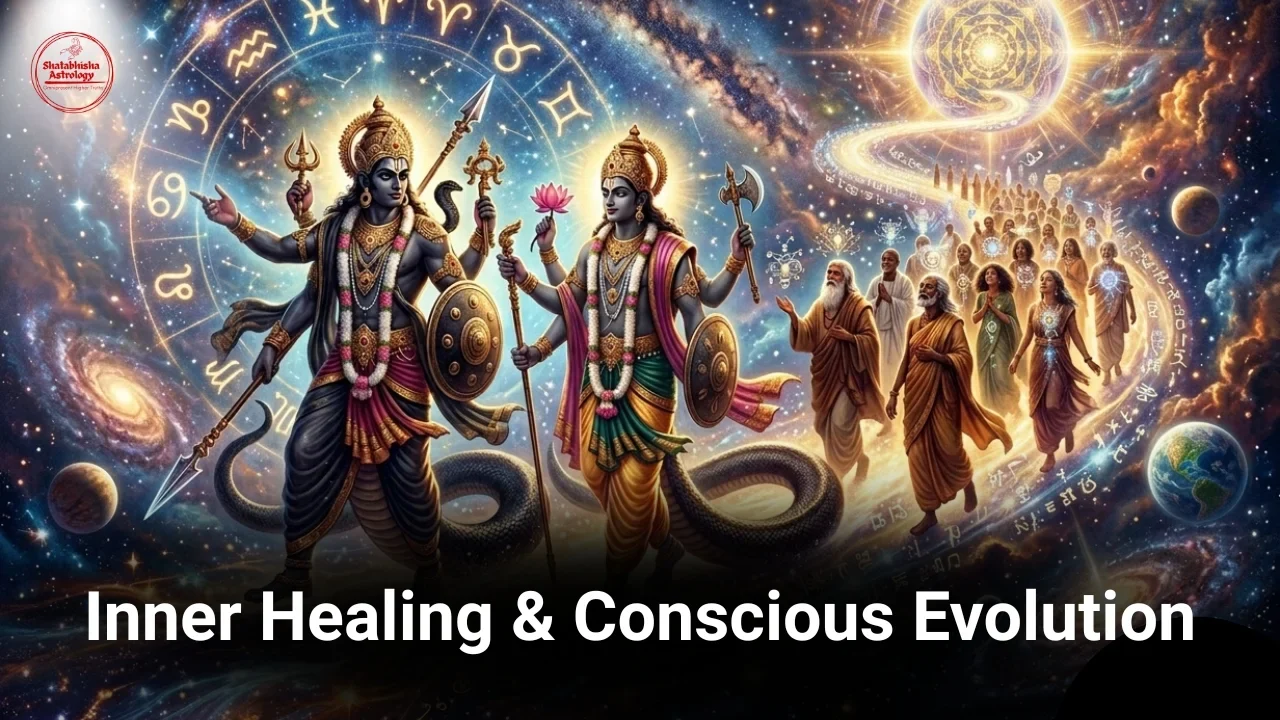
Predicting Crisis, Guiding Transformation, and Completing the Rahu – Ketu Journey
Most people approach astrology with a very natural expectation. They will say, “Tell me what will happen.” This comes from a genuine place. Life often feels uncertain, and prediction offers a sense of control, even if only for a moment. When the future is named, the mind relaxes slightly, believing it has something to hold on to.
But if astrology is used only in this way, it remains incomplete. Prediction can describe events, but it cannot explain why those events carry such a strong inner impact. It can tell you when something may happen, but not fully reveal what it is trying to change within you. And without that understanding, the same patterns tend to repeat, just in different forms.
A birth chart does not only maps external possibilities. It reflects patterns of consciousness, how a person desires, avoids, reacts, attaches, and withdraws. It shows the inner movements that shape outer experiences. This is why two people can face similar events but respond in completely different ways. The difference lies not in fate, but in awareness.
Among all these patterns, the Rahu–Ketu axis stands out as the clearest indicator of this inner dynamic. It reveals where the person is pulled into experience and where they are being asked to release attachment. It shows both the area of fascination and the area of detachment, and more importantly, the unconscious habits connecting the two.
When astrology is understood at this level, it becomes more than a tool for prediction. It becomes a map for inner healing and conscious evolution. It shows where crisis may arise, but also how that crisis can become a transformation. It does not just prepare a person for events. It prepares them to meet those events with awareness. And that is where the real journey of Rahu and Ketu begins to complete itself.
The Shift From Prediction to Interpretation
Prediction gives answers that the mind naturally seeks. It tells you what will happen and when it may happen. This creates a sense of certainty, even if temporary. It helps a person prepare externally, but it does not always prepare them internally. Without a deeper understanding, prediction can leave the person waiting, worrying, or reacting, rather than truly seeing, truly watching only.
Interpretation is like you are truly decoding the encrypted chart. Interpretation moves in a different direction. It asks why this is happening and what it is asking from you. It brings the focus back to the inner process behind the outer event. Instead of treating life as something that simply happens to you, interpretation reveals how each phase is connected to a deeper pattern that is unfolding within you.
When interpretation is missing, prediction can become dangerous. Crisis begins to feel like punishment, as if something has gone wrong or life is turning against you. Success feels like luck, something random and undeserved. And gradually, life itself starts appearing chaotic and meaningless, because there is no visible connection between events and inner growth, inner evolution.
But when the Rahu – Ketu axis is understood, this entire perception shifts. Crisis is no longer seen as an attack. It becomes direction. Pressure is not something to escape. It becomes information about what is ready to change. Timing is no longer random. It becomes meaningful, showing exactly when a certain pattern can no longer continue in the same way.
This is the real shift from prediction to interpretation or decoding. One tells you what is coming. The other shows you how to meet it. And without the second, the first can never lead to true understanding.
Reading the Birth Chart as a Living Being
A horoscope is not a static diagram that can be decoded once and for all. It is a living system, constantly activating, shifting, and responding. I always say to my students – If you only learn to predict from planetary placements, the chart becomes mechanical and limited. But when you begin to listen to the birth chart, when you sense its movement, when you know how the energy flows through the houses and signs, when you sence the pressure and its rhythm. It starts speaking in a completely different way. It becomes less about calculation and more about understanding energy in motion.
This is why I often say – prediction alone is not enough. A chart is worth something only when you can relate to it, when you can feel what it is trying to express. Each horoscope carries a certain inner tension, a certain direction, and a certain unresolved pattern. If you approach it as a fixed structure, you will miss its living quality. But if you approach it as a dynamic system, it begins to reveal its deeper meaning.
Three layers always work together in this system, and none of them can be separated from the others.
1. Natal Axis (Rahu–Ketu Placement)
The Pattern of Imbalance
The natal axis shows the fundamental imbalance a person carries. It reveals where life is overactivated, where there is excessive pull, fascination, or compulsion. At the same time, it shows the area that remains underlived, avoided, or taken for granted. This is not just about events. It is about inner orientation. One side pulls attention strongly, while the other quietly waits to be understood.
2. Dasha (Time Activation)
When the Pattern Demands Attention
The second layer is timing. The dasha does not create the pattern, but it activates it. It decides when a certain imbalance can no longer remain in the background. It brings the axis into focus and determines which planetary energy will trigger the process. What was dormant becomes active, and what was ignored starts demanding attention.
3. Transit (Immediate Pressure)
Where Awareness Is Forced Now
The third layer is immediate pressure. Transits show where life is applying force in the present moment. They bring situations, encounters, and circumstances that make awareness unavoidable. If the pattern of a natal chart is the seed and dasha is the timing, then transit is the direct push that brings everything into experience.
When all three layers align, events become difficult to avoid. Life narrows, pressure increases, and the person is brought face-to-face with what needs to be seen. From the outside, it may look like a sudden change or a crisis. But from within the chart, it is a precise activation of a pattern that was always there, now asking to be understood.
How Astrology Predicts Psychological Crisis
Let us make this very clear. Astrology does not directly or simplistically predict emotions. A chart does not literally say, “You will have anxiety,” or “You will feel lost.” That is not how deeper astrology works. What astrology actually reveals are the conditions under which inner imbalance can no longer stay hidden.
A psychological crisis begins when unconscious patterns lose their ability to remain stable. For a long time, a person may function normally on the surface while carrying unresolved fear, suppressed desire, emotional avoidance, or inner fragmentation underneath. As long as life supports those patterns, they remain invisible. But when certain activations occur, the hidden structure starts cracking.
This is where astrology becomes profoundly important. The chart shows where a person is psychologically overextended, where they are disconnected from themselves, and when those imbalances are likely to surface intensely. The crisis is not created suddenly by the planets. The planets activate what was already developing internally for years.
For example, one person may experience overwhelming anxiety during a certain period, another may go through identity collapse, emotional dependency, obsessive thinking, or deep emptiness. These experiences look different externally, but astrologically, they arise from the same principle. The unconscious can no longer remain unconscious.
The Rahu – Ketu axis plays a central role in this process. Rahu amplifies pressure, desire, fear, and psychological intensity. Ketu weakens old attachments, motivations, and familiar emotional structures. When both movements become strongly activated together, the person feels internally destabilized because the old way of functioning stops working.
This is why psychological crisis often appears “suddenly” to the individual. In reality, the chart shows a gradual buildup long before the visible collapse happens. Dasha activates the dormant imbalance, transit applies immediate pressure, and life circumstances force confrontation. The mind then experiences what it calls anxiety, confusion, emptiness, or breakdown.
But astrology, when understood deeply, does not stop at naming the crisis. It reveals the meaning behind it. The purpose is not to label the person as damaged. The purpose is to understand what pattern is breaking and what new awareness is trying to emerge through the pressure.
Crisis Indicators in Chart Reading
While reading a chart, it is important to understand that certain combinations and timings do not automatically indicate “bad fate.” They indicate periods where inner imbalance becomes active and impossible to ignore. Astrology is not showing punishment. It is showing activation. The chart reveals windows where unconscious patterns rise to the surface and demand awareness.
1. Rahu Mahadasha with Weak Axis Awareness
Desire Amplification and Identity Instability
When Rahu Maha Dasha begins without enough self-awareness, desire starts amplifying rapidly. The person may suddenly feel pulled toward achievement, recognition, relationships, power, or experiences that previously seemed distant. At the same time, the self becomes unstable because the inner system is expanding faster than understanding.
This often creates confusion. The person keeps changing direction, chasing intensity, or trying to build a stronger identity externally while feeling uncertain internally. External instability may also increase because Rahu pushes life beyond familiar limits. If awareness is missing, the person becomes consumed by the movement instead of learning from it.
2. Ketu Mahadasha After Rahu Over Identification
Loss of Meaning and Collapse of Motivation
Ketu mahadasha becomes especially intense after long over-identification with Rahu-driven pursuits. If a person has built their entire identity around achievement, attachment, validation, or control, Ketu starts dissolving the emotional investment in those things.
This creates a strange emptiness. What once felt meaningful suddenly loses energy. Motivation weakens, withdrawal increases, and life may appear emotionally colorless. The native often feels confused because external success or structure may still exist, yet inwardly the connection to it has disappeared. This is not meaningless suffering. This is the beginning of separation from false identification.
3. Rahu/Ketu Transit Over Moon or Lagna
Emotional and Identity Disturbance
When Rahu or Ketu strongly activate sensitive personal points, emotional and psychological disturbance becomes more visible. The mind feels restless, reactions intensify, and the usual sense of stability weakens. Thoughts become excessive, emotions fluctuate, and the person may feel disconnected from their previous identity.
These periods are especially important because they directly affect how a person experiences themselves internally. Old emotional patterns rise quickly, and avoidance becomes difficult. What was hidden beneath daily functioning begins surfacing into conscious awareness.
4. Rahu–Saturn or Rahu–Moon Activation
Fear-Based Pressure and Inner Conflict
Certain activations create especially heavy psychological pressure. Rahu, combined with restrictive or emotionally sensitive energies often produces fear-based thinking, internal conflict, and a strong sense of being trapped between desire and limitation.
The native may feel pulled forward by urgency while simultaneously feeling blocked internally. This creates tension, anxiety, emotional heaviness, or obsessive concern about the future. Again, the purpose of such periods is not punishment. The pressure exists because an unresolved pattern has reached a point where it can no longer remain unconscious.
These are not “bad yogas” in the deeper sense. They are activation windows. They mark periods where life intensifies enough to expose what has been avoided, overdeveloped, or disconnected within the person. Whether that activation becomes breakdown or transformation depends entirely on awareness and participation.
Predicting Breakthrough, Not Just Breakdown
A mature astrologer does not stop at identifying difficulty. Anyone can point at a challenging period and say that pressure is coming. But deeper astrology asks a more important question: What can this pressure become if it is understood correctly? This is where astrology moves beyond fear and begins serving transformation.
Every crisis contains two possible directions. One leads toward breakdown, where the person becomes overwhelmed, reactive, and trapped inside unconscious patterns. The other leads toward breakthrough, where the same pressure produces awareness, honesty, and inner reorganization. The external events may look similar in both cases, but the inner outcome becomes completely different.
This is why an astrologer should never speak as if crisis has only one meaning. A chart does not merely show suffering. It shows energy under tension, and tension can either collapse a structure or reshape it into something more conscious. The role of astrology is not to frighten the person with possibilities of failure, but to illuminate the doorway hidden inside the difficulty.
When Rahu intensifies desire, confusion, or instability, one person may become consumed by compulsion, while another may finally recognize what has been driving them unconsciously for years. When Ketu removes attachment and familiar emotional support, one person may fall into emptiness, while another may discover clarity for the first time. The planetary movement is the same. Awareness changes the direction.
This is why astrology always shows both possibilities simultaneously. The chart contains indicators of pressure, but it also contains the potential for integration. A mature astrologer learns to see not only where a person may break, but where they may awaken. And often, both processes begin at the exact same point.
Example: Rahu in the 10th – Ketu in the 4th
This axis beautifully shows the difference between prediction, interpretation, and true guidance. All three may look connected, but they operate at completely different depths of astrology.
At the most basic level, prediction focuses only on visible outcomes. The astrologer may say that the person will face career instability, dissatisfaction in professional life, or emotional unrest during certain periods. These statements may be accurate externally, but they only describe the surface movement of events. They explain what may happen, but not why it is happening internally.
A deeper level of interpretation sees the psychological structure beneath the event. Here, the astrologer recognizes that the person has unconsciously built identity around achievement, recognition, or external validation. The inner emotional foundation remains underdeveloped, ignored, or disconnected. So when pressure comes through career instability or burnout, the real collapse is not professional but based on identity. Life is dismantling a false sense of self that depended entirely on outer success.
At the highest level, astrology becomes guidance rather than description. The astrologer no longer focuses on controlling events. Instead, they orient the person toward inner alignment. The guidance here is profound, and that is, do not desperately chase external stability while the inner foundation remains weak. Develop emotional grounding first. Learn how to belong to yourself rather than to achievement.
When that inner grounding begins to form, career naturally starts realigning in a healthier way. Decisions become clearer, ambition becomes purposeful rather than compulsive, and work stops functioning as emotional compensation. This is master level guidance, not because it predicts dramatic events, but because it reveals the deeper movement the crisis is trying to create.
The Role of Timing in Healing
Timing in astrology is often misunderstood as nothing more than the scheduling of events. People want to know when something will happen, as if time is only a sequence of external outcomes. But deeper astrology sees timing differently. Timing is not only about events, but it is also about readiness. It reveals when a person is internally prepared, or forced, to confront a certain layer of themselves.
Rahu periods increase exposure. They push a person outward into experience, ambition, intensity, and confrontation with desire. These are not passive periods. They demand engagement. Life becomes louder, faster, and more psychologically charged because something inside the person is trying to expand into awareness. Avoidance becomes difficult during such times because Rahu keeps amplifying whatever has remained unconscious.
Ketu periods move in the opposite direction. They reduce illusion by withdrawing emotional investment from what once felt important. This creates introspection, whether welcomed or not. What previously distracted the person loses its grip, and inner emptiness or silence becomes more noticeable. These periods are not meant for blind withdrawal, but for conscious reflection. Ketu asks the person to see what remains when external identification weakens.
A skilled astrologer understands this difference deeply. They do not label one period as good and another as bad. Instead, they recognize the psychological requirement of the timing. Sometimes life demands action, courage, and exposure. At other times, it demands slowing down, observing, and consciously withdrawing from unnecessary noise.
This is why mature guidance sounds very different from simplistic prediction. The astrologer says, “This is the time to act,” when expansion is necessary. Or they say, “This is the time to withdraw consciously,” when reflection and inner restructuring are required. In both cases, timing is being used to align the person with the movement of life rather than against it.
Good and bad are shallow categories. Readiness is deeper. Astrology becomes truly healing when timing is understood not as reward or punishment, but as the precise moment when a particular kind of awareness becomes possible.
The Three Stages of Rahu–Ketu Evolution
Every individual moves through certain stages in their relationship with the Rahu – Ketu axis, whether consciously or unconsciously. These stages are not fixed categories but movements of inner development. Some people remain trapped in the first stage for most of their lives. Others are pushed forward through crisis, reflection, and awareness. The axis keeps evolving until its deeper lesson is understood.
Stage 1: Unconscious Living
Rahu as Obsession – Ketu as Avoidance
The first stage is unconscious living. Here, the person is completely identified with the movements of the axis without realizing it. Rahu expresses itself as obsession, compulsive desire, emotional urgency, or endless chasing. Ketu expresses itself as avoidance, emotional disconnection, withdrawal, or numbness. The individual swings between wanting too much and disengaging completely, without understanding the pattern behind it.
Life in this stage feels highly reactive. Events dominate the inner world because the person does not yet see how strongly unconscious patterns are shaping experience. Desire feels like destiny, and avoidance feels like protection. Relationships, achievements, fears, and crises are experienced as external problems rather than reflections of inner imbalance.
Because awareness is low, the person constantly reacts to pressure instead of learning from it. Rahu pulls them toward intensity and attachment, while Ketu quietly disconnects them from parts of themselves they do not know how to face. This creates inner fragmentation. The person feels driven by life rather than conscious within it.
At this stage, astrology is often used only for prediction and reassurance. The person wants to know what will happen next, hoping external change will remove discomfort. But the real issue is not the event itself—it is the unconscious relationship with desire and avoidance that keeps recreating suffering in different forms.
Stage 2: Crisis and Realization
Pressure, Emptiness, and the Beginning of Awareness
The second stage begins when unconscious living can no longer continue comfortably. The old patterns that once felt normal start creating visible psychological pressure. Rahu intensifies desire, fear, urgency, and emotional overload, while Ketu quietly removes satisfaction from the very things the person depended on. One side creates pressure, the other creates emptiness. Together, they destabilize the old way of living.
At this stage, life often feels repetitive and exhausting. Similar emotional struggles, relationship patterns, disappointments, or inner conflicts keep returning in different forms. What once seemed like isolated problems now begins to reveal a deeper pattern underneath. The person starts asking a very important question: “Why does this keep happening again and again?”
That question marks the beginning of awakening. For the first time, attention shifts from blaming external situations toward observing the inner structure behind them. The person may still feel confused, anxious, or emotionally overwhelmed, but something essential has changed, and unconscious repetition is no longer completely invisible.
This stage is painful because identity begins cracking. Old coping mechanisms stop working properly, yet a new understanding has not fully formed. The person stands between two worlds – the familiar patterns that no longer bring stability, and a deeper awareness that is only beginning to emerge. This is why crisis and realization often appear together.
Here, astrology becomes far more meaningful. The chart is no longer used merely to predict events. It becomes a mirror showing the recurring axis that has been shaping experience all along. The person begins recognizing that the crisis is not random punishment, but pressure toward consciousness.
This is the turning point. Not because suffering suddenly ends, but because awareness finally enters the process. And once awareness begins, evolution becomes possible.
Stage 3: Integration (The Third Path)
Conscious Engagement and Conscious Detachment
The third stage begins when the inner war between Rahu and Ketu starts dissolving. Desire is no longer unconscious compulsion, and detachment is no longer avoidance. Rahu becomes conscious engagement – the ability to participate fully in life, relationships, work, and experience without becoming psychologically possessed by them. Ketu becomes conscious detachment – the ability to step back, observe, and release without disconnecting emotionally from life itself.
At this stage, life feels different internally. The person is no longer constantly reacting to pressure, chasing intensity, or escaping discomfort. There is participation instead of compulsion. Decisions become clearer because they are not being driven entirely by fear, emptiness, or emotional urgency. The person starts responding from awareness rather than from unconscious patterns.
This does not mean struggle disappears completely. Challenges still come, emotions still arise, and life still moves through cycles of gain and loss. But the relationship with those experiences changes fundamentally. The person is involved, yet not trapped. They can pursue goals without losing themselves in them, and they can let go without collapsing into emptiness.
In this stage, astrology itself begins to look different. The birth chart is no longer seen as a prison of fate, but as a map of energy and awareness. Timing becomes guidance rather than fear. Crisis becomes information rather than punishment. The Rahu – Ketu axis stops functioning like a tug-of-waar and starts functioning like a balanced movement of growth and release.
This is not perfection. Perfection is another form of psychological pressure. The third path is something far more real alignment. An inner state where action, awareness, desire, and detachment are no longer fighting each other. And from that alignment, a quieter and more conscious way of living naturally begins to emerge.
How to Use Astrology for Inner Work (Practical Framework)
Astrology becomes truly transformative only when it is used for observation rather than dependency. A birth chart is not merely something to predict from; it is something to dialogue with. The purpose of inner work through astrology is not to control life, but to understand the patterns through which life keeps repeating itself.
Step 1: Identify Your Axis
Where You Chase and Where You Avoid
The first step is very simple, but extremely revealing. Identify the houses where Rahu and Ketu are placed. Do not rush toward interpretation immediately. First, sit with the emotional movement of the axis itself.
Ask honestly:
- Where am I constantly chasing experience, validation, control, or intensity?
- Where do I disconnect, avoid, withdraw, or remain underdeveloped?
Then write it in direct and personal language:
- “This is where I chase.”
- “This is where I avoid.”
This exercise is more powerful than it appears. Most people know their desires, but they do not know the fear hidden beneath those desires. Similarly, they know where they feel detached, but they do not recognize how much unconscious avoidance exists there.
Rahu shows the area where life pulls you into repeated engagement, often with emotional urgency. Ketu shows the area where energy withdraws, where familiarity creates blindness, or where emotional participation becomes weak. Neither side should be judged as good or bad. The goal is simply to observe the pattern honestly.
The moment you can clearly see where you compulsively move toward life and where you unconsciously move away from it, the axis starts becoming conscious. And awareness of the axis is the beginning of inner transformation.
Step 2: Observe Without Judgment
Tracking the Movement of the Axis
Once the axis has been identified, the next step is observation. Not correction, not suppression, not self-improvement in the usual sense, just observation. For the next 30 to 60 days, begin tracking the moments when Rahu becomes activated and the moments when Ketu takes over.
Notice your Rahu triggers carefully. Observe what creates urgency, emotional intensity, obsession, comparison, fear of missing out, or the feeling that something must happen for you to feel complete. These moments often appear automatically and very quickly. Rahu usually speaks in the language of “more,” “faster,” “now,” or “I need this.”
At the same time, observe Ketu’s withdrawal. Notice where your energy suddenly disconnects, where interest disappears, where emotional participation weakens, or where avoidance quietly enters. Ketu often hides behind numbness, silence, indifference, or the statement “It doesn’t matter anyway.”
The important point is this: do not rush to fix anything immediately. Most people begin judging themselves the moment they observe a pattern. They try to correct desire, control emotion, or force detachment. But judgment interferes with clarity. The goal right now is not transformation through force. The goal is to see.
When patterns are observed repeatedly without denial or moralizing, something remarkable begins to happen. The unconscious starts becoming conscious. You begin noticing that many reactions are not random at all. They follow predictable inner movements. The axis reveals itself through daily life.
This stage may feel simple, but it is foundational. Because no real integration is possible until a person can watch their own patterns honestly without immediately trying to escape, justify, or control them. Observation itself begins to weaken unconscious repetition. And that is where inner work truly starts.
Step 3: Align with Dasha
Working With the Timing Instead of Fighting It
Once observation becomes stable, the next step is learning to align with the timing of your current period. Dasha is not merely a prediction system; it is a description of the kind of psychological and energetic movement life is emphasizing right now. When you work against that movement unconsciously, friction increases. When you align with it consciously, growth becomes more natural.
If You Are in a Rahu Dasha
Engage Consciously, Not Compulsively
Rahu periods demand participation. Life pushes you toward new experiences, unfamiliar territories, stronger desires, and situations that challenge your old limits. During these phases, avoiding life completely usually increases frustration and inner pressure. Rahu wants engagement, but conscious engagement.
This means you should participate in opportunities, relationships, ambitions, and changes with awareness rather than urgency. The danger of Rahu dasha is impulsiveness. The mind starts believing that immediate action will solve inner restlessness. This is where compulsive decisions, emotional extremes, and unstable choices arise.
So the goal is not suppression of desire, but slowing down enough to see it clearly. Engage fully, but do not allow urgency to become your guide. Rahu dashas are meant for expansion of awareness through experience, not for losing yourself inside experience.
If You Are in a Ketu dasha
Reflect Deeply, But Do Not Disappear
Ketu dasha works differently. They naturally reduce emotional attachment to things that once felt important. Interests may fade, social energy may decrease, and inner questioning becomes stronger. These phases are valuable for reflection because they expose what no longer carries real meaning.
But the danger here is total withdrawal. Many people mistake emotional distance for wisdom and start disconnecting from life completely. This creates numbness rather than clarity. Ketu dashas are not asking you to abandon life; it is asking you to see through illusion.
So reflect consciously. Spend time understanding your patterns, motivations, and emotional dependencies. Allow silence and introspection, but remain connected to life in practical ways. The goal is clarity, not disappearance.
When dasha is understood this way, astrology becomes deeply practical. Instead of fighting the current phase or labeling it as good or bad, you begin cooperating with its deeper purpose. Rahu teaches conscious engagement. Ketu teaches conscious release. Alignment happens when you stop resisting the movement and start participating in it with awareness.
Step 4: Use Transits as Signals
Recognize Activation Windows
Transits should not be approached with fear. The real purpose of transit is not to create panic about future events, but to increase awareness about present activation. When Rahu or Ketu transits sensitive points in the chart, they temporarily intensify certain psychological and emotional patterns that already exist beneath the surface.
During these phases, reactions become stronger and more immediate. Thoughts may feel more obsessive, emotions more unstable, or decisions more urgent than usual. External situations often mirror this inner activation, creating conflict, attraction, confusion, or sudden change. But the important thing to understand is this – the transit is not creating a completely new reality. It is amplifying what was already unresolved.
This is why awareness becomes extremely important during such windows. Instead of reacting impulsively, pause and observe the intensity itself. Notice what is being triggered repeatedly. Ask yourself – What pattern is demanding attention right now? The stronger the emotional charge, the more valuable the observation becomes.
Avoid making highly reactive decisions during intense Rahu – Ketu activations, especially decisions driven by fear, obsession, emotional exhaustion, or the need for immediate relief. Such moments often distort perception. What feels absolutely urgent today may look completely different once the activation settles.
These phases are activation windows, not random events. Life is temporarily increasing pressure so that unconscious movements become visible. If approached unconsciously, the transit creates confusion and impulsive action. If approached consciously, the same transit becomes a period of accelerated self-understanding.
This is how astrology becomes practical inner work. Transits stop being something to fear and start becoming signals, moments where awareness must become sharper because life is speaking more loudly than usual.
The Limitation of Pure Prediction
Prediction alone has a hidden limitation – it easily creates dependency. When astrology is used only to forecast events, people slowly stop relating to their own awareness and start waiting for time to rescue them. Their attention becomes fixed on dates, periods, and outcomes rather than on understanding themselves.
This is why the same questions begin repeating again and again: “When will this end?” “When will life become good again?” These questions are natural, especially during difficult periods, but they also reveal something deeper. The person is looking for relief without necessarily looking for understanding. They want the pressure to disappear, while the pattern causing the pressure often remains untouched.
But the Rahu – Ketu axis does not function according to simple ideas of good and bad timing. It does not merely ask whether a dasha is favorable or unfavorable. Its deeper question is much more direct – “What have you understood?” Until that answer changes internally, the outer pattern tends to repeat itself in different forms.
This is why some people continue suffering even during supposedly positive dashas, while others experience profound growth during difficult ones. Favorable timing cannot permanently solve unconscious repetition. A supportive phase may temporarily reduce pressure, but if the underlying pattern remains unchanged, life eventually recreates the same lesson through new circumstances.
The purpose of astrology, therefore, is not to make a person psychologically dependent on prediction. It is to increase awareness so that timing can be used consciously. When understanding deepens, even difficult periods become meaningful. And when understanding is absent, even good periods eventually turn into repetition.
Pure prediction asks, “What will happen next?”
Conscious astrology asks, “What is this experience trying to teach you about yourself?”
That shift changes everything.
The Freedom Astrology Actually Offers
The real freedom astrology offers is often misunderstood. Most people approach it hoping to remove uncertainty from life. They want reassurance that nothing painful will happen, that difficult periods can be avoided, or that the future can be controlled if understood early enough. But true astrology does not work by removing uncertainty. Life remains dynamic, unpredictable, and alive.
What astrology can remove is blindness.
It reveals the hidden patterns behind experience. It shows where a person is acting unconsciously, where fear is shaping decisions, where attachment is creating suffering, and where avoidance is blocking growth. This clarity does not stop life from moving, but it changes how the movement is experienced internally.
True astrology does not promise that nothing will go wrong. No authentic system can make that promise, because challenge and change are part of evolution itself. What astrology offers instead is something far more valuable – the ability to understand what is happening while it is happening.
And understanding changes experience completely.
A crisis or unfavorable period without understanding feels like punishment. The same crisis with understanding becomes transformation. Pressure without awareness feels unbearable. Pressure with awareness becomes direction. Even uncertainty changes its quality when the person can see the deeper pattern moving underneath it.
This is why conscious astrology is not about escaping difficulty. It is about meeting life with clarity instead of confusion. The events may still come, but blindness no longer dominates the experience. And once blindness begins dissolving, fear also begins losing its control.
That is the deeper freedom astrology offers, not freedom from life, but freedom from unconsciousness within life.
The Quiet Completion of the Axis
There comes a subtle stage in inner evolution where the Rahu – Ketu axis no longer feels like an internal conflict. The extremes begin softening naturally. Rahu stops creating panic, urgency, and compulsive chasing. Ketu stops producing emptiness, numbness, or emotional disappearance. The same energies remain present, but their psychological grip weakens.
At this stage, desire still exists, but it is no longer driven by fear. The person can move toward goals, relationships, creativity, or experience without feeling internally desperate. Wanting something no longer means becoming enslaved by it. There is engagement without psychological possession.
At the same time, detachment also changes its quality. Letting go no longer feels like loss, rejection, or withdrawal from life. The person can release situations, identities, or emotional attachments without collapsing inwardly. There is space inside the experience rather than resistance against it.
This is not detachment from life. That is an important distinction. Many people imagine spiritual maturity as emotional distance or disinterest in the world. But the quiet completion of the axis creates something entirely different. It creates clarity within life. The person remains involved, connected, responsive, and fully human yet inwardly lighter.
Here, the axis no longer operates as a source of unconscious suffering. Rahu provides movement without panic. Ketu provides perspective without emptiness. The individual stops swinging between grasping and escaping. Instead, there is a calm participation in life as it unfolds.
This completion is quiet because it does not announce itself dramatically. It appears in small but profound changes, that is, less inner conflict, less emotional urgency, clearer decisions, and a growing sense that nothing external is required to feel psychologically complete. The person still lives fully, but no longer lives in bondage to the axis.
So, Finally You Can Say..
Together, Rahu and Ketu perform a single sacred movement. One pushes you into life, the other pulls away illusion. One creates engagement, the other creates perspective. And between these two forces, consciousness slowly begins to awaken.
The real purpose of the axis is not suffering, success, detachment, or achievement by themselves. Its deeper purpose is transformation from unconscious repetition into conscious living. Until awareness enters, the same emotional patterns repeat through different people, situations, and phases of life. But once awareness begins, repetition starts turning into understanding.
That is the true journey of the Rahu – Ketu axis, not escaping life, but finally living it consciously.
 Punarvasu Nakshatra Compatibility Part 1 – (Ashwini to Ashlesha)Most nakshatras are given one ideal life partner. Punarvasu is given two, Bharani and Pushya, and both of them rate exactly seventy-six per cent. That…
 What a Remedy is Supposed to ChangeThe earlier article in this line asked whether a remedy was aimed at the right planet. That question is a real one and it settles a large number of ca…
 When the Remedy Do Not WorkMost people who ask this question have already spent money. A stone was bought and worn on the right finger on the right day. A pooja was done exactly…
2 thoughts on “Astrology as a Map of Inner Healing & Conscious Evolution”
This is one of the most mature and psychologically deep pieces on astrology I’ve read. Article ka psychological crisis wala part honestly sabse powerful laga. Especially yeh idea ki planets directly anxiety ya breakdown create nahi karte, balki andar ke hidden patterns aur unresolved emotions ko surface par le aate hain. Astrology aur psychology ko itne mature aur deep way mein connect karna really insightful tha.
Beautifully written and deeply insightful.
🙏🙏🙏🙏I HOPE U LIKE MY COMMENT
KETU IN 4 ND RAHU IN 10 ….IS 100 💯 PERCENT ACCURATE.
I M GOING THROUGH SPIRITUAL AWAKENING. CURRENTLY …..U R SOOO. ACCURATE…
WHILE READING THIS PARTICULAR KETU 4 ND RAHU 10 AXIS …I GOT TEARS IN MY EYES
NEERAJ SIR U R ALWAYS ACCURATE….🙏🙏
I LIKE THE DEAPTH OF UR KNOWLEDGE…🔥🔥🔥
ACCEPT MY GRATITUDE 🙏🙏🙏